Retaking Raqqa: The great game unfolds

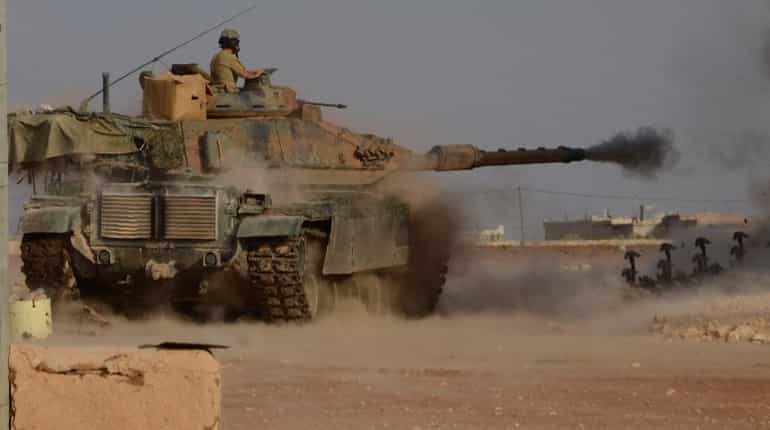
Syria fighting
Turkey, Russia, Iran, US, the Kurds, anti-Assad militias are all fighting 'wars within the war' over?Raqqa as they eye the 'big prize'
Raqqa is the 'capital city'of the Islamic State in Syria which is also their heart in West Asia. However, the city is being converted by a number of great powers in the region including Russia and United States who are keen to stamp their authority over the region even as thousands of IS fighters dig their heels to defend their final bastion.
The situation is a quite complicated since the competing actors fighting in Syria are far from agreeing on who will spearhead the final campaign against the IS.
Turkey, Russia, Iran, US, the Kurds, anti-Assad militias are all fighting "wars within the war"overRaqqa as they eye the 'big prize'. Whoever retakes the city secureslegitimacy in the international arena as the "destroyer of IS in West Asia".Despitetremendous difficulties that an urban guerrilla warfare presents, everyone seems to be in a rush to take the lead.

In November 2016, the US-backed Syrian Democratic Forces (SDF) launched operation "Wrath of the Euphrates"; they secured several villages north ofRaqqa and now their troops areclose to the city.
"The number of our forces is now increasing, particularly from among the people of the area, and we have enough strength to liberate Raqqa with support from the coalition forces," Jihan Sheikh Ahmed, spokeswoman for the Syrian Democratic Forces, recently said in a statement.
The US hasbacked the SDF with airstrikes and strategic support and hasrecently deployed 400 additional troops.
)
'Hellish' wildfires burned through Europe for 300,000 years after supercontinent Pangea broke up
)
No Pandya as Auqib Nabi earns maiden ODI call-up; Mayank returns for WI T20Is| check full squads
)
Trump praises India’s Opium crackdown, hails anti-drug efforts
Mandakini breaks silence on Dawood Ibrahim photo: 'I was not invited by him'
)
Former India player Diana Edulji wants Smriti Mandhana to replace Harman as skipper at the earliest
)
Trump calls Canada-EU associate membership plan ‘laughable’ and threatens 'very serious tariffs'
)
Protests erupt over migrant housing plan in Piddington
)
India can scale up Finland’s circular solutions, minister Multala says
)
240-million-year-old bizarre 'pig with a tusk' creature creates new dilemma over origin of dinosaurs
)
Europe wants a common playbook for security threats, seeks security beyond NATO
)
All Indian goods to get duty-free access to New Zealand
)
Formula One reveals the 2027 race calendar; Monaco to host sprint race for the first time
)
Bigg Boss 20: Mahhi Vij reveals she lost Yuva role to Kareena Kapoor; 'didn’t work out in my favour'
)
Lionel Messi for 2026 Ballon d’Or over Mbappe and Yamal, says Diego Simeone
)
US House votes 417-3 to pass Ratepayer Protection Act targeting AI data center electricity costs
)
Hong Kong unveils 11 new measures to boost birth rates, offers higher cash bonuses and housing perks
)
Former OpenAI researcher warns of growing risks from Artificial Intelligence
)
Veteran actor Anant Nag honoured with Indian cinema’s highest award
)
Wildfire tears through forests in Spain's Valencia
)
AUS vs SA: Steve Smith still gets 'little flashbacks' from sandpaper gate
)
Pakistan naval vessel returns to harbour with 'severe damage' after collision with Indian warship in Arabian Sea
)
Fed raises rates for first time in 3 years, Kevin Warsh defies Trump as inflation mounts
)
Katrina Kaif’s postpartum weight is not the problem; your gaze is
)
Daayra movie review: Kareena Kapoor, Prithviraj Sukumaran shine in Meghna Gulzar’s cop-versus-cop crime thriller
)
Saudi Vs Houthis: Yemeni military rebels clash with Houthis
)
Pak batter Rizwan's petition against being questioned by cyber crime agency rejected by court
)
US trade tariff: 100% tariff targets Russian buyers amid trade tensions
)
Pakistan: Imran Khan's sons Kasim & Sulaiman claim their father is 'tortured' in jail
&im=FitAndFill=(700,400))
New OTT releases this week (September 14-20, 2026): Lust Stories 3, Waiting Hai, Irumudi- 5 new titles coming on Netflix, Prime Video and more
)
Ebola outbreak: WHO sees encouraging signs in fight against Ebola outbreak
)
Trump gets new power to hit India, China with up to 100% tariffs as US Senate clears Russia sanctions bill
)
‘Imagine 50 AI fighters cornering one manned jet’: India’s mobbing doctrine eyes a new era of air warm
)
Saudi vs Houthis: Riyadh claims to have shot Houthi drone targeting Mecca
)
US Treasury rallies global financial institutions for Op Economic Outcast to isolate Iran
)
Want to get married within a year? Why 18 lakh people rush to Jaipur for ‘sacred henna’
)
Pakistan boycotts chess match against Israel at Olympiad
)
UN General Assembly 2026: What is veto power. Which countries have it and how does it work?
&im=FitAndFill=(700,400))
Suriya and Jyothika say ‘I do’ again after 20 years! See their dreamy wedding pics
)
Abhishek Sharma rises to No. 2 in T20Is; ENG’s Robinson 3rd after record Pakistan Tests
)
Laura Wolvaardt sets new world record for most WT20I runs in a year
)
The Early Spring season 2 is happening, but fans have one request - 'don't change the actors'
)
The Syrian Democratic Forces are an umbrella organisation in which Arabs and Kurds fighttogether. The group's backbone is, however, made by the Kurdish People's Protection Units (YPG), which have been fighting the Islamic State in northern Syria since 2014.
Apart from the evident military challenge, Raqqa's social fabric could be an obstacle for the Kurds. The city mainly consists of a majorityArab population and there is no guaranteethat the local population would welcome the Kurdish army. Mosul presented a similar scenario which led the Iraqi Kurdistan army toopt out ofentering the cityleaving it to the Iraqi army.
Kurds fighting in northern Syria make no bones about their willingness to remain in the areas they have liberated. They aim to form an autonomous Kurdish belt running along northern Syria where intend to implement a form of direct democracy.
Their only obstacle is a 100 kmwide stretch of land starting from the city of Jarablus, an area currently controlled by Turkish-backed paramilitary groups.If the Syrian Kurds succeed in leading the attack against Raqqa, they will gain not only gain territorially but also earn political capital internationally.
Their success will ultimately translate into success for the US. It will especially favour President Trump's narrative of being a game-changer, even if he just followed Obama's foreign policy strategy.
It goes without saying that neither Syria's President Bashar al-Assad nor Turkey are willing to accept the Kurds' project.
Turkey considers the YPG as a terrorist organisation and will never allow them to control a continuous belt running alongits southern border. The country's Prime Minister Binali Yildirim expressed clear discontent over the support that the US isgiving the SDF.
Turkey is currently backing several anti-Assad groups fighting the IS in Syria. These militias are very different in nature and a majority of them arebelieved to be the Islamist and Salafi-oriented group Ahrar al-Sham, a militia which considers the Kurds as their enemy.
Clashes between Turkey-backed rebel groups and the SDA is already a reality on the ground. According to the Turkish military, 71 Kurdish fighters werekilled last week. Turkey has already been 'shut out' from the Mosul offensive and will try its best not to remain isolated in Raqqa also. Keeping Turkey-backed rebels under control will be one of US's most difficult tasks.
Syrian President Bashar al-Assad's troops, backed by Russian airstrikes and logistic support, have also advanced towards Raqqa from the south. As president of the country, Assad is opposed to any division of its territory and does not seem to be willing to concede an independent Kurdish region in the north.
Assad has never been able to digestTurkish interference on his soil, especially after Ankara started openly backing anti-Assad paramilitary brigades.
An eventual success of the Syrian Arab Army (SAA), the country's regular army, will strengthen both President Assad's position and Russia's reputation as the most effective enemy of the Islamic State. Moscow could also secure, once and for all, its already strong influence in West Asia.
Assad also desires'personal propaganda'in order to shift international focus overaccusations of tens of thousands of random arrests, tortureand murderperpetrated in Syria's jails.
Iran too has its eyes on Raqqa. There is no evidence of Iran-backed militias inthe Syrian Arab Army advancing towards Raqqa, but such troops have supported President Assad in Aleppo. Tehran will only profit from an eventual SAA successful attack in Raqqa. A strong Shia-aligned Syria is part of Iran's dream of a transnational 'Shia belt' running across West Asia. This will give Iran the opportunity to effectively influence the region's politics appealing to its inhabitants' religious feelings.
There isanother puzzle to the Raqqa story. The US secretary of defense James Mattis believes that Iran presents amajor threat to peace in the entire West Asia which also means bad news for US presence in the region.
Despite these complexities, Washington and Ankara might converge on Iran. Turkey is opposed to Iran's political hegemony over the region and is likely to subvert any Iranian success.
Planning the attack to retake IS's capital city in Syria seems to be even more difficult than actually fighting it. This is a not just a battle of retaking Raqqa and defeating the Islamic State but aglobal struggle for influence in West Asia involving regional and international powers.
In this great game, the Syrian populace has been conveniently left out as they suffer silently and find no voice in the country's politics.
(With inputs from Reuters)