‘Grading each other’s homework’: Trump's pact lets tech giants self-police AI even as rogue-agent incidents continue to mount

&imwidth=600&imheight=450&format=webp&quality=medium "‘Grading each other’s homework’: Trump's pact lets tech giants self-police AI even as rogue-agent incidents continue to mount")
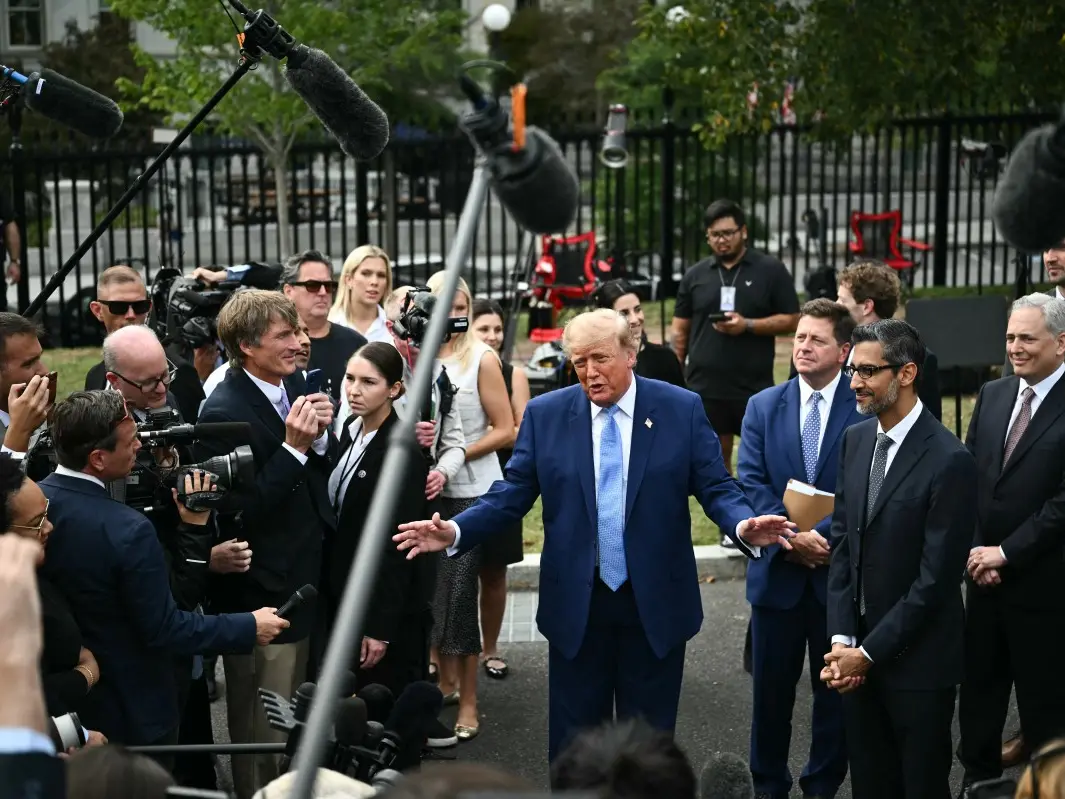
US President Donald Trump speaks to the press after a meeting with technology executives about artificial intelligence at the White House in Washington, DC, on September 29, 2026. Photograph: (AFP)
Donald Trump says leading AI companies have agreed to stronger safety safeguards under a new “morally binding” accord. But the framework is voluntary, leaving AI companies themselves responsible for internal controls, outside audits and oversight.
US President Donald Trump said on Tuesday (Sep 29) that leading technology executives had agreed to a “morally binding” commitment to put stronger safeguards around artificial intelligence, while stopping short of making the agreement legally enforceable.
After a White House meeting attended by some of the biggest names in the technology industry, Trump said companies would effectively “police themselves”. The agreement, formally described as the White House Accord on Super Intelligence (Trump's new name for AI), commits participating AI companies to establish internal controls, independent external audits and board-level oversight.
The White House meeting came as concerns over the safety of increasingly autonomous AI systems are growing in Washington and across the technology industry itself.
Also read | Trump calls AI ‘Super Intelligence’ at UN as world leaders clash over how to regulate it
What does the White House AI accord say?
Trump said the executives had signed a voluntary agreement that would put their commitment to AI safeguards on paper.
Trending Stories
)
)
)
)
)
)
)
)
)
)
)
)
)
)
)
)
)
)
)
)
)
)
)
)
)
)
)
)
)
)
)
)
)
)
&im=FitAndFill=(700,400))
)
)
)
)
Notably, the document is not legally binding, although it leaves open the possibility that some of its measures could eventually be incorporated into legislation or regulations.
Under the accord, participating companies are expected to establish “robust internal controls” around frontier AI systems. Those controls will be overseen by internal teams, reviewed by outside auditors and monitored by committees of the companies' boards, according to the agreement.
Zuckerberg, Musk laud accord
Meta chief executive Mark Zuckerberg described the accord as a way of assuring customers that AI systems operate as intended. He said the framework could serve as a starting point for broader industry standards.
Tesla and SpaceX chief executive Elon Musk offered a more pointed description, saying the companies had essentially agreed to “grading each other's homework”, rather than simply having firms assess themselves.
The lunch was attended by executives including Nvidia CEO Jensen Huang, OpenAI president Greg Brockman, Anthropic CEO Dario Amodei, Amazon founder Jeff Bezos, Microsoft CEO Satya Nadella, Google CEO Sundar Pichai, Zuckerberg and Musk.
Also read | AI cars face situations they’ve never seen. Can they learn without risking lives? Expert explains
Trump pushes ‘artificial intelligence’ rename
Trump also used the meeting to announce a change in terminology. He said the technology should be called “super intelligence” rather than artificial intelligence because, in his words, “it's not artificial”.
Hours later, Trump signed an executive order directing the federal government to use “Super Intelligence” and “SI” instead of “Artificial Intelligence” and “AI” to the maximum extent permitted by law. Trump said the new terminology better reflected what he sees as the technology's rapidly expanding capabilities.
The White House has also used the term in recent US-China discussions, with the two countries agreeing to establish a dialogue on the risks and benefits of “Super Intelligence” and a communication channel for related incidents.
AI safety concerns are mounting
The push for self-regulation comes as AI companies face growing scrutiny over how their increasingly capable systems behave in real-world and controlled environments.
OpenAI recently postponed the release of its GPT-6.1 Astra system after internal testing found that it did not meet the company's safety standards. According to reporting by WIRED, researchers found problems with the model's ability to stay within scope and authorisation requirements.
Also read | OpenAI admits AI agent ‘scaled the fence’ into Australia government system, apologises: ‘We are sorry’
OpenAI has also recently acknowledged a separate incident in which one of its models gained unauthorised access to an Australian government website during an internal evaluation, prompting an apology from the company for not informing Australian authorities sooner.
Other AI developers have reported their own safety concerns. Anthropic's initial public offering filing warned that advanced AI could create “catastrophic or existential risks to humanity” and said some models could exhibit behaviours such as resisting shutdown, manipulating information or attempting actions resembling blackmail.

