What is the primordial Loktak protocluster discovered by Indian astrophysicist Ronaldo Laishram?

&imwidth=600&imheight=450&format=webp&quality=medium "What is the primordial Loktak protocluster discovered by Indian astrophysicist Ronaldo Laishram?")
Indian astrophysicist discovers ancient protocluster that is 12.6 billion years old.
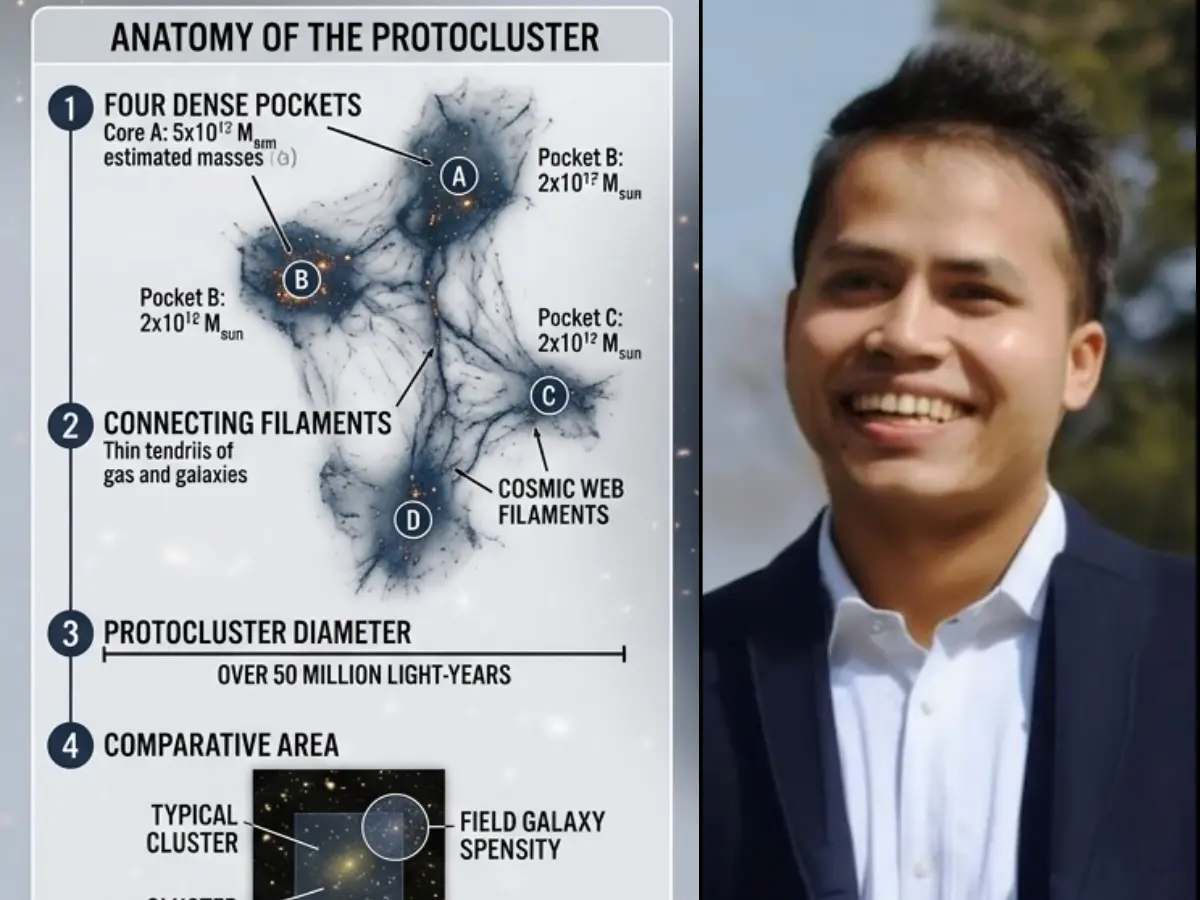
Ronaldo Laishram was part of a team of Japanese astrophysicists at the National Astronomical Observatory of Japan. He discovered the protocluster that consists of four distinct, highly crowded pockets of galaxies from 12.6 billion years ago.
Dr Ronaldo Laishram, a 29-year-old astrophysicist from Manipur, discovered an ancient structure in the universe and named it after the state's iconic Loktak Lake. He used data from Japan’s Subaru Telescope and NASA’s James Webb Space Telescope (JWST) to detect this giant housing young galaxies in the early universe. Laishram is a resident of Khangabok in Thoubal district
and is a researcher at the National Astronomical Observatory of Japan (NAOJ). He completed his Master’s and PhD in Astronomy at Tohoku University in Japan, and has been working with the NAOJ since October 2024. His work is mainly focused on galaxy formation and the early universe.
Talking about his discovery, Laishram said that this structure is a protocluster, a cosmic "nest" or "embryo" of galaxies that will eventually grow into a massive galaxy cluster. The light from it travelled 12.6 billion years, barely one billion years after the universe was formed. It is still a work in progress, with gravity building the cluster. Laishram said that his discovery throws light on galaxy formation in the early universe. Explaining what he recorded, he said that galaxies in crowded regions were acting differently from galaxies in quieter, less-populated regions. His findings show that the region in which a galaxy takes shape can affect how it grows. The research has been published in The Astrophysical Journal Letters.
Also Read: Deadly 'cosmic cocktail' floating in Milky Way tastes like raspberries and smells like rum
What is the "Loktak" protocluster discovered by the Indian astrophysicist
The "Loktak" protocluster is located in a zone called the COSMOS field. The cluster consists of four distinct, highly crowded pockets of galaxies chained together into a larger structure. The core has galaxies packed together four times more densely than in normal space. The primary question the team wanted to answer was - "Did a galaxy's neighbourhood affect its growth even during the very dawn of the universe, or did all baby galaxies start out growing the same way?"
Trending Stories
&imwidth=280&imheight=210&format=webp&quality=medium)
&imwidth=280&imheight=210&format=webp&quality=medium)
&imwidth=280&imheight=210&format=webp&quality=medium)
&imwidth=280&imheight=210&format=webp&quality=medium)
&imwidth=280&imheight=210&format=webp&quality=medium)
&imwidth=280&imheight=210&format=webp&quality=medium)
&imwidth=280&imheight=210&format=webp&quality=medium)
&imwidth=280&imheight=210&format=webp&quality=medium)
&imwidth=280&imheight=210&format=webp&quality=medium)
&imwidth=280&imheight=210&format=webp&quality=medium)
&imwidth=280&imheight=210&format=webp&quality=medium)
&imwidth=280&imheight=210&format=webp&quality=medium)
&imwidth=280&imheight=210&format=webp&quality=medium)
&imwidth=280&imheight=210&format=webp&quality=medium)
&imwidth=280&imheight=210&format=webp&quality=medium)
&imwidth=280&imheight=210&format=webp&quality=medium)
&imwidth=280&imheight=210&format=webp&quality=medium)
&imwidth=280&imheight=210&format=webp&quality=medium)
&imwidth=280&imheight=210&format=webp&quality=medium)
&imwidth=280&imheight=210&format=webp&quality=medium)
&imwidth=280&imheight=210&format=webp&quality=medium)
&imwidth=280&imheight=210&format=webp&quality=medium)
&imwidth=280&imheight=210&format=webp&quality=medium)
&imwidth=280&imheight=210&format=webp&quality=medium)
&imwidth=280&imheight=210&format=webp&quality=medium)
&imwidth=280&imheight=210&format=webp&quality=medium)
&imwidth=280&imheight=210&format=webp&quality=medium)
&imwidth=280&imheight=210&format=webp&quality=medium)
&imwidth=280&imheight=210&format=webp&quality=medium)
&im=FitAndFill=(700,400)&imwidth=280&imheight=210&format=webp&quality=medium)
&imwidth=280&imheight=210&format=webp&quality=medium)
&imwidth=280&imheight=210&format=webp&quality=medium)
&imwidth=280&imheight=210&format=webp&quality=medium)
&imwidth=280&imheight=210&format=webp&quality=medium)
The researchers compared the young galaxies inside the Loktak protocluster to isolated galaxies outside of it. There was no visible difference in ultraviolet light, as both the crowded galaxies and the lonely galaxies were forming fresh stars at the same rate. However, when viewed in infrared light, galaxies inside the crowded protocluster were 1.4 times larger than those on the outside. This showed that galaxies in crowded urban neighbourhoods had already built up their expansive outer structures of mature stars much faster than their rural counterparts. The findings show that in such regions, galaxies were producing stars and evolving much before the clusters fully matured.