

&imwidth=800&imheight=600&format=webp&quality=medium "NASA’s James Webb telescope captured supernova from the dawn of universe")
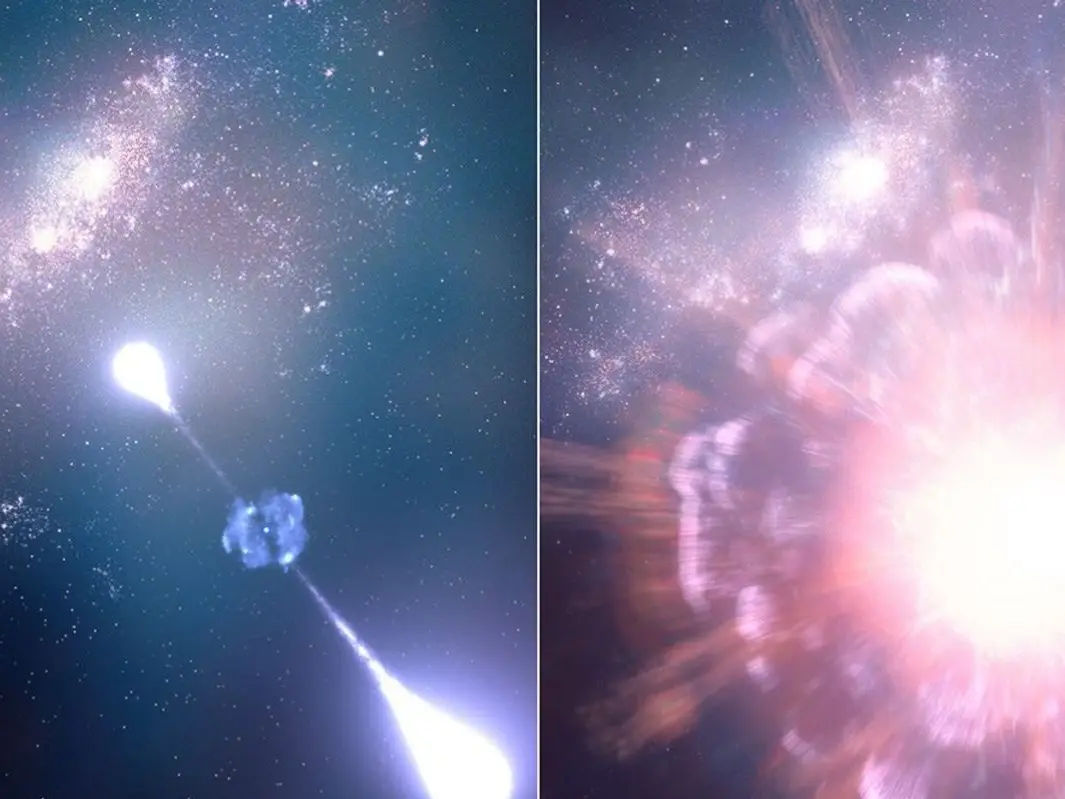
An international team of astronomers using NASA’s James Webb Space Telescope (JWST) have detected a supernova that exploded when the universe was only about 730 million years old, placing it deep in the era of reionization according to Phys.org. It also provided the most distant direct evidence yet of a stellar explosion from the early cosmos. This was the period when the first stars and galaxies were forming and transforming the newborn universe. The event was associated with a bright burst of gamma-ray labelled GRB 250314A.
Webb’s sensitive infrared observations helped in detecting and distinguishing the fading light of the explosion from its faint host galaxy.
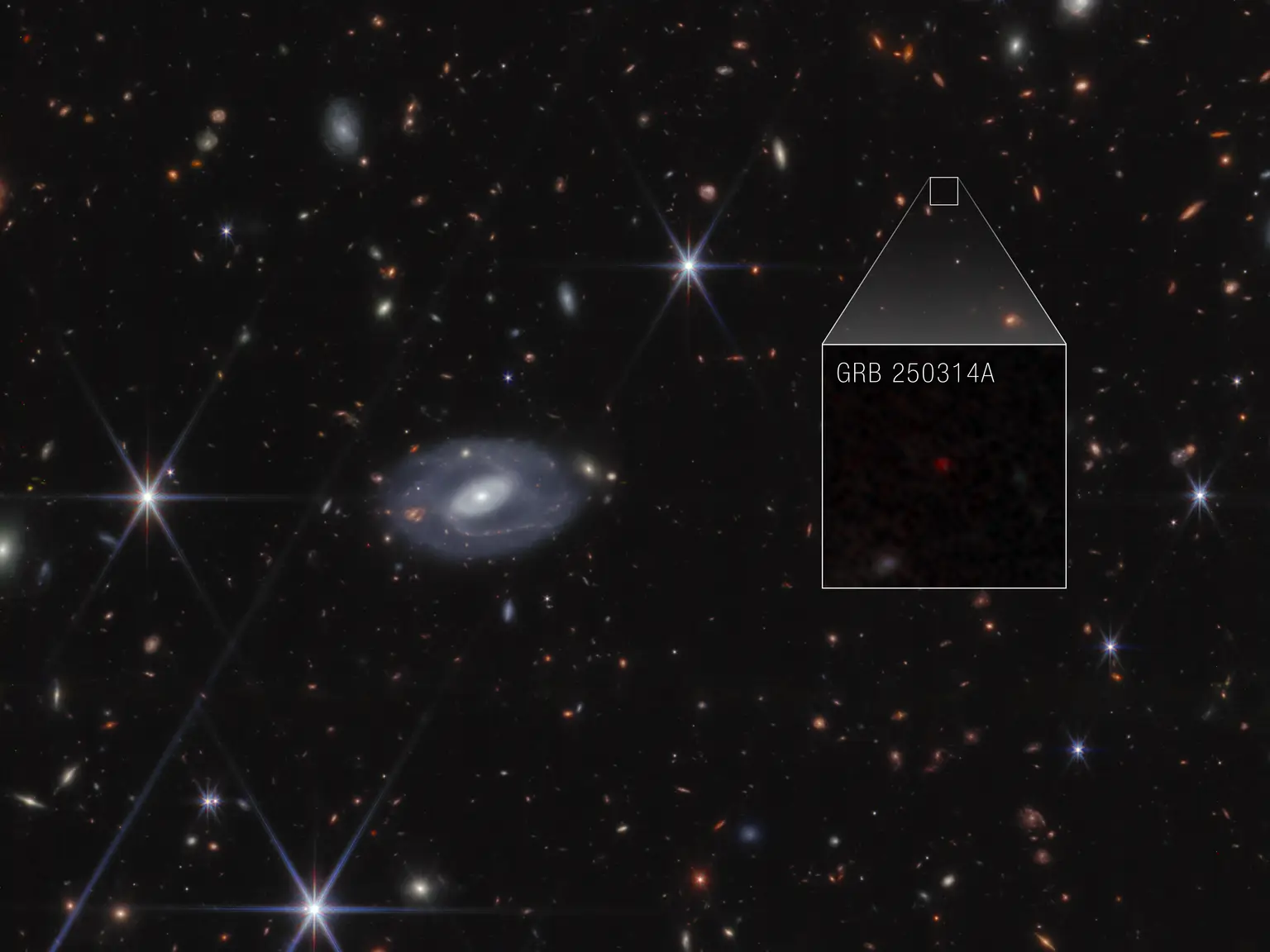)
NIRCam Image Photograph: (NASA, ESA, CSA, STScI)
How the explosion was found
The supernova was initially flagged in March 2025 by a gamma-ray burst detected by the space-based Variable Objects Monitor. Gamma-ray bursts are explained as, intense flashes of high-energy radiation often linked to catastrophic events such as the collapse of massive stars. Follow-up observations with the European Southern Observatory's Very Large Telescope (ESO/VLT) in Chile, confirmed the extreme distance implied by the signal. Details of the discovery are described in a study recently published in the journal Astronomy & Astrophysics. Roughly 110 days after the initial burst, JWST captured near-infrared images using its NIRCam instrument, thus enabling scientists to isolate the light from the supernova itself and study its properties despite the enormous cosmic distance.
Significance of the discovery
This supernova is not just the most distant ever directly observed but also closely resembles certain similar explosions seen in the nearby universe, such as the well-studied GRB-associated supernova, SN 1998bw. Analysis indicates that the massive star which exploded in the early universe had spectral and brightness characteristics comparable to those of long-duration gamma-ray burst-associated supernovae seen much closer to Earth today. The findings challenge the assumptions that the early stars, formed under environments with extremely low metallicity conditions, would behave very differently from their modern counterparts.
The research team, according to phys.org, plans to secure a second epoch of JWST observations in the next one to two years. By that time, the light of the supernova is expected to have faded significantly, thus, allowing the team of astronomer to completely characterise the properties of the faint host galaxy thus, confirming the contribution of the supernova.

