

&imwidth=800&imheight=600&format=webp&quality=medium "'Kai Po Che!': Why do Indians fly kites during Independence Day? Did you know it was once a mark of protest?")
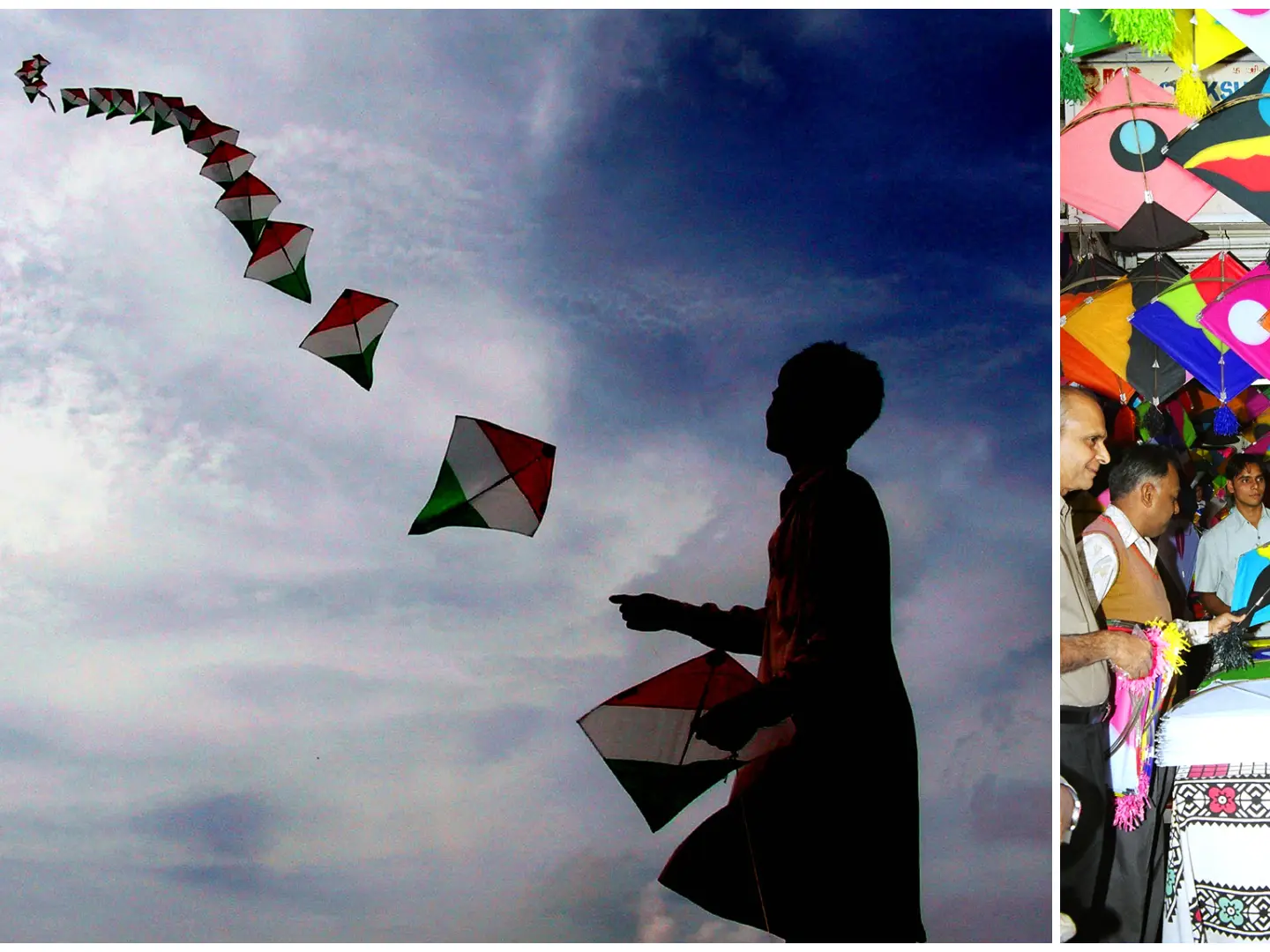
Every year on August 15, when India marks its Independence Day, the skies of many cities are filled with kites, trying to fly above each other and 'cut' each other down. The kite-flying tradition is intricately linked to India's freedom from British colonial rule, as it was once used as a form of protest. Today, kite enthusiasts battle it out, trying to cut the opponents’ kite strings using threads or ‘manjha’ coated with abrasives. These informal contests promote community bonding. Often, the kites carry patriotic and social messages like “I Love India” or “Beti Bachao (save the girl child).” Here is the story of how kites became associated with India’s Independence Day.
How kite flying was used as a symbolic protest during India's freedom struggle
In 1927, during a movement against the Simon Commission, Indians flew kites with slogans like 'Go Back Simon' as a peaceful form of protest. The Simon Commission was seven UK lawmakers sent by the British government to review the Government of India Act 1919 and recommend reforms. Led by Sir John Simon, the commission was strongly opposed by Indians as it had no Indian members. There were widespread protests and boycotts in India as essentially the fate of Indians was being determined by a group that had no Indians in it.
Kite flying against Simon Commission is believed to be its beginning as a mark of freedom, resistance, and patriotism. Since 1947, when India gained independence, the soaring kites came to represent liberty, national pride, and the joy of freedom.
Kite flying thus became a patriotic gesture, celebrating unity and independence.
There is no specific individual or group credited with starting the kite flying tradition on Independence day; it emerged organically during the freedom movement, gaining prominence in the 1920s.
Trending Stories
Where are kite flying events and competitions most popular during Independence Day?
Kite flying during Independence Day is particularly popular in North India, especially in cities like Delhi, Lucknow, Bareilly, and Moradabad. In the north and west, the states of Gujarat and parts of Rajasthan and Punjab have a strong kite-flying traditions. In the east, kite flying is seen in Kolkata, West Bengal.
Old Delhi is especially known for its vibrant kite flying culture, where it's celebrated with rooftop gatherings, competitions, and patriotic music. Markets sell kites in the colour of the tricolor Indian flag, ‘tiranga’, with various slogans. In Old Delhi, Syed Mohiuddin, known as Bhai Mian, was a popular figure known for his kite shop and large-scale kite flying feats, as part of competitions known as 'patang baazi'.
Gujarat is also widely known for its kite-flying tradition as the host of the International Kite Festival. During Independence Day, phrases like 'Kai Po Che' (shouted when one cuts down another's kite) fill the air in the western Indian state. Gujarat is also home to the Patang Kite Museum, showcasing the historical and artistic significance of kites in India.
When did kite flying reach India?
It is believed that kites were brought to India by Chinese travellers in the 4th–7th centuries.
Kite flying as a recreational and competitive activity predates the independence movement. It became popular during Mughal rule and is also a strong part of Hindu festivals like Makar Sankranti and Basant Panchami.
But kite flying is losing popularity. Urbanisation, safety concerns, and bans on synthetic strings like 'Chinese manjha', which use sharp glass-coated threads, have reduced participation in kite flying in some areas.

