

&imwidth=800&imheight=600&format=webp&quality=medium "Killing the Himalayas slowly: Human urine is melting a glacier on Mount Everest")
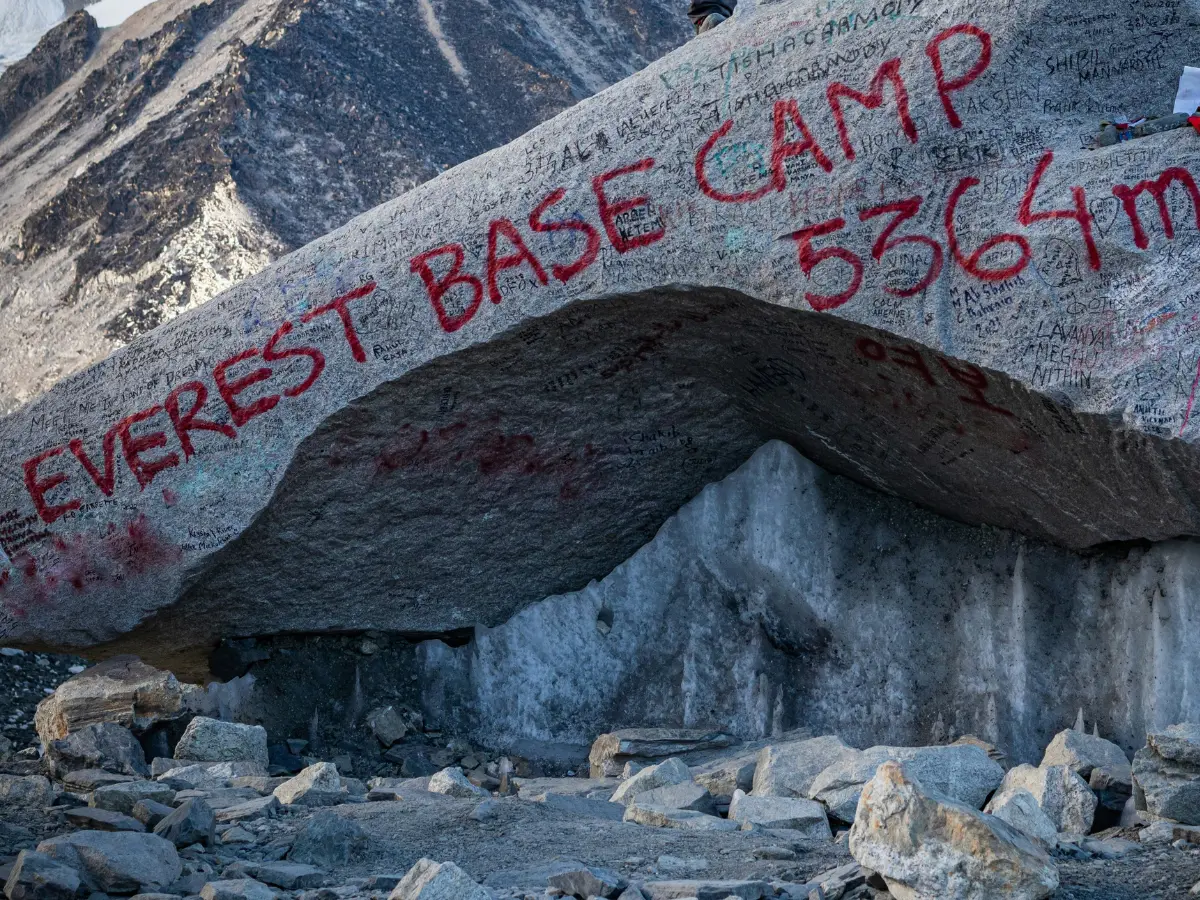
Urine from climbers who gather to ascend Mount Everest every year is melting tons of ice every climbing season, research has noted. The Everest Base Camp is set up on top of the Khumbu Glacier. Nearly 1,600 tents, with basic facilities like kitchens, showers, generators, Wi-Fi and in some cases, heated floors, crop up on the glacier every year. The heat generated by all these things causes a spike in the ground temperature.
A study published by a group of Nepalese and American scientists in the journal Regional Environmental Change shows how this human activity is driving the glacier to melt, setting the stage for an imminent disaster. Nepal was shaken by a massive flash flood on August 26, 2026, washing away villages and killing more than 1,200 people. The disaster was attributed to a glacial lake outburst.
Also Read: Beginning of the end? More glacial lake outbursts threaten millions in India, Nepal and China
Heat from urine is melting ice
The new study focused on how, along with global warming and fossil fuel consumption, human urinary discharge is also causing the glacier to melt. The higher altitude requires climbers to drink more water, in turn leading them to pee more. According to the researchers, in the 2023 season, nearly 6,766 litres of urine were produced per day. Khim Lal Gautam and his colleagues said that the urine alone carries a lot of heat and is enough to cause considerable melting of the glacier.
Estimating how much ice that amount of heat could melt, the researchers said the glacier lost 154 tons of ice in that climbing season alone. However, human urine is not the biggest factor here. After exiting the body at around 37 degrees Celsius, it cools down as well. Researchers calculated how much ice it could melt in this state. They noted that only a little of that heat reaches the ice, as the rest either escapes into the air or rocks.
Trending Stories
Fuel is the biggest driver contributing to melting ice
The bigger problem is not urine, but all the fuel consumption linked to the Base Camp. In the 2023 season alone, 824 cylinders of LPG, 18,935 litres of kerosene and 5,130 litres of gasoline were used for cooking, heating and electricity. It accounted for about 94 per cent of the melting caused by humans, while urine made up the other 6 per cent.
Scientists have warned that the Himalayas are warming faster than other regions. Ice loss nearly doubled after 2000, compared to the previous quarter, as per a 2019 study published in Science Advances. The team said that the surface temperatures at Base Camp are increasing faster than other parts of the Khumbu Glacier, rising at about 0.28 degrees Celsius per year.
Shifting the Base Camp
The team analysed whether the camp should be shifted, and if yes, where? They identified two places southwest of the current camp. However, shifting would pose logistical issues, besides igniting disaster at a new place. They have called for better waste management and reliance on solar power. To save the Khumbu Glacier, some portion of the camp can be shifted. But human-induced heating might aggravate the problem.

