

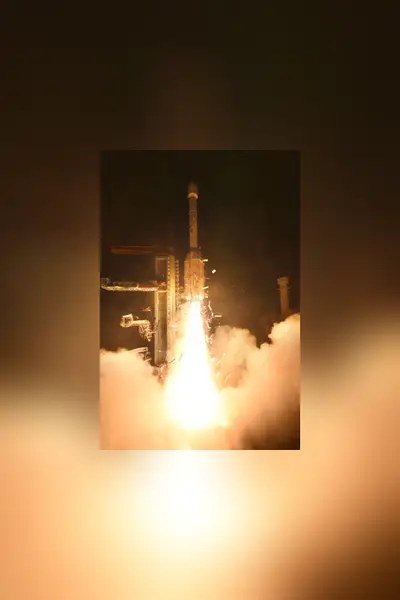
Ending an eight-month lull, Indian space agency ISRO delivered a much-needed comeback with the successful launch of the GSLV-F17 rocket carrying the EOS-05 satellite. The 52-meters-tall GSLV rocket that weighed 420-tons lifted off at 2:55am Indian time, from the second launchpad of the Satish Dhawan Space Centre, carrying the 2,367kg Earth-imaging satellite built by ISRO. In barely 20 minutes, the three-stage rocket placed the satellite in its designated initial orbit. ISRO's launches scheduled for 2026 were halted after repeat mid-flight failures of ISRO's workhorse PSLV rockets: PSLV-C61 in May 2025 and PSLV-C62 in January 2026.
Announcing the launch outcome, ISRO Chief Dr. V. Narayanan said that the EOS-05 satellite was successfully and precisely injected into the required orbit. He added that the satellite's solar panels have been deployed and that the satellite's health condition is perfectly alright. While ISRO intended to place the satellite in an initial elliptical(egg-shaped) orbit of 170kms perigee (nearest point from Earth) and 28,934kms apogee (farthest point from Earth), the rocket had delivered a better performance and placed the satellite in a 171kms perigee and 31,026kms apogee. He also projected that the EOS-05 satellite would have an operational life of seven to nine years.
Tracing the 25-year operational history of the GSLV rocket, Dr. Narayanan pointed out that the EOS-05 was the heaviest satellite to be launched by this vehicle. He recalled and contrasted that GSLV had lifted a satellite weighing 1,356kg during its first launch mission; while it has lifted a 2,367kg satellite in its latest mission, which is its 19thflight. He elaborated that this enhancement of lifting power is a result of ISRO's efforts in constantly modifying and upgrading the the structural elements, propulsion systems of the vehicle. He pointed out that the GSLV rocket had seen almost a 50percent increase in its lifting power over these years. However, he mentioned that further enhancement of this vehicle's lifting power is ruled out.
Watch ISRO's post here
ISRO targets 6 launches by March 2027
Referring to the back-to-back, mid-flight PSLV failures, Dr. Narayanan said that ISRO had understood the reasons behind them and needed to validate their understanding via experiments. Without elaborating much, the ISRO Chief also mentioned that the agency is targeting six launches in the ongoing Financial year, of which the launch of Navigation satellite NVS-03 and Gaganyaan-G1 mission are planned by December 2026.
NVS-03 is one among five satellites that are part of India's regional navigation satellite fleet, which urgently requires replenishment of satellites to resume basic functionalities. Gaganyaan-G1 is the first in the series of three unmanned missions that India would carry out, before launching its crew to space on an Indian rocket, astronaut-carrying spacecraft. Gaganyaan is India's ambitious Human Spaceflight programme, which aims to send Indian astronauts to space and return them safely.
