2025 in space: 3I/ATLAS, quasi-moon and more - 10 weirdest cosmic events and objects discovered in universe

&imwidth=600&imheight=450&format=webp&quality=medium "2025 in space: 3I/ATLAS, quasi-moon and more - 10 weirdest cosmic events and objects discovered in universe")
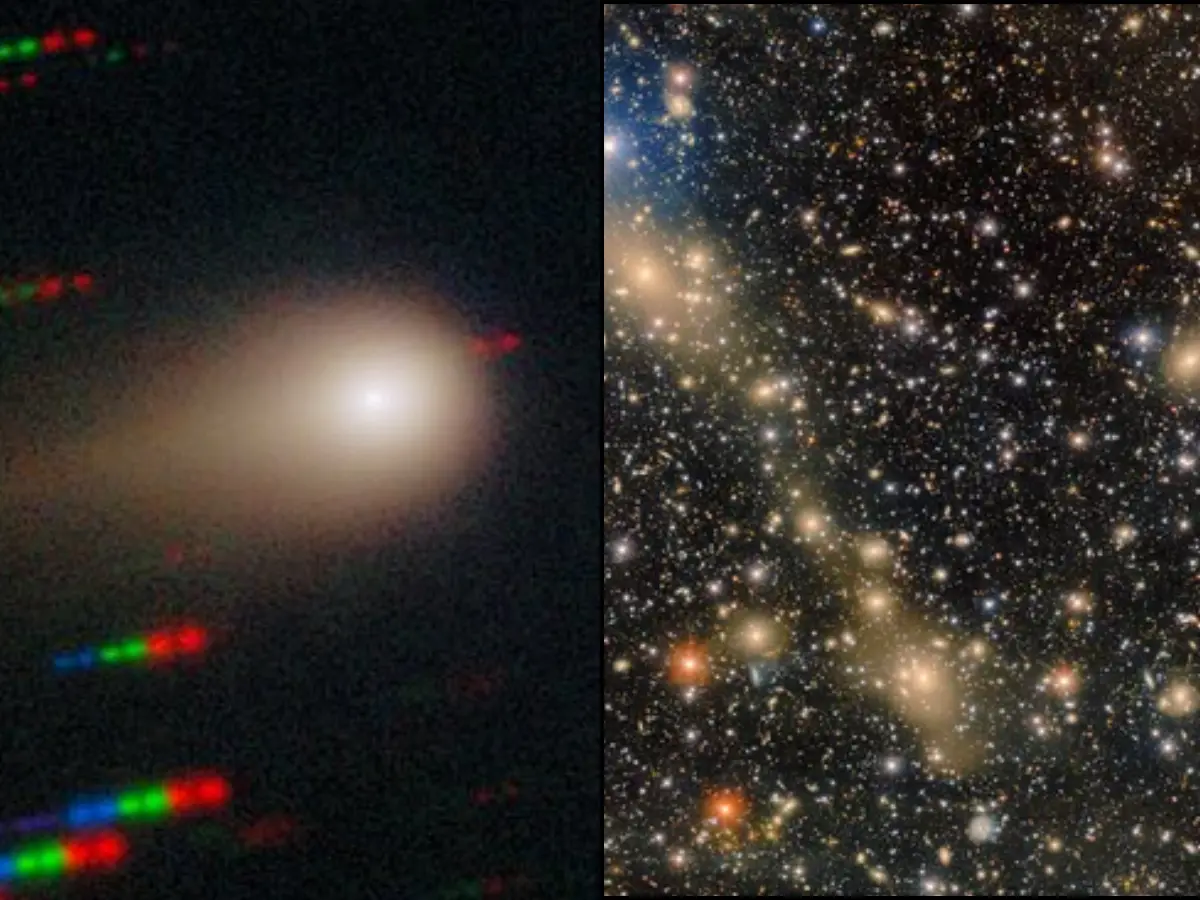
Yearender: Space in 2025. The most magical, stunning and shocking discoveries Photograph: (Gemini Telescope - CTIO/NOIRLab/NSF/AURA)
3I/ATLAS, comets, asteroids, quasi-moon and more. In 2025, scientists spotted several strange events and objects in the universe. There was a dying hole, and the oldest supermassive black hole. Here are some of the most mysterious cosmic events we saw in 2025.
The universe is filled with mysterious occurrences that humans still cannot understand. In the year 2025, scientists came across some strange cosmic objects and events that defied explanation. Some of them were those that had existed merely in theory for decades and showed themselves only now. This year, welcomed the third interstellar visitor, heard two black holes merging, proving for the first time a decades-old theory, and we stumbled upon a quasi-moon that has been slyly moving around the Sun on the same path as Earth, among other things. Here are some of the strangest and weirdest cosmic observations made in 2025.
The third interstellar object
3I/ATLAS, the visitor from outer space, was spotted zooming through our solar system in July 2025. Its hyperbolic trajectory was enough to reveal that it originated in some other corner of the Milky Way. It was dated to be 7 to 14 billion years old, which means it was born when our star system wasn't even born. The comet has been a topic of debate, especially because of its 200,000 km/hr speed, the emissions and the presence of a clear anti-tail.
Quasi Moon 2025 PN7
This year, astronomers were shocked to see that a quasi-moon had been living in Earth's orbit for nearly 60 years. 2025 PN7 was discovered on August 2 by the Pan-STARRS observatory in Hawaii. Scientists then scanned through past data to check for past records. They found images of the quasi-moon dating back to 2014. Further investigation showed it has been here way longer, and is going to stay in orbit for another 60 years.
First exo-moon
Trending Stories
)
)
)
)
)
)
)
)
)
)
)
)
)
)
)
)
)
)
)
)
)
)
)
)
)
&im=FitAndFill=(700,400))
)
)
)
)
)
)
)
)
)
)
)
A group of scientists think they have spotted the first exo-moon, that is, a moon in another star system. This exomoon orbits HD 206893 B, a Jupiter-like exoplanet, at a distance of 133 light-years from Earth. The planet is equal to the mass of 28 Jupiters, and its exomoon is around 0.4 Jupiter masses. NASA has to date come across 6,000 exoplanets, but never an exomoon. Their findings still need to be confirmed.
Bridge of stars
In August 2025, scientists came across a galaxy cluster 700 million light-years from Earth. They spotted a faint glow from stray stars that were slowly being ripped from their home galaxy by another galaxy. This bridge of stars spans a million light-years between two galaxies in the cluster Abell 3667. Researchers say that this means that Abell 3667 formed from two smaller clusters, which merged around a billion years ago.
Black hole merger proving Hawking's theory right
In January 2025, scientists heard two black holes merging to form a gigantic cosmic object. Using the Laser Interferometer Gravitational-wave Observatory (LIGO), they found evidence for a theory proposed by Stephen Hawking over 50 years ago. LIGO witnessed two black holes merging to form a black hole significantly bigger than the two colliding objects. Before the merger, the combined surface area of the two black holes was 243,000 square kilometres. The new black hole had a surface area of 400,000 square km.
First moments of a supernova
Scientists at the European Southern Observatory (ESO) were able to capture the first moments of a dying star for the first time. While they observed in 2024, the findings were released in 2025. While the star’s surface was meeting a violent end, the scientists saw the shape of a supernova at its earliest, ephemeral stage.
The golden comet
Comet C/2025 K1 (ATLAS), which was discovered in May 2025, turned into a spectacular golden ribbon after reaching perihelion. It came within 50 million kilometres of the Sun on October 8 and was expected to be torn to shreds. However, not only did it survive this trip, it emerged as a strange golden coloured comet. It appeared "a red/brown/golden colour rarely seen in comets." This comet also broke up into several pieces later on, with at least three parts observable.
Largest spinning structure in the universe
Scientists came across a 50-million-light-year-long cosmic thread that is possibly the largest spinning object in the universe. They found a huge filament of dark matter which is spinning, with the galaxies inside it also rotating in the same direction. It is located 140 million light-years away, with a row of 14 galaxies placed in a line that spans 5.5 million light-years long and 117,000 light-years wide. This row of galaxies is embedded in the larger filament that's 50 million light-years in length, with about 300 galaxies living inside it.
Oldest supermassive black hole
In 2025, astronomers made another astounding discovery. They found a supermassive black hole that was born only 500 million years after the Big Bang. The black hole sits at the centre of a galaxy named CAPERS-LRD-z9. It is estimated to weigh up to 300 million times the mass of our sun. The discovery raised questions about the formation of supermassive black holes. The study authors suggested that it is proof that early black holes grew much faster than we thought possible.
Fast-spinning asteroid
NASA came across the near-Earth asteroid 2025 OW in August and was befuddled to see it spinning at extreme speeds. It was discovered on July 4, 2025, and is about 200 feet wide and has an irregular shape. It was also found to be spinning rapidly, completing one rotation every 1½ to 3 minutes. This makes it one of the fastest-spinning near-Earth asteroids. It has been spinning without breaking apart, which shows that it is a solid object instead of being a loosely bound rubble pile like other asteroids.

