
&imwidth=800&imheight=600&format=webp&quality=medium "Scientists see first moments of a dying star as it turns into a supernova")
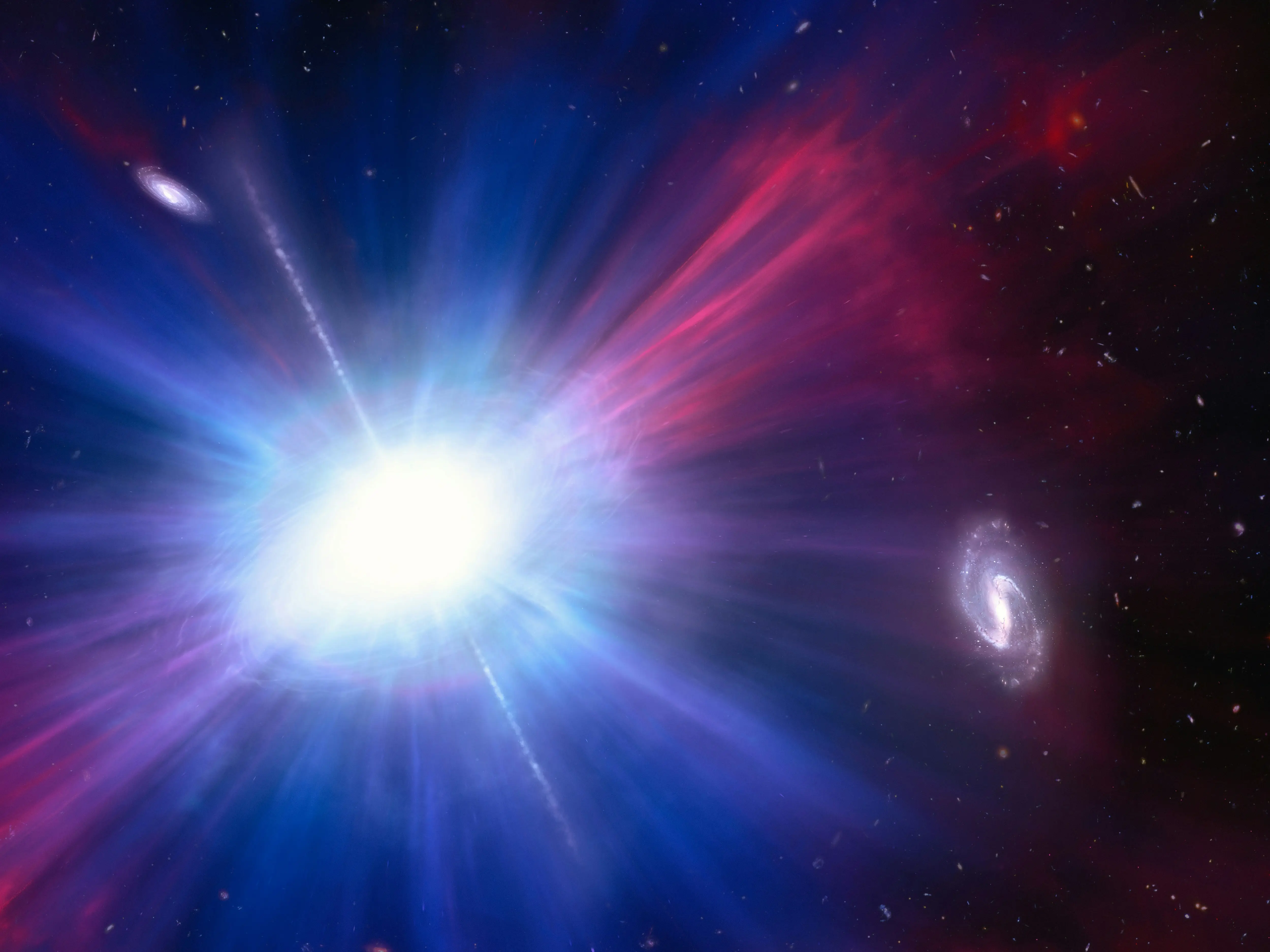
Scientists at the European Southern Observatory (ESO) have captured the first moments of a dying star. It pointed the Very Large Telescope (VLT) in Chile at supernova SN 2024ggi in April 2024 and saw an astonishing view for the very first time. Supernovas are nothing but a cosmic occurrence that happens after a star dies. While the star’s surface was undergoing an agonising end, ESA saw the shape of a supernova at its earliest, ephemeral stage. The finding was published in Science Advances on November 12. Yi Yang, an astronomer at Tsinghua University and co-author of the study, said in a statement, "The geometry of a supernova explosion provides fundamental information on stellar evolution and the physical processes leading to these cosmic fireworks."
The paper states that the initial blast rendered an olive shape. When the material propagated outward and interacted with matter around the star, it flattened while maintaining the same axis of symmetry. What they saw wasn't exactly a colour-filled blast, but a reconstruction of its geometry from the polarisation of its light.
Supernovas happen when a massive star, one much bigger than the Sun, runs out of fuel and eventually dies. Its core collapses and its outer mass falls inward. It then bounces outwards, releasing a huge amount of energy, which is what makes the supernova appear extremely bright. This "bounce shock" has remained a puzzle for decades, Yang wrote in the study. Supernova SN 2024ggi is located in the galaxy NGC 3621, 22 million light-years away. It was so massive that before turning into a supernova, it was a red supergiant star with a mass that was 12 to 15 times that of the Sun and a radius 500 times larger.

Scientists at ESO were able to capture the short-lived “breakout” shape using a technique called spectropolarimetry. Lifan Wang, co-author of the study and an astronomer at Texas A&M University, said, "The technique delivers information about the geometry of the explosion that other types of observation cannot provide."

