When hockey became India's identity: The Olympic golden era that defined a nation

&imwidth=600&imheight=450&format=webp&quality=medium "When hockey became India's identity: The Olympic golden era that defined a nation")
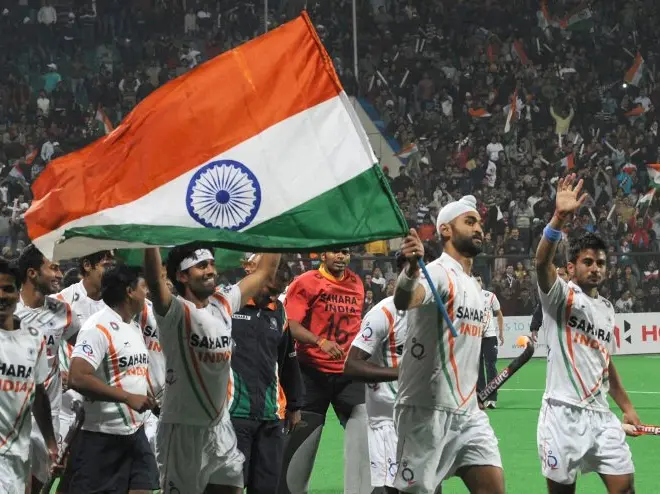
Sandeep Singh of India waves the Indian national flag with teammates after winning the men's field hockey finals match between India and France of the FIH London 2012 Olympic Hockey qualifying tournament at the Major Dhyan Chand National Stadium in New Delhi on February 26, 2012 Photograph: (AFP)
India's hockey team gave a newly independent nation its first Olympic gold in 1948, beginning a golden era that produced eight Olympic titles
There was a time when the world did not associate India with cricket, badminton or athletics. Before those sports produced their own generations of champions, it was hockey that carried the Indian flag across the globe. For decades, the Indian men's hockey team was not merely successful at the Olympics. It was dominant. India won eight Olympic gold medals in hockey, a record that remains unmatched by any team in the sport, along with one silver and three bronze medals. But the most powerful chapter of that story started in 1948.
Just one year after India gained Independence, the country arrived at the London Olympics carrying something far bigger than a hockey stick. It was the first Olympics for India as an independent nation, and hockey gave the newly free country the perfect sporting statement. India defeated Great Britain 4-0 in the final to win the gold medal. It was India's first Olympic gold as an independent nation, and the symbolism could hardly have been greater. The former colonial power was beaten on its own soil, while the Indian flag rose above the podium. For a country still finding its identity after Independence and Partition, the victory represented much more than sport.
The dynasty that started before Independence
India's hockey story had already begun before 1947. The team won three consecutive Olympic gold medals at Amsterdam 1928, Los Angeles 1932 and Berlin 1936. Major Dhyan Chand became the defining figure of that era, helping establish Indian hockey as a global force. The 1936 Berlin Games were particularly memorable. India defeated Germany 8-1 in the final, while Dhyan Chand's extraordinary skill helped cement his reputation as one of the greatest players the sport had seen. But Independence changed the meaning of those victories. The hockey team was no longer simply representing British India. It was now representing a sovereign nation. And the first opportunity to demonstrate that came in London in 1948.
London 1948: The gold that belonged to a free India
The 1948 Olympics were held in a world still recovering from the Second World War. For India, the Games came just months after Independence. The team had to navigate the enormous political and social changes that had accompanied Partition. Several players who had been part of India's hockey ecosystem before Independence were now representing Pakistan. Yet the Indian team remained formidable.
Trending Stories
)
)
)
)
)
)
)
)
)
)
)
)
)
)
)
)
)
)
)
)
)
)
)
)
)
)
)
)
)
)
)
)
)
)
&im=FitAndFill=(700,400))
)
)
)
)
Led by captain Kishan Lal, India progressed through the tournament and reached the final against Great Britain.
The result was emphatic: India won 4-0. That victory became the first Olympic gold medal for independent India.
It was the kind of sporting moment that could define a nation. The country had just emerged from colonial rule. Its institutions were still taking shape. Its economy and infrastructure faced enormous challenges. Yet on the Olympic hockey field, India was already a world power.
The golden run continued
The London triumph was not an isolated moment. India followed it with gold at Helsinki in 1952 and Melbourne in 1956, extending the Olympic winning streak to six consecutive Games from 1928 through 1956. No other team has matched that run in Olympic hockey. The 1952 final produced another iconic performance. Against the Netherlands, India won 6-1, with Balbir Singh Sr. scoring five goals, a record for an individual in an Olympic men's hockey final that remains part of the sport's history.
Four years later, India defeated Pakistan 1-0 in the Melbourne final to claim its sixth consecutive Olympic hockey gold.
By then, Indian hockey was not simply successful. It was the standard against which the rest of the world measured itself. The team's style, built around close control, dribbling, speed and intricate passing, became synonymous with Indian hockey. The term ‘Indian dribble’ itself emerged from the team's remarkable stick skills.
The end of the streak, and another beginning
India's Olympic dominance eventually faced its biggest challenge. At the 1960 Rome Olympics, Pakistan defeated India 1-0 in the final, ending India's run of six consecutive gold medals. India had to settle for silver. But the setback did not immediately end the golden era. India reclaimed Olympic gold at Tokyo 1964, defeating Pakistan 1-0 in the final.
Bronze medals followed at Mexico City 1968 and Munich 1972, before India finished seventh at Montreal 1976.
Then came one final Olympic gold. At Moscow 1980, India returned to the top of the podium, winning its eighth and most recent Olympic hockey gold. That triumph marked the final gold medal of India's historic Olympic hockey dynasty.
More than medals
The significance of India's hockey dominance cannot be measured only through its medal tally. Hockey gave generations of Indians sporting heroes at a time when international sporting success was still rare. Dhyan Chand. Balbir Singh Sr. KD Singh Babu. Leslie Claudius. Udham Singh. Prithipal Singh. Charanjit Singh. These were names that represented excellence long before India developed the sporting ecosystem that exists today.
The hockey team also helped create an emotional connection between sport and national identity. When India won in London in 1948, the victory carried the weight of a newly independent country. When the team returned to the top in Tokyo in 1964, it reaffirmed India's place among the world's elite. And when India won its eighth Olympic hockey gold in Moscow in 1980, it added another chapter to a legacy that had already stretched across more than five decades.
The long wait for a new Olympic medal
After the 1980 gold, Indian hockey entered a very different era. The team went through decades without another Olympic medal. India even missed the Olympic qualification in 2008, a dramatic low point for a team that had once seemed almost unbeatable. The revival finally came at Tokyo 2020, held in 2021 because of the pandemic, when India won men's hockey bronze.
Paris 2024 brought another bronze, giving the men's team back-to-back Olympic medals and signalling that the sport's historic legacy was beginning to find a new generation. The golden age may belong to history, but its influence remains.
The sport that announced India to the world
Today, Indian sport has many faces. Cricket has produced global superstars. Badminton has created Olympic champions. Athletics has given India a historic Olympic gold. Wrestling, shooting, boxing and weightlifting have all produced their own icons. But hockey came first. It was the sport through which generations of Indians learned what it meant to see their country dominate on the world's biggest sporting stage.
And perhaps that is why the 1948 London gold remains so special. India had been independent for less than a year. The country was beginning the difficult task of building a new identity. On a hockey field in London, its athletes provided one of the earliest reasons for millions of Indians to look at the world and say: we belong here.
That is the enduring legacy of Indian hockey. Not just eight Olympic gold medals. But the sporting identity of a nation.

