
&imwidth=800&imheight=600&format=webp&quality=medium "Cars are getting electric! Are e-buses the next big leap? Inside India’s push for carbon-free transit")
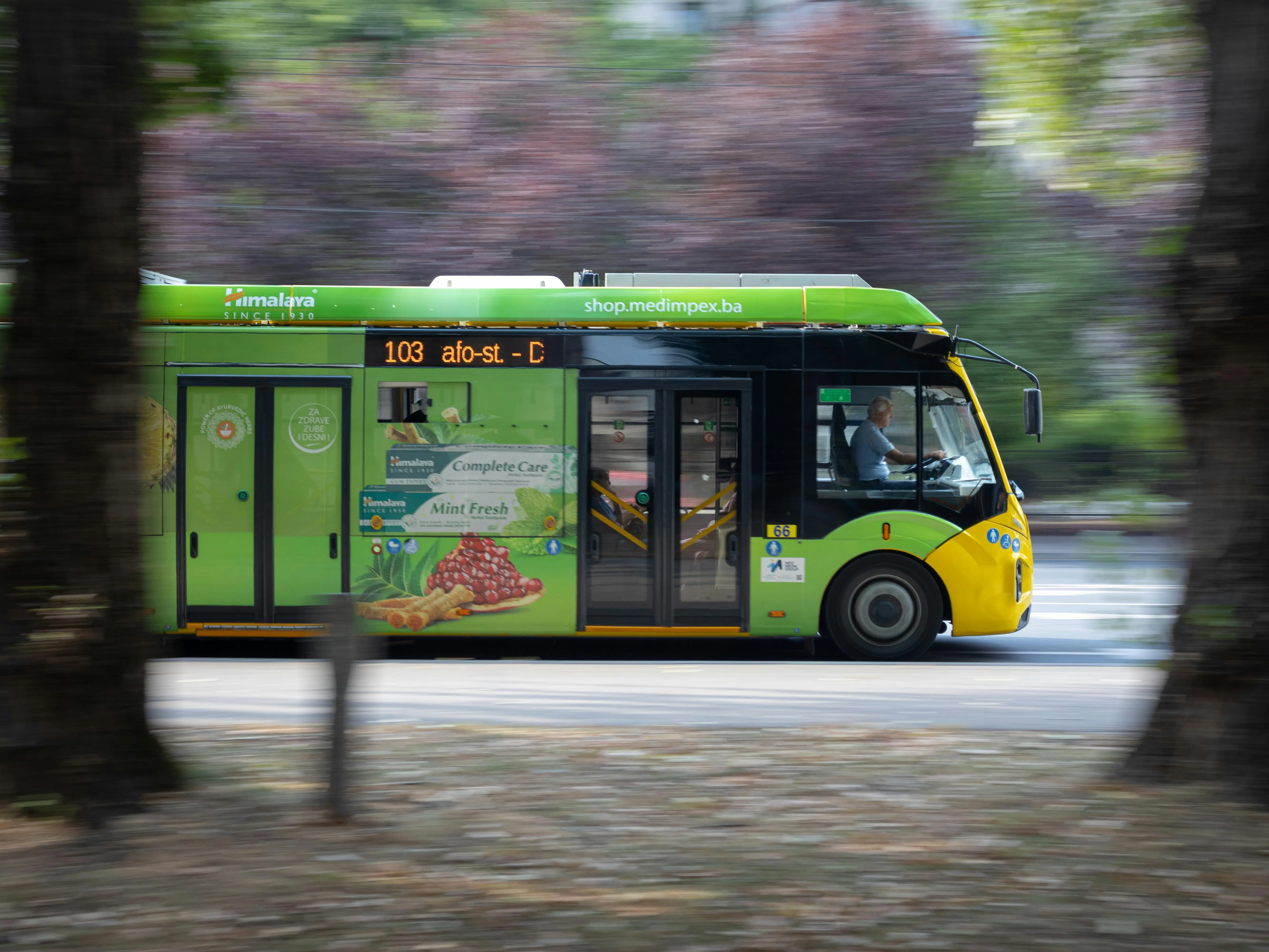
India’s transport sector is undergoing a rapid shift towards electric vehicles (EVs). Total EV sales in India topped two million units in 2024, up 25 per cent on the previous year, as government schemes and consumer interest fuel adoption. However, buses, especially intercity coaches have remained a small part of this growth. In FY2024 just 3,644 electric buses were sold (about 4 per cent of annual bus registrations).
The vast majority of India’s 2.4 million buses are still diesel-powered, and some 93 per cent are privately operated. Public transit authorities have driven most of the fleet electrification so far, with state-run undertakings buying thousands of e-buses under subsidy schemes. But experts note that intercity coaches carry enormous passenger volumes, roughly 228 million travellers each day, nearly ten times Indian Rail’s patronage, so electrifying this segment could cut a large chunk of transport emissions.
India’s Electric Bus Landscape

The electric bus market in India has accelerated rapidly from a low base. In FY2024 sales jumped 81 per cent year-on-year, compared to modest growth for cars and motorbikes. Yet even after this surge, EV buses still account for only a few percent of new buses. For context, over the past decade 90–98 per cent of buses sold were diesel or petrol. Adoption is highly uneven: urban centres like Delhi, Mumbai and Bangalore lead, while many states have yet to see significant deployment. Maharashtra alone registered 2,423 new e-buses in FY24, versus just 600 in smaller markets.
Government targets are ambitious. Phase II of the Faster Adoption and Manufacturing of (Hybrid &) Electric Vehicles (FAME) scheme (2019–24) envisaged incentives for 7,000 e-buses, and a recent policy aims to replace 800,000 diesel buses with EVs by 2030. The broader goal is 30 per cent EV adoption across the auto sector by 2030. India’s EV uptake in recent years has outpaced global averages; one analysis notes that EV adoption in India is three times the world rate, driven by falling battery costs and strong policy support. Total EV registrations (for cars, 2- and 3-wheelers, goods vehicles, etc.) reached over two million in 2024, roughly 7–8 per cent of all vehicles sold. In that mix, buses remain a minority: FY24 saw roughly 3,600 e-bus sales, after about 1,900 in FY23, itself an 85 per cent jump on the year before.
To date, this expansion has largely been steered by public transport fleets and municipal undertakings. Under FAME Phase I (2015–19) only 425 e-buses received purchase subsidies, but Phase II (2019–24) approved about 7,120 buses. These incentives were available to state and city transport agencies, municipal corporations and other public bodies. In practice, a few major government orders have supplied thousands of buses: for example, by mid-2025 India’s Centre floated a tender for 10,900 e-buses for five big cities under the new PM e-Drive scheme. These tenders are often structured under the “Gross Cost Contract” model, where agencies pay operators per kilometre to run buses, which has accelerated sales of EV coaches to state undertakings.
Trending Stories
)
Trump says Russia has ‘lost control’ of its diesel industry, calls for end to ‘ridiculous, never-ending’ war
)
Putin's United Russia party wins 355 seats in Duma election; 4 other parties cross threshold to enter parliament
)
Delhi Air pollution: Strict crackdown on waste burning
)
‘0% chance’: Nvidia CEO Jensen Huang dismisses AI extinction fears by 2030
)
Samay Raina-Mukesh Chhabra controversy explained: What happened over girlfriend joke on India's Got Latent?
)
Trump's helipad event overshadowed by audio failure as major TV networks suspend pool coverage
)
Russia-Ukraine war: Russian strikes knock out three of Ukraine's largest steel plants
)
Four decades after leaving Kolkata, the Birlas may be coming back for more
)
Glitch in the matrix caught on camera: Woman vanishes after talking to reporter
)
IIT Bombay tensions ease after three-hour open house; director’s assurances pacify students
)
Samsung raises Galaxy S26 prices by Rs 20,000: Here’s what each model now costs
)
J&K Assembly Session begins amid chaos: BJP, ruling alliance clash as statehood demand dominates
)
Bessent meets China’s He Lifeng to prepare for Trump-Xi summit
)
8,000 bees worth over $20,000 stolen from hives in Queensland
)
US and China vie for AI dominance as calls grow for regulation | Gravitas
)
FIFA chief Infantino wants to reform governing body with consultation from federations
)
The Verdict | The Mecca Agreement is under scrutiny as Houthis attack Saudis
)
Saudi Arabia exits China-led mBridge digital currency platform amid Saudi-Houthi conflict
)
'Lot of things to learn from experienced players': Jayasuriya backs Rohit, Virat for 2027 ODI World Cup
)
Taylor Swift has a 'proud wife' moment as Travis Kelce scores first touchdown of season: 'That’s my husband!'
)
North Korea's nuclear tests triggered 1,399 earthquakes: Earth is still shaking | Gravitas
)
Mahabharat actor Saurav Gurjar arrested in Hyderabad, sent to 14-day judicial custody in sexual exploitation case
&im=FitAndFill=(700,400))
New OTT releases this week (September 21-27, 2026): Shaque: Trust No One, Hunkkaar, Don’t Be Shy- 5 new titles coming to Netflix, Prime Video and more
)
From ‘communist’ to ‘great mayor’: Trump praises Mamdani after New York meeting, discusses immigration and housing
)
WATCH | Mysterious lights over Tehran caught on video. Drone, aircraft or something else?
)
White House TV pool halts Trump coverage after CNN barred from UNGA events
)
Iranian airlines to shut worldwide on Sept 23, Bessent warns of US banking ban
)
China expels top generals Zhang Youxia, Liu Zhenli over ‘disloyalty’, corruption
)
Pilot recreates Mona Lisa in sky over Oklahoma and Arkansas in four-hour flight: VIDEO
)
UK PM Burnham agrees to 'defensive' military support for Saudi Arabia against Houthis
)
Jailer 2: Vidya Balan joins Rajinikanth's upcoming film as Kantha | Watch
)
Microsoft executive called AI training the ‘largest theft of labour in human history’
)
40-foot waves crash into cruise ship in dangerous stretch near Antarctica. Watch
)
US-Iran war, peace deals and more: What to expect from Trump's UNGA 2026 speech
)
Explainer: Why rare-earth export licences and Board of Trade are US priorities ahead of Trump-Xi summit
)
BTS fans mock iHeartRadio’s day 2 turnout after short set controversy
)
The Scandal: Why so scandalous? Ji Chang Wook leaves you gasping for air
By contrast, private intercity operators have seen few incentives. Their market share (93 per cent of buses) makes them crucial for any mass shift, yet they were largely ineligible under past EV programs. Industry observers point out that only about 7 per cent of India’s buses are public transit, so focusing solely on those leaves a huge gap. In recognition, the government in 2024 launched PM e-Drive and PM e-Bus Sewa schemes to extend support. The PM e-Drive programme (Oct 2024–Mar 2026) has a Rs 10,900 crore outlay, of which Rs 4,391 crore is earmarked to subsidise 14,028 electric buses by March 2026.
A related PM e-Bus Sewa, Payment Security Mechanism (PSM) scheme (Rs 3,435 crore) aims to underwrite about 38,000 buses nationwide. Such measures have widened the net to include municipal and state-run city buses, but private intercity fleets currently get little direct capital subsidy. According to Sudhakar Chirra, an ordinary state-run corporation could claim FAME capex of Rs 55–85 lakh per bus, whereas private operators see no FAME benefit. They do, however, get some relief via permit and tax waivers – for example, exemption of the national transport permit fee (about Rs 3 lakh per bus per year) and relief from some local levies – roughly equating to Rs 10 lakh of annual support per bus.
The Intercity Challenge: Range, Charging and Cost
At the vanguard of this movement is Fresh Bus, a Bengaluru-based startup founded in 2019 by Sudhakar Chirra, former co-founder of the bus-aggregator AbhiBus. Chirra saw that while AbhiBus solved ticketing, customers still complained about “poor captain behaviour, lack of cleanliness, unsafe stopovers, and a confusing boarding process. Why isn’t there a unified intercity travel experience like we see in flights and trains?” he wondered.
This question and the promise of lower costs drove him to launch Fresh Bus with an all-electric fleet. Fresh Bus currently operates some 85 EV coaches on seven intercity routes from Bengaluru, including to Tirupati, Chennai, Coimbatore and Mysuru, with Hyderabad launching soon. The company offers online ticketing, real-time tracking and even a loyalty programme, aiming to deliver a reliable, branded travel experience powered by clean energy.
Electrifying intercity travel poses unique obstacles compared to city transit. Intra-city e-buses typically run short, looped routes and return to a depot each night, making overnight charging feasible. Intercity coaches, by contrast, must cover hundreds of kilometres between cities, often multiple trips a day. This creates acute range and charging demands. While talking to WION, Chirra explained, the “first challenge is range” – to cover most Indian intercity routes a bus needs either a 650 km single-charge range or very fast mid-journey charging. Current high-capacity electric buses can manage about 250–300 km on a charge, which covers roughly 40 per cent of typical intercity trips, but longer routes require infrastructure. Without 600+ km range, operators must “carefully select routes that fall within the current range,” which limits network design.
Mid-route charging itself is technically and financially daunting. A heavy intercity bus needs chargers of 240 kW or more, some systems even trial 1.5 MW chargers to fast-charge in tens of minutes. Installing such high-power stations is “a tedious task”: it demands reinforced grid connections, transformers and dedicated distribution infrastructure, entailing huge capital outlays. Private operators with small fleets often cannot justify this. Most public EV chargers today are far lower power (typically 60 kW), far too slow for a bus turnaround – plugging into one would take hours. Fresh Bus therefore builds its own high-power depots. As Chirra noted, “we need to turn around a bus in about 40 minutes, so it makes sense for us to install our own charging capacity.” These stations are custom-designed to Fresh Bus’s routes: the company leases land at terminals and motorway stops, specifies the number of chargers needed, and partners with specialist CPOs (ChargeZone, Statiq, etc.) to install 1.5 MW chargers dedicated exclusively for its fleet.
Cost is another consideration. Diesel coaches are cheaper to buy (roughly Rs 1.3 crore each) than fully electric intercity coaches (around Rs 1.7–1.8 crore). But fuel accounts for a huge fraction of diesel operations – for example, on a long route like Hyderabad–Bangalore, diesel could be Rs 7 lakh per month. By contrast, electricity for an EV coach costs roughly one-fifth as much. “Higher capex, lower opex,” as Chirra puts it. Over the lifecycle, studies show total cost of ownership for a modern AC e-bus is about 15–20 per cent less than an equivalent diesel bus. The savings on fuel and maintenance can therefore justify the premium, if utilisation is high. Fresh Bus’s strategy is to leverage data and tech to optimise routes, maximise passenger load factor and boost revenue, making the business case for the extra upfront investment.
Operationally, running an EV fleet adds complexity. The company relies on partners for vehicle acquisition and infrastructure. Fresh Bus sources buses from established OEMs (e.g. Olectra-BYD, JBM, Exponent/Veera, Azad) with the largest battery packs available. Chirra has a strict rule of thumb: “1 kilowatt-hour gives us 1 kilometre of range,” so buses with at least 425 kWh battery are needed for 400 km routes. For example, Fresh Bus is deploying a new 13.5-metre sleeper coach (made by Exponent in partnership with Veera Vahana) with a 420 kWh battery, coupled to a 1.5 MW charger that can fill it in 15 minutes. This set-up lets the bus run up to 650 km per day by charging during brief layovers.
Vehicle leasing is also part of Fresh Bus’s model. Rather than invest its own capital in the whole fleet, Fresh Bus works with financiers like Vertelo (a Macquarie platform) to buy buses which Fresh Bus then leases. The chargers and civil works are similarly financed in partnership with infrastructure firms. Chirra says this reduces risk and concentrates Fresh Bus on service quality and technology, rather than asset-heavy ownership.
Fresh Bus: Innovating the Highway Journey
Fresh Bus brings many innovations to the traditional coach experience. On-board, each EV bus has large picture windows and an LCD screen showing “My Journey View” a digital map and progress tracker for the trip. This synchronises with the Fresh Bus app and website so passengers always know where they are. The service emphasises comfort and professionalism: drivers and conductors (“captains” and “stewards”) are well-trained and incentivised, buses are kept clean, and routes have no unauthorised stops (a common issue on some private buses).
Fundamentally, Fresh Bus’s core claim is economics. Chirra calculated early on that diesel fuel accounted for 55 per cent of operating costs for a conventional intercity bus, but only 12–13 per cent for an electric one. These savings allow Fresh Bus to offer perks, like fixed Wi-Fi and snacks, from the surplus. By reinvesting in customer experience and data-driven route planning, the startup aims to win market share and show that EV coaches can be commercially viable. “Electric buses combine better unit economics, enhanced customer experience, and tech-driven efficiency,” Chirra asserts, summarising Fresh Bus’s value proposition.
The company’s early results are encouraging. As of mid-2025 it had 85 buses on the road and was adding vehicles at a rapid clip. Fresh Bus launched its first route (Bengaluru–Tirupati) to exploit existing charging facilities near Bangalore, then expanded to Chennai, Coimbatore and Mysuru, with Hyderabad coming soon. All told, the routes cover key pilgrimage and business corridors in the south. Passenger acceptance appears strong: many riders report appreciating the modern vehicles and convenient booking. Chirra notes that consistent, clean service, once a rarity, is attracting a loyal base.
Investors have taken notice. In August 2024 Fresh Bus raised a Series A of $10.5 million (Rs 87.5 crore) led by Maniv Mobility with Shell Ventures, Alteria and Riverwalk. The funding was earmarked to add 15 new routes and deploy 150 more buses. In practical terms, it took Fresh Bus’s fleet from about 20 vehicles to roughly 100. The company has already signalled plans for a Series B of ~$30 million to continue scaling. “With this funding we are taking the count to 100 buses… The goal is to expand from 100 buses to approximately 1,000 buses within the next three years,” Chirra said in mid-2025. Such growth, if realised, would make Fresh Bus a major national operator.
To meet its expansion plans, Fresh Bus will rely on continuing cost reductions in EV technology and strategic infrastructure. Each new bus adds charging demand, so the company is mapping highway stops and planning where to build more fast-charging depots. It is also exploring battery swapping or higher-density packs to extend range. Meanwhile, Fresh Bus’s data team analyses route profitability daily, tweaking schedules to boost occupancy. Chirra believes that with disciplined use of tech, the payback on an electric coach can be as short as 3–4 years. These figures align with industry studies showing that, over their lifetime, electric intercity buses can be more profitable than diesel due to fuel savings, once the initial hurdle is overcome.
Emissions Savings and Environmental Impact
Every electric coach on the road directly displaces pollution. Fresh Bus has publicised the scale: each of its buses is estimated to save over 90,000 litres of diesel per year, cutting roughly 200 tonnes of CO2 annually. If the company reaches 1,000 buses, that would equate to about 200,000 tonnes of CO2 avoided each year. By contrast, a single diesel bus emits over a hundred tonnes of CO2 per year just from fuel combustion. These savings contribute to India’s climate targets and air quality goals. India’s rural and intercity bus travel accounts for some 64 per cent of all bus vehicle-kilometres, so electrifying these routes would substantially reduce fossil fuel use and soot across large regions.
Future Outlook: Intercity EVs and India’s Climate Goals
India’s transportation policies now explicitly target a massive bus electrification. According to the Autocar analysis, the country’s ultimate goal is to replace 800,000 diesel buses by 2030, of which 550,000 would be privately operated coaches. Achieving even a fraction of that would dramatically reduce CO₂ emissions and oil imports. The first steps, funding a few tens of thousands of buses, have been taken with FAME, PM e-Drive and city tenders. But scaling to the hundreds of thousands will require bringing private operators like Fresh Bus onboard.
Intercity EV adoption still faces hurdles. Charging infrastructure on highways must improve: shared charging hubs along key corridors would help small operators. Financing remains tight: private companies often struggle to obtain capital or credit for EV buses due to the high upfront cost. Experts have suggested interest subsidies or loan guarantees to bridge this gap. There is also a need for continued vehicle innovation, lighter buses, more energy-dense batteries, and perhaps on-the-fly charging solutions.
Yet the momentum is unmistakable. Even under conservative projections, annual e-bus sales could exceed 17,000 units by FY2027 (about 15 per cent of total bus sales). This would bring electric buses into the mainstream.
In conclusion, India’s intercity electric bus movement is still in its early chapters, but poised for growth. Fresh Bus’s journey highlights both the opportunities and challenges. Drawing on technology and customer focus, it demonstrates that EV coaches can operate profitably and cleanly on long-haul routes. As government policy broadens incentives and infrastructure catches up, more operators may follow suit. If India can indeed put hundreds of thousands of EV coaches on the road by 2030, the impact on emissions and energy security would be profound, a key step towards its climate and transport goals.
