Vande Mataram and Inquilab Zindabad: Two slogans, two visions of Indian nationalism

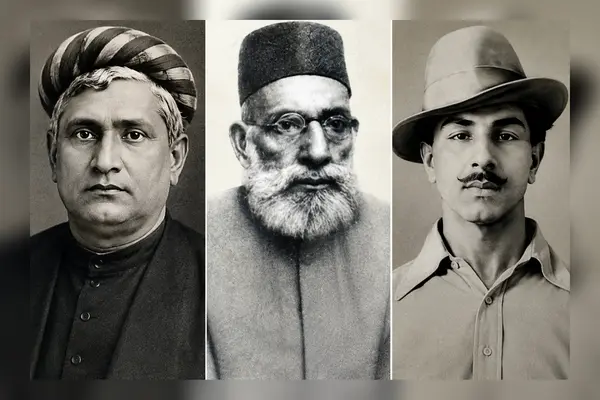
Bankim Chandra Chattopadhyay, Hasrat Mohani and Bhagat Singh
How Vande Mataram and Inquilab Zindabad emerged from different political traditions and came to represent competing ideas of Indian nationalism.
80 years after Indian Independence, two slogans still reverberate through the Indian streets and provide competing visions of Indian nationalism. One is a hymn that visualises the country as a mother, while the other is a battle cry that envisions the future. Both of them abundantly feature in the vocabulary of Indian politics and surface often in parliamentary debates. These words have outlived the movement which birthed them.
A song from a novel
"Vande Mataram" - "I bow to thee, Mother" did not begin as a slogan at all. It began as a passage of prose and verse inside a novel, Anandamath, by the Bengali writer Bankim Chandra Chattopadhyay, but turned into a slogan for the movement. Set against the backdrop of the Sanyasi Rebellion of 1770, it is considered India's first Political novel. The broad contour of the novel is that a band of ascetic warriors fight against oppressive rulers. Inside the novel, a song is woven, sung by the ascetic rebels, composed of a hybrid of Sanskrit and Bengali. The song addressed the land as a mother, sorrowful and in need of her children's devotion.
The song might have just remained a literary flourish if it were not for Rabindranath Tagore, who set "Vande Mataram" to music and sang it at a session of the Indian National Congress, giving it a public life far beyond the novel's pages. Then, in 1905, against the partition of Bengal, the song became an anthem of resistance that followed. The British banned the public rendition of it in some provinces. To sing Vande Mataram became in itself an act of defiance.
An Urdu poet
Trending Stories
)
)
)
)
)
)
)
)
)
)
)
)
)
)
)
)
)
)
)
)
)
)
)
)
)
)
)
)
)
)
)
)
)
)
&im=FitAndFill=(700,400))
)
)
)
)
“Inquilab Zindabad” is Urdu for “Long Live the Revolution”, and is credited to the activist Hasrat Mohani, who coined it around 1921. Mohani had an unusual position, a devout Muslim and one of the early members of the Communist Party of India, and a fierce anti-colonial agitator, all at once. His slogan brought in the energy of the Russian Revolution and mixed with the anti-colonial mood sweeping India. He was a prominent figure of the Khilafat movement, which criticised the British policies against the Ottoman Empire. What makes Mohani unusual is that despite having a Muslim intellectual and political environment and being part of the Khilafat movement, he embraced communism, rejecting the partition and two-state solution.
However, the slogan would have remained a footnote in Indian history if it were not for Bhagat Singh and Batukeshwar Dutt, who threw non-lethal bombs onto the floor of the Central Legislative Assembly in Delhi and stood their ground and shouted "Inquilab Zindabad" to be arrested. In Bhagat Singh's words, to make the deaf hear. They went on to shout the same slogan at the end of their life during execution in 1931. Cementing his and the slogan's legacy as uncompromising revolutionary sacrifice.
The politics of slogans
To understand Vande Mataram, one has to understand the social situation of the novel and the author. It was the genre-defining first political fiction of India. The song was a linguistic brilliance, with a deeply rhythmic, sonorous, and mantric quality. It evokes vivid imagery and personifies the nation. It borrows heavily from Hindu devotional tradition in the later stanzas. So much so that Rabindranath Tagore, its early champion, later expressed reservations about promoting the song's later stanzas,
Historically, the narrative of the novel Anandamath is called flawed by many scholars. Set against a backdrop that casts Muslim rulers as antagonists, some of its passages carried a charge that unsettled Muslim leaders within the nationalist movement. Then comes the author's own position in the text: Bankim was an upper-caste, high-ranking civil servant, a Deputy Magistrate under the British Raj. He was a product of the English-educated Bengali elite. Bengal's peasantry was predominantly Muslim, while the landlords and colonial middlemen were largely Hindu, which shaped Bankim's narrative. The novel ends with a profound narrative shift: a realisation that India needs colonial rule, though it remains confusing whether the author himself believed it or was just trying to get the novel published.
Compared to this, Singh and his contemporaries in the Hindustan Socialist Republican Association meant the phrase as something closer to a class rallying cry than a nationalist one. Their revolution was aimed not just at British rule but at a future social order, one influenced by socialist thought, secular by design, addressed to workers and peasants rather than to any single religious community.
The difference is stark. One expresses devotion to the nation through the imagery of the motherland, while the other emerged as a call for revolutionary change and a new social order. One personifies the nation as a mother, while the other invokes revolution as a means of transforming society.