

&imwidth=800&imheight=600&format=webp&quality=medium "Towards Mission Sudarshan Chakra: Why India’s successful test of Integrated Air Defence Weapon System matters")
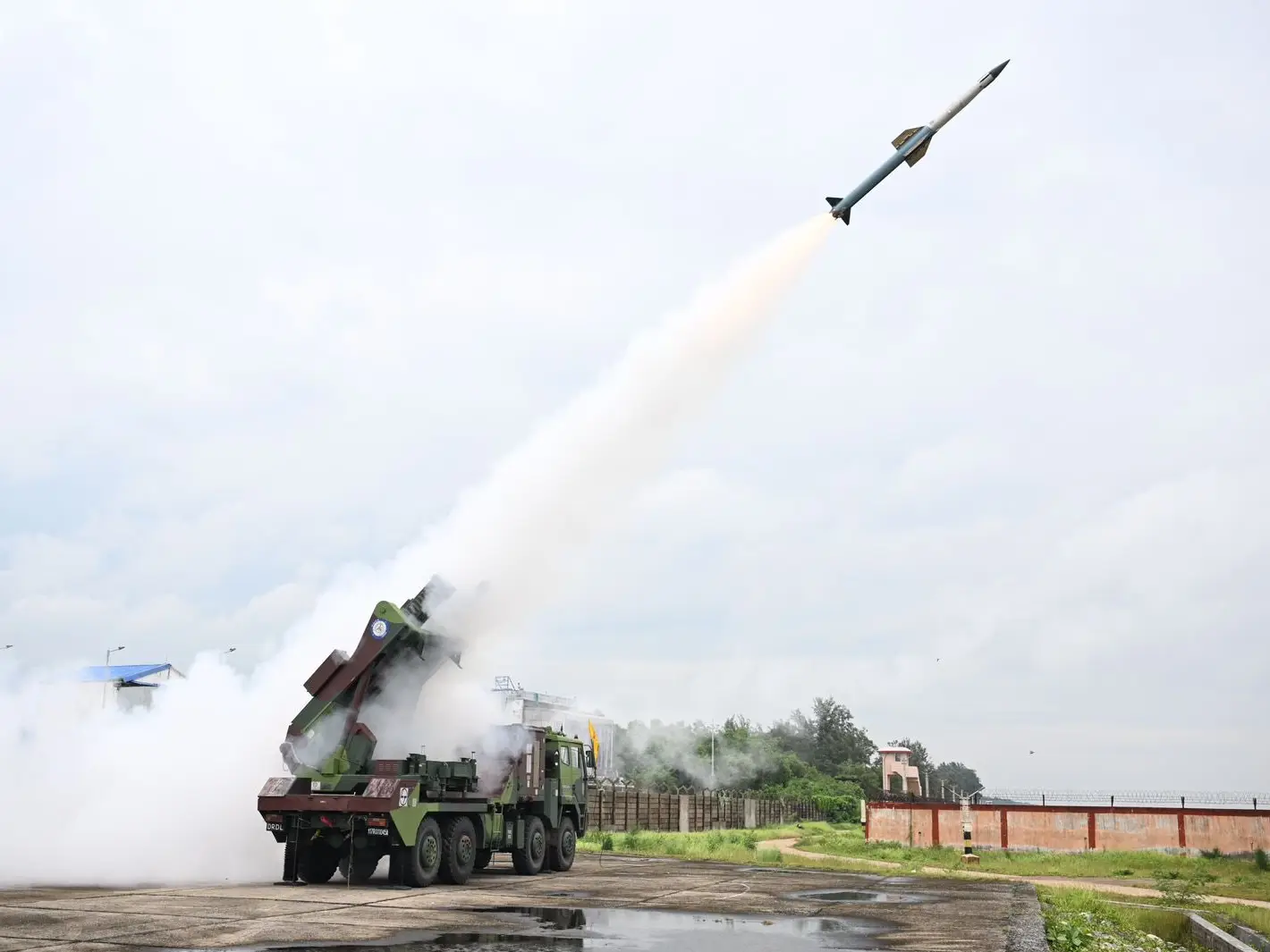
India's Defence Research and Development Organisation (DRDO) successfully held the flight test of the Integrated Air Defence Weapon System (IADWS). The test took place on Saturday (Aug 23), off the Odisha coast. This marks a crucial step towards India’s ambitious Mission Sudarshan Chakra, a comprehensive indigenous air defence shield. The hope is to create a shield similar to Israel’s Iron Dome by 2035. India even aims to expand the scope of Sudarshan Chakra beyond Iron Dome, envisioning it for a subcontinent-level theatre with both defensive and offensive capabilities.
IADWS would be perhaps India’s most ambitious defence mission with far-reaching consequences
IADWS is aimed at integrating different systems to tackle aerial threats like drones, loitering munitions, cruise missiles, and high-speed aircraft. The system will offer surveillance, battle management, and weapon control.
What are the components of India’s air defence system?
What you should know about QRSAM, VSHORADS and DEW
QRSAM, VSHORADS, and DEW are the core components of IADWS. QRSAM, or Quick Reaction Surface-to-Air Missile, is a short-range system with a range of 25 to 30 kilometres, which can target aircraft, helicopters, cruise missiles, and glide bombs. It is capable of engaging multiple threats simultaneously.
Trending Stories
&imwidth=180&imheight=135&format=webp&quality=medium)
Cornell University suspends fraternity parties over 2024 gang rape allegations
&imwidth=180&imheight=135&format=webp&quality=medium)
'Don't ever mess with nature!': Trump’s tiger attack post triggers social media backlash as victim's family issues heartbreaking tribute
&im=FitAndFill=(700,400)&imwidth=180&imheight=135&format=webp&quality=medium)
Navratri 2026: 9 days, 9 forms of Goddess Durga and 9 colours- Check the complete list
&imwidth=180&imheight=135&format=webp&quality=medium)
MI5 chief warns Russia is UK’s ‘aggressor number one’ as Iran and AI threats grow
&imwidth=180&imheight=135&format=webp&quality=medium)
UK school ditches technology, shifts from screen to pen and paper for learning
&imwidth=180&imheight=135&format=webp&quality=medium)
Sidhu Moose Wala’s younger brother wins hearts by recreating late singer’s signature move at Toronto Hologram Show
&im=FitAndFill=(700,400)&imwidth=180&imheight=135&format=webp&quality=medium)
IMF World Economic Outlook: 10 economies to watch for growth in FY27 and FY28 - Where does India stand?
&imwidth=180&imheight=135&format=webp&quality=medium)
Blasts heard in Sanaa as Saudi-led coalition warns civilians to evacuate; Houthis vow retaliation
&imwidth=180&imheight=135&format=webp&quality=medium)
UEFA Champions League: Atletico Madrid sink Manchester United as Viking FK hold Bayern Munich to 3-3 draw
&imwidth=180&imheight=135&format=webp&quality=medium)
Robot gropes girl, makes thrusting movements in bizarre crime in Germany
&imwidth=180&imheight=135&format=webp&quality=medium)
1,500 drones illuminate Mumbai sky as Cordelia Cruises unveils second ship, Cordelia Sky
&imwidth=180&imheight=135&format=webp&quality=medium)
Measles kills again: 6 dead in Pennsylvania as America faces its worst outbreak in decades | Gravitas
&imwidth=180&imheight=135&format=webp&quality=medium)
Girl 'dead' for 8 hours wakes up at her own funeral, dad insists she wasn't breathing
&imwidth=180&imheight=135&format=webp&quality=medium)
Is the AI chip boom already over? Global semiconductor stocks slide as investors question unbridled spending
&imwidth=180&imheight=135&format=webp&quality=medium)
Anupam Kher joins Ranbir Kapoor's Ramayana as Jatayu, new poster unveiled
&imwidth=180&imheight=135&format=webp&quality=medium)
CMs Vijay-Naidu meet in Vijayawada, discuss water sharing, river-linking
&imwidth=180&imheight=135&format=webp&quality=medium)
New Delhi rejects Beijing’s claims and remarks on Ladakh location naming exercise
&imwidth=180&imheight=135&format=webp&quality=medium)
Trump reconsidering calling off Nidal Hasan's execution livestream. Here's why
&im=FitAndFill=(700,400)&imwidth=180&imheight=135&format=webp&quality=medium)
New OTT releases this week (October 12-18, 2026): Sacrifice, Koffee with Karan S9, Roadies Rebirth- 6 titles coming on Netflix, JioHotstar and more
&imwidth=180&imheight=135&format=webp&quality=medium)
Suicidal man survives jump from 11th floor in Japan, could now be tried for murder
&imwidth=180&imheight=135&format=webp&quality=medium)
France accuses Musk of ‘online harassment’ of European leaders, warns of poll interference
&imwidth=180&imheight=135&format=webp&quality=medium)
OpenAI employee arrested by FBI after allegedly hiding recording device in office
&imwidth=180&imheight=135&format=webp&quality=medium)
Ken Paxton's Dubai night out with two US fugitives sparks political storm as Texas Senate race tightens
&imwidth=180&imheight=135&format=webp&quality=medium)
Pope Leo XIV diagnosed with lung cancer after surgery, Vatican says 'successful surgery and recovering'
&imwidth=180&imheight=135&format=webp&quality=medium)
Trump accuses Houthis of driving up oil prices before US midterms, warns of consequences
&imwidth=180&imheight=135&format=webp&quality=medium)
China's counter-surveillance industry booms amid heightened espionage fears | Gravitas
&imwidth=180&imheight=135&format=webp&quality=medium)
'Ouch!!! That must hurt': Kangana Ranaut hails Kamal Haasan's sharp reply to Elon Musk over Starlink row
&imwidth=180&imheight=135&format=webp&quality=medium)
US Midterms 2026: In Alaska, cost-of-living anxiety meets strangest ballot in high-stakes Senate race
&imwidth=180&imheight=135&format=webp&quality=medium)
Mundhe: Fight against unsafe food goes on
&imwidth=180&imheight=135&format=webp&quality=medium)
‘My president, I mean my husband’: Trump's new press secretary Katie Zacharia's first briefing goes off the rails in 14 minutes
&imwidth=180&imheight=135&format=webp&quality=medium)
Marco Rubio to visit India next week, focus on energy cooperation and strategic ties
&imwidth=180&imheight=135&format=webp&quality=medium)
'Turn approver, resign, we'll forgive you': Rahul Gandhi claims receiving messages from CEC Gyanesh Kumar
&imwidth=180&imheight=135&format=webp&quality=medium)
Pakistan to chair UN-backed global Borrowers’ Platform as its own debt burden mounts, triggers sarcastic reactions on social media
&imwidth=180&imheight=135&format=webp&quality=medium)
Delhi Police arrest Cockroach Janta Party's Saurav Das, Ashutosh Ranka, Ajinkya Shinde in Jantar Mantar case, to be produced before court
&imwidth=180&imheight=135&format=webp&quality=medium)
Saudi Arabia strikes Yemen oil sites as Houthi missiles target Riyadh; 'limited fire' breaks out at Aramco
&imwidth=180&imheight=135&format=webp&quality=medium)
L Murugan resigns as Union Minister, expresses wish to return to grassroots
VSHORADS, which stands for Very Short-Range Air Defence System, is a man-portable system with a range of up to 6 kilometres. It has an uncooled imaging infrared seeker and is designed to target aircraft, drones, and helicopters.
DEW, or Directed Energy Weapon, is a laser-based weapon system with unlimited firing capacity. Capable of disabling drone electronics at close range, DEW is a cost-effective option for tackling multiple threats.
The IADWS system is managed by a centralised command and control centre developed by the Defence Research & Development Laboratory (DRDL), which coordinates missile systems, radars, and communication networks.
Also read: 'You mean Sudarshan Chakra?' Russian diplomat responds on being asked about India’s Iron Dome
Proudly Indian: IADWS is an indigenous defence system
According to reports, all technologies used in IADWS have been developed in India, another feather in the Atmanirbhar Bharat (self-reliant India) initiative. The IADWS system integrates with the Indian Air Force’s Integrated Air Command and Control System (IACCS) and the Indian Army’s Akashteer battlefield management network, aiming to be a comprehensive defence and offence system against enemy targets.
How IADWS was tested
During the Saturday test, IADWS successfully destroyed three aerial targets simultaneously: two high-speed unmanned aerial vehicles (UAVs) and one multicopter.
IADWS demonstrated flawless coordination among its missile, laser, and detection subsystems during the test.
IADWS is designed to tackle nuclear and hypersonic weapons threats too
As mentioned, IADWS aims to be more expansive than Israel’s Iron Dome. Designed to be scalable and versatile, it intends to build a robust, large-scale defence against nuclear, hypersonic, and drone-based threats.
IADWS can eventually be adapted to protect both military and civilian infrastructure of India.
A strategic asset for India: precision and reliability like Sudarshan Chakra
The strategic value of IADWS lies in its precision and reliability, inspired by the mythical Sudarshan Chakra, the all-destroying discus weapon of Lord Vishnu.
It has drawn lessons from Indian defence forces’ experience during Operation Sindoor against Pakistan, where India successfully countered drone and missile attacks from the neighbouring country.
The IADWS is only the beginning. Mission Sudarshan Chakra is much bigger
IADWS could be a part of Mission Sudarshan Chakra, but not the complete system, which is far more ambitious.
The broader Sudarshan Chakra mission aims to create a nationwide, integrated defence shield by 2035.
Sudarshan Chakra will incorporate defensive and offensive capabilities across air, land, sea, cybersecurity, and surveillance.
This means Sudarshan Chakra will cover a larger territory to address more complex threats.
Rakshak-Suraksha Kavach is India’s other defence system
At Aero India 2025, DRDO also showcased Rakshak-Suraksha Kavach, another indigenous multi-layered defence system.
Still in the design stage, Rakshak Kavach features similar technologies, including QRSAM, VSHORADS, and DEW.
It may serve as a complementary or parallel system under the Sudarshan Chakra initiative.

