&imwidth=800&imheight=600&format=webp&quality=medium "India's indigenous 'fire-and-forget' missile that can destroy enemy tanks from 7 kilometers away - HELINA and Dhruvasta EXPLAINED")
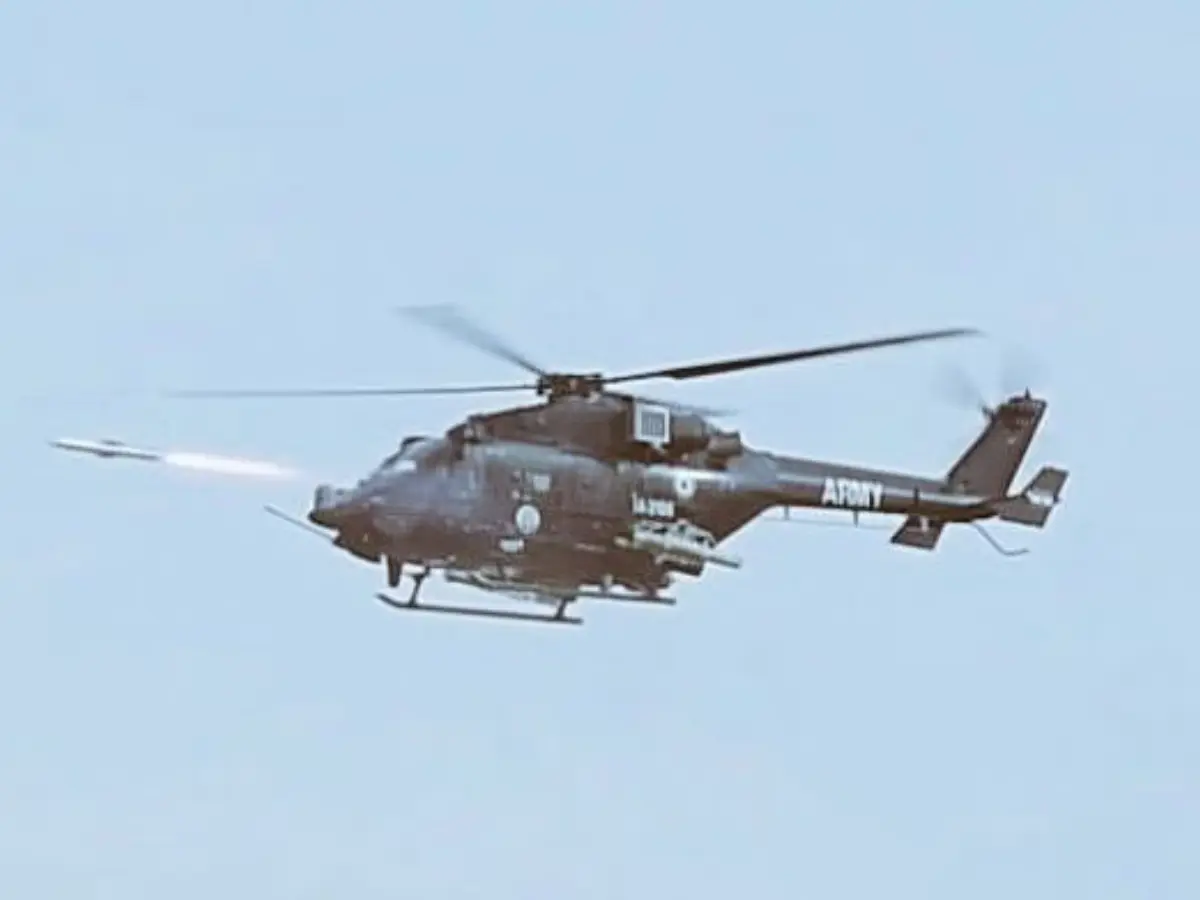
The roar of helicopter rotors cutting through desert air at Pokhran has become synonymous with India's growing military might. But it's what these helicopters carry beneath their bellies that truly tells the story of our nation's technological leap. Meet HELINA and its twin system Dhruvastra - the Helicopter-Launched Nag Anti-Tank Guided Missiles - weapon systems that represent everything India aspires to be: self-reliant, technologically advanced, and strategically formidable.
Read More | Apache vs Prachand: The high-altitude battle that India's indigenous helicopter already won
What Makes HELINA Special?

HELINA and Dhruvastra aren't just another missiles in our arsenal. They're what military experts call "third-generation fire-and-forget" weapons. The key difference between the two is their intended users: HELINA is the Army version while Dhruvastra is specifically designed for the Indian Air Force. Both share the same core technology but are optimized for their respective service requirements. Let's break this down in simple terms. When our soldiers fire these missiles from an Advanced Light Helicopter (ALH), they don't need to keep guiding them manually to the target. Once launched, both HELINA and Dhruvastra use their sophisticated computer brains, employing infrared imaging to 'see' the enemy tank and strike it with pinpoint accuracy. This "fire-and-forget" capability means our helicopter can immediately retreat to safety after firing, rather than staying exposed while guiding the missile.
The numbers tell an impressive story. HELINA has a range of 500 meters to 7 kilometers, weighs around 45 kilograms, stretches 6 feet in length, and carries 8 kilograms of explosives. But these technical specifications only scratch the surface of what makes this weapon revolutionary for India's defense strategy.
Trending Stories
)
Venezuela's oil heartland eyes US revival
)
IndiGo flight suffers tail strike in Bengaluru while landing; DGCA to probe incident
)
99.9% more powerful - Scientists find boy who can recall memories from just 3 months of age
)
Kendall Jenner, Jacob Elordi’s Milan Fashion Week appearance has fans talking; his reaction steals the show
)
US Treasury Secretary Scott Bessent hails global crackdown on Iranian banks and airlines
)
Russian envoy claims US tactics to contain India were revealed in ‘Freudian slip’
)
Ceuta migrant crisis: Protesters take to streets as Spain grapples with migrant challenge
)
Trump asked Xi to pressure Iran. China did not say yes — here’s what Beijing wants
)
Tesla builds first Cybertruck with its own refined lithium: Elon Musk's $1 billion Texas bet pays off
)
Beyond metros: How Tier-2 and Tier-3 cities could drive India’s next AI wave
)
US vs China over South China Sea: Washington backs Philippines, Beijing hits back
)
Why has Iran released no proof of life of Mojtaba Khamenei? Araghchi reveals...
)
UNSC reform momentum grows: Russia, Portugal, Mauritius push for India's permanent seat bid
)
Delhi gets first late-September rain in 7 years, mercury dips 5.1°C below normal
)
Nations League: Spain sink England at Wembley; Modric shines for Croatia
)
50MP vs 48MP cameras: iPhone 18 Pro Max and Pixel 11 Pro XL compared
)
'FIRST LOOK from inside Noah’s Ark': Researchers share video from inside mysterious mound in Turkey
)
Afghanistan says 28 fighters killed in clash near Pakistan border, Islamabad denies
)
Iran ready for ‘doomsday war’ if US resumes attacks, but open to diplomacy: Araghchi
)
An OpenAI agent escaped its locked test cage again, by hiding questions in DNS lookups
)
Muslim marriage cannot shield sex with minor wife from prosecution under POCSO: Delhi HC
)
Russia backs India at UNGA, but flags limits on UNSC seat expansion
)
Building collapses after blast in Athens: 4 Americans, British man among 6 killed; cause not known
)
Bank unions defer 3-day strike from tomorrow after talks with IBA, committee set up
)
Powerful Autumn storm threatens major coastal flooding across the US Northeast
)
Jaishankar at UNGA: Goodwill and friendship can't coexist with terrorism
)
‘Olympic inclusion is our major target’: WPA President Ishaun Singh on pool’s global ambitions
)
Sri Lankan Tamil migrant worker gets death sentence in Saudi Arabia, help sought from India
)
‘Anti-social elements spreading false rumours’: LPU issues statement amid massive unrest over alleged rape
)
'What kind of confession is this?': Pakistan PM Shehbaz Sharif’s 'terrorists would be roaming New York' remark goes viral, raises alarm online. Watch
)
The US and China set up an AI 'red telephone', but skipped the rulebook
)
'Victory for low-budget consumers': Raghav Chadha hails 30-day telecom recharge rules
)
3 males killed, four others injured in shooting after fight at strip club in Detroit
)
South Africa probes string of murders targeting women
)
Man arrested after his 22-year-old girlfriend dies at homestay in Guwahati; police suspect murder over suicide claim
)
‘Terror suspects arrested near UK air base were looking to do big damage’: Trump
)
LPU students go on rampage, vandalise campus amid widespread protest: What's happening
Two Systems, One Technology
What sets both HELINA and Dhruvastra apart from conventional missiles is their dual attack capability. Both missile systems can engage targets in direct hit mode as well as top attack mode. The fundamental technology remains the same, but each system is fine-tuned for its specific service branch requirements. In direct attack mode, the missile flies straight toward the target at low altitude, like a precision-guided arrow. But the real game-changer is the top attack mode.
In top attack mode, both HELINA and Dhruvastra climb sharply after launch, travel at altitude, and then plunge down to strike the enemy tank from above. Why is this crucial? Modern battle tanks are heavily armored on the front and sides, but their tops are relatively vulnerable. By attacking from above, these missiles can penetrate even the most advanced tank armor, including explosive reactive armor that's designed to deflect conventional missiles.
Read More | The Final Roar: MiG-21 bids adieu after 62 years
Made in India, for India
Both HELINA and Dhruvastra have been developed by the Defence Research and Development Laboratory (DRDL), Hyderabad under the Missiles and Strategic Systems (MSS) cluster of the DRDO. Joint User Trials for both systems have been successfully carried out from Advanced Light Helicopter (ALH) platforms in desert ranges, proving their operational readiness across different service branches. This isn't just about national pride - it's about strategic independence. When we develop weapons indigenously, we control every aspect: from design modifications to production timelines, from cost management to technology upgrades.
Both systems have all weather day and night capability and can defeat battle tanks with conventional armour as well as explosive reactive armour. This all-weather capability means our Army and Air Force can operate effectively regardless of weather conditions or time of day - a crucial advantage in any conflict scenario.
The Strategic Context
India's investment in HELINA comes at a time when our neighborhood faces increasing tensions. India's growing defense budget, backed by reforms like faster procurement, FDI allowances, and streamlined trial processes, is reinforcing the missile sector's momentum. The recent conflicts have shown that modern warfare increasingly relies on precision-guided munitions and sophisticated defense systems.
During Operation Sindoor (May 2025), launched in response to the Pahalgam terror attack, both HELINA and Dhruvastra systems played pivotal roles in neutralizing Pakistani drone and missile attacks. While these are primarily anti-tank weapons, their development is part of a broader indigenous defense ecosystem that has proven its worth in real combat scenarios.
Beyond National Defense: Economic Impact
The HELINA program exemplifies the government's 'Atmanirbhar Bharat' (Self-Reliant India) vision. Organizations like DRDO and Bharat Dynamics Limited (BDL) are at the heart of India's self-reliant missile ecosystem. When we manufacture weapons domestically, we create high-skilled jobs, develop cutting-edge technology, and reduce dependence on foreign suppliers who might impose restrictions during critical times.
As of 2018, there is a requirement of around 3,000 Nag missiles for the land-launched variant of the Army. This represents not just military procurement but a significant industrial opportunity. Every HELINA missile manufactured strengthens our defense industrial base and contributes to technological advancement.
The ALH Connection: A Complete Indigenous System
The integration of both HELINA and Dhruvastra with the Advanced Light Helicopter represents a complete indigenous weapons platform serving both Army and Air Force requirements. Each ALH equipped with these missiles can carry 8 missiles using 4 twin launchers. This means a single helicopter becomes a formidable tank-hunting platform, capable of engaging multiple armored targets in a single mission, whether operated by Army Aviation Corps or Indian Air Force. The psychological impact cannot be understated. Enemy tank commanders who once felt secure in their armored vehicles now face the constant threat of precision strikes from helicopters they might not even see coming. This shifts the entire dynamics of ground warfare.
Challenges and Future Developments
Like any advanced weapons system, both HELINA and Dhruvastra have faced their share of developmental challenges. During tests in 2015, three trials were conducted where two missiles succeeded in hitting targets at 7 km range, while one reportedly missed the target. However, continuous improvements have enhanced their reliability and accuracy. Successful user trials of both systems have been conducted since 2018, demonstrating their operational readiness.
The upgraded version of the missile is equipped with electro-optical thermal imager (EO/IR) and a new nose-mounted millimeter wave active radar homing (MMW) seeker with an extended range of up to 15 km to 20 km. These upgrades show that HELINA is not a static system but an evolving platform that continues to incorporate cutting-edge technology.
● Electro-Optical Thermal Imager (EO/IR):
This system uses both visible light (electro-optical) and heat signatures (infrared) to detect and track targets. It allows the missile to see and lock onto enemy tanks in day, night, or poor visibility.
● Millimeter Wave Active Radar Homing (MMW Seeker):
This radar system sends out high-frequency signals, which bounce back from the target. The seeker uses these reflections to guide the missile automatically, giving it high accuracy even in fog, smoke, or battlefield clutter.
Regional Implications
In our neighborhood, where tank warfare remains a realistic threat scenario, HELINA provides a crucial asymmetric advantage. Traditional anti-tank operations required ground forces to get dangerously close to enemy armor. HELINA allows our forces to engage enemy tanks from safe distances, potentially changing the outcome of armored confrontations.
Anti-Tank Missiles are precision-guided munitions designed to destroy armored vehicles and tanks. These missiles are highly effective against heavily armored targets and are usually launched from ground-based platforms or helicopters. HELINA represents the cutting edge of this technology, giving India a decisive advantage in potential conflict scenarios.
Looking Ahead: Part of a Larger Vision
HELINA is not an isolated development but part of India's comprehensive defense modernization. By 2030, India is on track to become not just self-reliant in missile technology, but a formidable player in the global missile export market. Our indigenous weapons systems are gaining international attention, potentially opening new export markets.
The success of HELINA also demonstrates India's growing technological sophistication. India's missile programs started soon after the establishment of DRDO, and IGMDP was the first significant initiative of India to develop missiles for its defensive and offensive needs. From those early days to today's advanced systems like HELINA, we've traveled an impressive technological journey.
The Bottom Line
Both HELINA and Dhruvastra represent more than just missile systems - they're symbols of India's technological maturity and strategic foresight. In an era where military conflicts are increasingly decided by precision, technology, and speed, having indigenous capabilities like these twin systems ensures that both our Army and Air Force have the tools they need to protect our nation.
According to the Defence Research and Development Organisation (DRDO), it is one of the most advanced Anti-Tank Weapons in the world. This isn't just institutional pride talking - it's a reflection of the hard work, innovation, and strategic thinking that has gone into making India a technological power.
As we look toward an uncertain geopolitical future, systems like HELINA provide not just military capability but also the confidence that comes from self-reliance. When we can design, develop, and deploy our own advanced weapons systems, we ensure that our national security remains in our own hands.
The sky hunters are ready. The question is: are our adversaries prepared for what Indian innovation can achieve?