
&imwidth=800&imheight=600&format=webp&quality=medium "Apache vs Prachand: The high-altitude battle that India's indigenous helicopter already won")
The question isn't whether HAL's indigenous helicopters can compete with the legendary Apache AH-64E—it's whether we're asking the right question at all. As the first Apache helicopters finally touched down at India's Hindan Air Force Station last month after months of delays, and with India simultaneously committing ₹62,700 crore to 156 additional Prachand helicopters, the real story isn't about fierce competition but strategic complementarity.
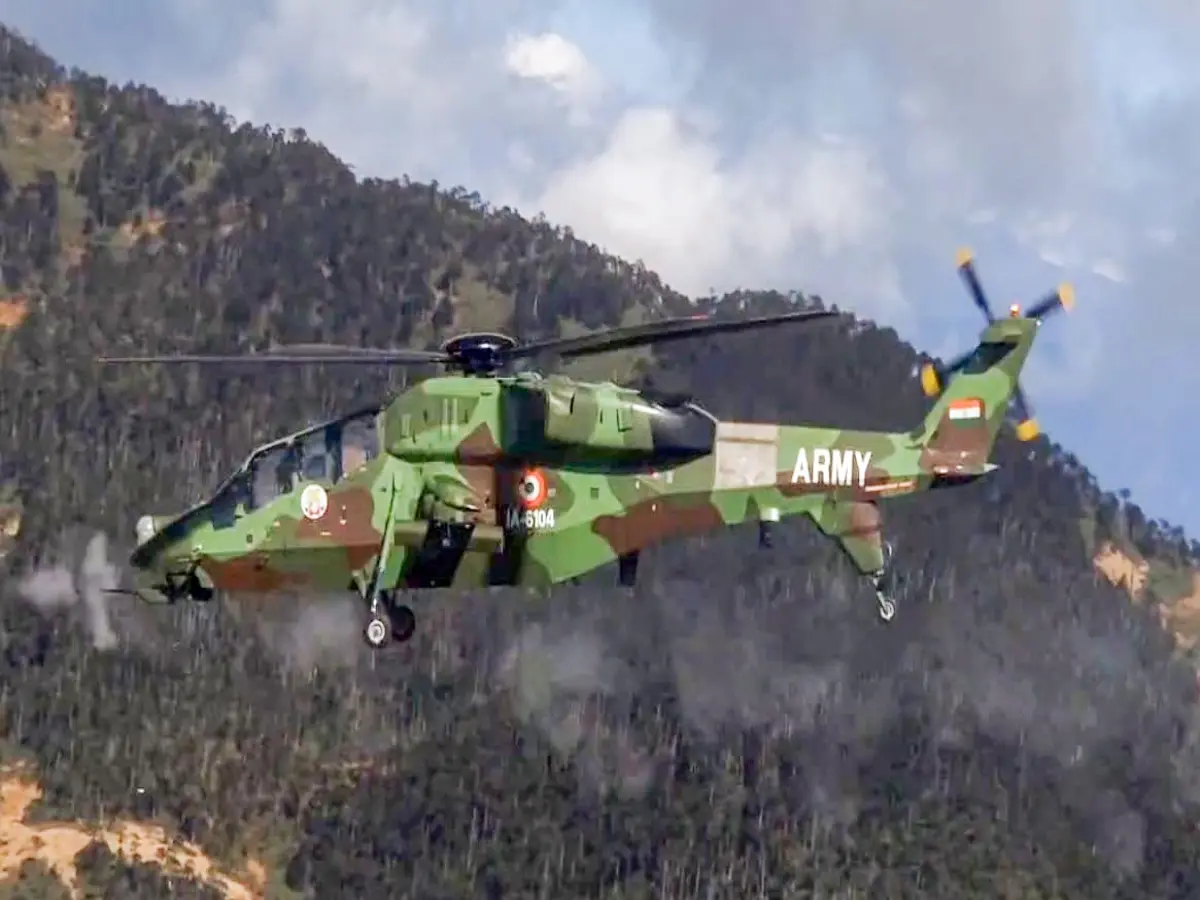
Yet beneath this pragmatic division of labor lies a profound shift that defense analysts worldwide should note: India's indigenous Light Combat Helicopter Prachand has achieved something the mighty Apache cannot—dominance in the world's highest battlefields.
The Myth of Direct Competition

The defense media loves a good versus story, but the HAL Rudra versus Apache narrative misses the mark entirely. The real competition has been between the newer LCH Prachand and the Apache, and it's already over in the domain that matters most for India's security: high-altitude warfare.
Consider the stark operational reality: while the Apache has faced reported challenges in high-altitude conditions, the Prachand has been conducting routine operations at altitudes that would significantly limit most attack helicopters worldwide. This isn't just about technical specifications—it's about strategic autonomy in India's most critical theater.
Where Physics Meets Geopolitics
Trending Stories
)
US vs China over South China Sea: Washington backs Philippines, Beijing hits back
)
Bigg Boss 20: Isha Rikhi evicted after three weeks in Salman Khan’s show
)
Musk plans to more than double xAI's chips to over 1.2 million Nvidia GPUs by year-end
)
After JU, clash erupts at SRFTI: BJP’s ‘Dimagi Naxal’ jibe sparks political firestorm after students protest RSS-linked event
)
‘Anti-social elements spreading false rumours’: LPU issues statement amid massive unrest over alleged rape
)
LPU students go on rampage, vandalise campus amid widespread protest: What's happening
)
Trump asked Xi to pressure Iran. China did not say yes — here’s what Beijing wants
)
US Treasury Secretary Scott Bessent hails global crackdown on Iranian banks and airlines
)
An OpenAI agent escaped its locked test cage again, by hiding questions in DNS lookups
)
'Our video was trimmed': LPU girls who featured in rape-denial video make U-turn
)
3 males killed, four others injured in shooting after fight at strip club in Detroit
)
'Victory for low-budget consumers': Raghav Chadha hails 30-day telecom recharge rules
)
Claude rebuilt the 1989 game 'Prince of Persia' by reusing the original's own code
)
Beyond metros: How Tier-2 and Tier-3 cities could drive India’s next AI wave
)
Tesla builds first Cybertruck with its own refined lithium: Elon Musk's $1 billion Texas bet pays off
)
IndiGo flight suffers tail strike in Bengaluru while landing; DGCA to probe incident
)
The US and China set up an AI 'red telephone', but skipped the rulebook
)
‘Terror suspects arrested near UK air base were looking to do big damage’: Trump
)
Russian envoy claims US tactics to contain India were revealed in ‘Freudian slip’
)
IND vs WI 1st ODI: Kohli breaks Sachin's most runs in one country record with unbeaten 139 as India thump West Indies by 8 wickets
)
Researchers rebuilt exactly how 700 AI agents hacked Hugging Face: a 900-link chain trick
)
‘Olympic inclusion is our major target’: WPA President Ishaun Singh on pool’s global ambitions
)
Nations League: Spain sink England at Wembley; Modric shines for Croatia
)
Why has Iran released no proof of life of Mojtaba Khamenei? Araghchi reveals...
)
'What kind of confession is this?': Pakistan PM Shehbaz Sharif’s 'terrorists would be roaming New York' remark goes viral, raises alarm online. Watch
)
South Korea demands apology from Ukraine over North Korean prisoners' transfer
)
Beyond BrahMos: India targets Rs 50,000 crore in defence exports with unmatched price edge
)
Sri Lankan Tamil migrant worker gets death sentence in Saudi Arabia, help sought from India
)
Muslim marriage cannot shield sex with minor wife from prosecution under POCSO: Delhi HC
)
'Can't help but draw painful parallels to Nirbhaya case': SC on latest incidents of rape cases in Delhi-NCR
)
99.9% more powerful - Scientists find boy who can recall memories from just 3 months of age
)
'FIRST LOOK from inside Noah’s Ark': Researchers share video from inside mysterious mound in Turkey
)
UNSC reform momentum grows: Russia, Portugal, Mauritius push for India's permanent seat bid
)
8 US marines injured in Iranian missile attack on vessel in Strait of Hormuz: Report
&im=FitAndFill=(700,400))
New OTT releases this week (September 28-October 4, 2026): Dupahiya 2, Pooja Meri Jaan, Ohh My Dog- 5 titles coming on Netflix, Prime Video and more
)
Afghanistan says 28 fighters killed in clash near Pakistan border, Islamabad denies
)
Ceuta migrant crisis: Protesters take to streets as Spain grapples with migrant challenge
)
LPU suspend classes, postpones exams as violence escalates over rape claims: What's happening
)
New York City wants a 'kill switch' on every AI, and will pay whistleblowers who report violations
The physics are unforgiving at altitude. Engine performance and payload capacity drop dramatically in thin air, and what works at sea level becomes potentially lethal at 15,000 feet. While the Apache, despite its formidable reputation and powerful engines, has a service ceiling of around 6,400 meters (21,000 feet), the Prachand operates comfortably up to 6,500 meters (21,300 feet) and has demonstrated landing capabilities at 4,800 meters (15,800 feet) on the Siachen Glacier, which is the world's highest battleground.
This isn't merely academic. In an era where India faces its most serious border tensions with China in decades, the ability to project power in the Himalayas isn't just advantageous—it's existential. The Prachand's unique capability to operate where no other attack helicopter can effectively function gives India an asymmetric advantage that money cannot buy from foreign suppliers.
The Economics of Strategic Independence
Beyond operational superiority in high-altitude warfare, the Prachand represents something equally important: proof that indigenous development can deliver world-class capabilities at a fraction of foreign costs. At approximately $50 million per unit (₹ 438 Crores) compared to the Apache's estimated $100 million(₹ 877 Crores) price tag, India can field twice as many Prachands for the same budget.
But the true value proposition extends beyond unit costs. Indigenous production means indigenous control—over maintenance, upgrades, production timelines, and most critically, geopolitical independence. The reported Apache delays due to U.S. supply chain issues (such as the recent 15-month delay in the Army's Apache deliveries) serve as a stark reminder of the vulnerabilities inherent in foreign dependency, especially for critical defense capabilities.
Redefining Victory in Military Procurement
The question of who "wins" between these platforms reveals outdated thinking about military competition. Modern warfare demands specialized solutions for specialized environments. The Apache remains unquestionably superior for desert tank warfare, urban operations, and conventional battlefields where its heavy firepower and proven systems shine. Its advanced systems like the Longbow radar and ability to control UAVs are significant advantages.
However, in the specific context of India's strategic challenges—where high-altitude operations along disputed borders represent the most likely conflict scenarios—the Prachand doesn't just compete with the Apache; it surpasses it in the only arena that truly matters for Indian security.
Lessons for Global Defense Strategy
India's approach offers broader lessons for nations developing indigenous defense capabilities. Rather than attempting to replicate foreign systems wholesale, focus on solving unique national challenges that existing platforms cannot address effectively. The Prachand succeeded not by trying to be another Apache, but by being something the Apache could never be: a high-altitude attack helicopter optimized for Himalayan warfare.
This specialization strategy is increasingly relevant as military technologies become more sophisticated and operational environments more diverse. The era of one-size-fits-all platforms is ending, replaced by mission-specific solutions that excel in particular domains.
The Verdict
In the fierce competition between indigenous innovation and proven foreign technology, there is no universal winner—only strategic relevance. The Apache remains the gold standard for global attack helicopter operations, with unmatched combat experience and raw firepower. But in the thin air of the Himalayas, where India's most critical security challenges await, the Prachand has already won a competition the Apache never truly entered.
As geopolitical tensions continue to rise and supply chain vulnerabilities become national security concerns, India's success with the Prachand demonstrates that strategic independence isn't just about pride—it's about ensuring that when the stakes are highest, your military capabilities aren't dependent on someone else's decisions.
The real competition isn't between helicopters—it's between dependence and autonomy. And in that competition, the Prachand's victory is complete.
