

&imwidth=800&imheight=600&format=webp&quality=medium "Swiss President Parmelin backs India's push to democratise AI for all nations")
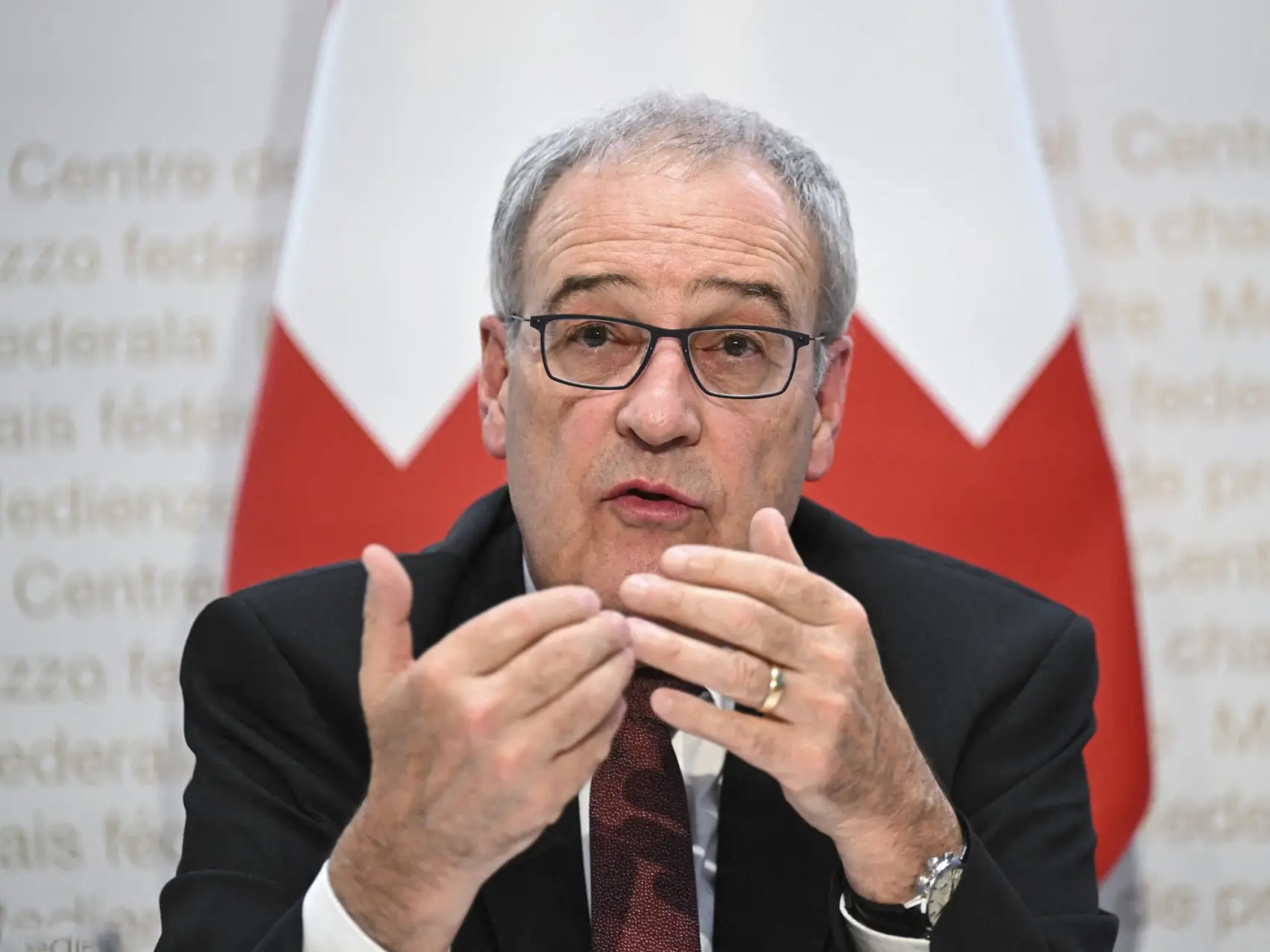
Swiss President Guy Parmelin has emphasised the shared commitment between Switzerland and India to ensuring artificial intelligence benefits all people and cultures, rather than a privileged few. Speaking to WION's Sidhant Sibal, ahead of the India AI summit, Parmelin said: "Switzerland and India share many values and the vision that AI should be accessible and should benefit every person and every culture, not just a few privileged ones"
As Switzerland gears up to host the AI Summit in Geneva in 2027, the president stressed building on previous gatherings, including the New Delhi summit. "As Switzerland prepares for the AI Summit in Geneva in 2027, we want to build on the achievements of the summits held so far, in particular the summit in New Delhi"
Parmelin also endorsed the need for diverse AI ecosystems. "Switzerland agrees with India that it is important for our societies and economies to not just be users of AI models built by others, but also to have ecosystems that allow us to develop the models and create the data ourselves"
Also read | Galgotias University blames professor Neha Singh's 'enthusiasm of being on camera' for AI robodog row
Full interview:
WION: On bilateral ties and TEPA: Switzerland and India have enjoyed strong relations for decades, culminating in the Trade and Economic Partnership Agreement (TEPA) between India and EFTA entering into force in October 2025, with commitments to $100 billion in investments and job creation. As President, how do you envision this agreement further strengthening economic cooperation between our two countries in the coming years?
Trending Stories
&imwidth=180&imheight=135&format=webp&quality=medium)
'Hell of a beautiful a**': Trump compliments Nicki Minaj as rapper joins him in Michigan rally
&imwidth=180&imheight=135&format=webp&quality=medium)
'Hire the robot, fire the human': Bill Gates's words hint at a bleak future
&imwidth=180&imheight=135&format=webp&quality=medium)
'Lousy president': Trump hits back at Obama over 'cheesecake factory' White House jibe
&imwidth=180&imheight=135&format=webp&quality=medium)
Student-led movement ousts Serbia's longtime leader as protests rage across Europe | GRAVITAS
&imwidth=180&imheight=135&format=webp&quality=medium)
Cameroon unveils school-based migration clubs to support young people’s migration choices
&imwidth=180&imheight=135&format=webp&quality=medium)
Jordan strikes 'terrorist organisations' in Syria after deadly church attack as Damascus shuts main border crossing
&imwidth=180&imheight=135&format=webp&quality=medium)
Microsoft offers voluntary exit packages to 60,000 employees in India, US, UK and Canada
&imwidth=180&imheight=135&format=webp&quality=medium)
Harry Kane favourite to win 2026 Ballon d’Or ahead of Lamine Yamal and Kylian Mbappé
&imwidth=180&imheight=135&format=webp&quality=medium)
'He is a red flag': Ex-India strength and conditioning coach on Rohit's fitness regime
&imwidth=180&imheight=135&format=webp&quality=medium)
Maurene Comey, daughter of ex-FBI director James Comey, was unlawfully fired as federal prosecutor, judge rules
&imwidth=180&imheight=135&format=webp&quality=medium)
‘That is a miss’: Ravi Ashwin questions Sooryavanshi’s demotion to No. 3 in 2nd T20I vs NZ
&imwidth=180&imheight=135&format=webp&quality=medium)
Hijack scare unfolds on United flight over suspicious text message. Here is what happened
&imwidth=180&imheight=135&format=webp&quality=medium)
Pakistan airline PIA unveils new crew uniforms, faces online criticism
&imwidth=180&imheight=135&format=webp&quality=medium)
'Skinwalker' sightings in Utah from 2010 detailed in new UFO Files
&im=FitAndFill=(700,400)&imwidth=180&imheight=135&format=webp&quality=medium)
New OTT releases this week (October 26-November 1, 2026): Baththa, Akka, The One About Matthew Perry- 7 titles coming on Netflix, Prime Video and more
&imwidth=180&imheight=135&format=webp&quality=medium)
Elon Musk’s Grok releases first AI-generated Odyssey episode, months after promising ‘historically accurate’ full-length film
&imwidth=180&imheight=135&format=webp&quality=medium)
US Midterms 2026: Last leg polls and forecasts indicate Democratic momentum, but Senate control remains uncertain
&imwidth=180&imheight=135&format=webp&quality=medium)
'Already tired of his 9-to-5': Baby born with a moustache becomes internet sensation, video goes viral | Watch
&imwidth=180&imheight=135&format=webp&quality=medium)
Zimbabwe slips four places to 14th out of 29 in Africa’s Digital Rights and Inclusion ranking
&imwidth=180&imheight=135&format=webp&quality=medium)
Maldives opposition leader demands transparency on Muizzu Govt's Pakistan defence, security deals
&imwidth=180&imheight=135&format=webp&quality=medium)
'She is a beautiful woman': Trump mocks Mexican President Sheinbaum, mimics her voice at US Midterms rally
&imwidth=180&imheight=135&format=webp&quality=medium)
At least five shot dead in Guwahati hotel over suspected property dispute, police launch investigation
&imwidth=180&imheight=135&format=webp&quality=medium)
Uttarakhand innovator Ravi Tamta builds flying car without any formal engineering degree
&imwidth=180&imheight=135&format=webp&quality=medium)
Trump offers $1 million before US midterms. What is he asking Americans to report?
&imwidth=180&imheight=135&format=webp&quality=medium)
‘All 3 SIR orders unanimous,’ EC tells SC, denies unilateral decision-making by CEC Gyanesh Kumar
&imwidth=180&imheight=135&format=webp&quality=medium)
Boys, aged 10 and 12, rape 9-year-old in UP’s Hathras, lure her with berries
&imwidth=180&imheight=135&format=webp&quality=medium)
'Shove that ballroom up your a**': Trump heckled at Mississippi rally over White House ballroom renovations | WATCH
&imwidth=180&imheight=135&format=webp&quality=medium)
Meta’s AI bet is getting more expensive: What its $95 billion share plan means
&imwidth=180&imheight=135&format=webp&quality=medium)
Trump’s oil and gas holdings surge to $81.6 million amid Iran war as Americans face rising fuel costs
&imwidth=180&imheight=135&format=webp&quality=medium)
'I've done my work sincerely': AR Rahman on facing backlash over Ramayana soundtrack
Guy Parmelin: With TEPA, we have laid the best possible foundation for further expanding our economic relations. Through tariff reductions, improved market access, and greater legal certainty, TEPA facilitates trade in goods and services and strengthens the framework conditions for businesses in both countries. In addition, we are currently negotiating a new bilateral investment protection agreement between Switzerland and India, which will further strengthen investor confidence. I am confident that, through these joint efforts, we will achieve and potentially even exceed the $100 billion investment target within the agreed timeframe.
WION: On AI and the India AI Impact Summit: Switzerland has actively supported and collaborated on global AI governance, including a close partnership with India ahead of the India AI Impact Summit 2026 in New Delhi, where you represented Switzerland. How can Switzerland and India build on AI corporations?
Guy Parmelin: Switzerland and India share many values and the vision that AI should be accessible and should benefit every person and every culture – not just a few privileged ones. Both countries agree that AI governance should be inclusive and multicultural, and we also share a regulatory approach that is sector-driven. Technological change can transform entire sectors, and both countries recognise the need to foster innovation while ensuring responsible and safe use of AI. Moreover, Switzerland is committed to multilateralism and multi-stakeholder AI governance. To foster international cooperation and dialogue, we participate in various international fora and processes on AI governance. As Switzerland prepares for the AI Summit in Geneva in 2027, we want to build on the achievements of the summits held so far, in particular the summit in New Delhi. We are committed to collaborating with all partners to make sure that everyone can benefit from the potential of AI, and that no one is left behind.
WION: On sovereign AI models: Switzerland has advanced its own sovereign AI efforts, such as the multilingual Apertus model. In what ways does Switzerland see potential for collaboration with India on developing sovereign or open AI models that prioritise data privacy, ethical governance, and national priorities?
Guy Parmelin: Switzerland agrees with India that it is important for our societies and economies to not just be users of AI models built by others, but also to have ecosystems that allow us to develop the models and create the data ourselves – and this goes for all cultures in our societies, and their languages. It is in this spirit that our universities created the Apertus model, which has been trained in over 1,000 languages. All elements of the Apertus production chain are openly accessible, so everything is transparent and traceable. Between India and Switzerland, there is already a vast and diverse ecosystem of cooperation, which will be further developed, not least because of the free trade agreement which was recently concluded.
WION: On AI governance and global summits: With Switzerland planning to host the AI Summit in Geneva in 2027, following the India-hosted event in 2026, how do you view the role of neutral platforms like Switzerland in bridging diverse perspectives on AI safety, inclusion, and regulation between the Global South and established tech powers?
Guy Parmelin: Switzerland's unique value in global AI governance is rooted in the spirit of Geneva as a neutral platform for international dialogue and cooperation. This is underlined by Geneva's diverse, interdisciplinary and dynamic ecosystem of international institutions focused on issues ranging from technical to humanitarian. Switzerland wants to build on the achievements of the AI Summits held so far, in particular the AI Impact Summit in New Delhi, and will collaborate with all partners to help ensure that everyone can benefit from the potential of AI, and that no one is left behind. We will build on the principles established at the Delhi summit: development of human capital; broadening access for social empowerment; trustworthiness of AI systems; energy efficiency of AI systems; use of AI in science; democratizing AI resources; and use of AI for economic growth and social good. To advance these principles, we will also build on several structures for voluntary cooperation, and work with stakeholders willing to give the summits a clearer and more sustainable, but still lightweight and efficient, working structure. Switzerland is also committed to passing the issues discussed here at the summit in New Delhi on to the various international organisations based in Geneva. One key vehicle for this is the annual AI for Good Summit in Geneva. This platform, co-hosted by Switzerland and organised by the International Telecommunication Union (ITU) and 30+ partners, is an important platform for bringing the issues discussed here in New Delhi to the technical and capacity-building programmes of the relevant international organisations.
WION: On India-Switzerland AI ties: Given the growing bilateral focus on research, innovation, and AI—evident in Switzerland's support for India's vision of safe, inclusive, and impactful AI—what specific areas of AI cooperation (such as multilingual models, ethical frameworks, or joint R&D) do you see as most promising for deepening ties between our two nations in the near future.
Guy Parmelin: In addition, Switzerland has been very active in many international fora that develop binding and non-binding technical, legal and ethical standards for developing and using AI. Switzerland wants to keep cooperating closely with India in all of these fields. Along with 55 other countries, Switzerland played a key role in the negotiation of the Council of Europe framework convention on AI – the first legally binding international treaty on AI. A legal instrument of global reach, it is also a framework for global cooperation on democracy, human rights and the rule of law when it comes to AI. With more and more countries from the global south, including Brazil, joining the process, we would like to encourage India to consider joining us, too. And we look forward to working with India to shape the upcoming UN dialogue on AI.
