&imwidth=800&imheight=600&format=webp&quality=medium "India's AI problem: Gaps in compute, hardware, infrastructure, chips affect readiness")
In India, like in much of the rest of the world now, talking about Artificial Intelligence makes one suddenly feel important. But is India AI-ready? The Asian giant is slowly coming to terms with and addressing its AI problem. It has several aspects, but the main gaps are in software, hardware and infrastructure. The AI skill gap among youth is tied to slow curriculum updates from primary school to college. AI regulation is still evolving. India's traditional IT sector is bleeding as global AI tools eat up the work it used to bill for. Slow AI adoption by these firms is making things worse. Here is a snapshot of India's AI problem.
Where India stands on AI readiness
International benchmarks place India in the middle. The IMF's AI Preparedness Index put India at 0.49 and ranked it 72nd of 174 economies, trailing China (0.63, rank 31), Singapore (0.80), Indonesia (0.52), and the US (0.77). The IMF warned AI could affect about 24 per cent of jobs in emerging economies like India's. India ranks higher on talent metrics. The Stanford AI Index 2025 noted India leads on AI hiring rate, at about 33 per cent annually.

India's AI compute and hardware gaps
Global breakthroughs in hardware, software, frontier models, agentic AI and chip design are the result of two decades of work, if not more, mainly in the US and China. India's AI-related compute was near zero until recently. Under the IndiaAI Mission, national common compute crossed roughly 34,000 GPUs by 30 May 2025: initial 18,417 GPUs plus 15,916 new units, according to state media. A third tender took the cluster past 38,000 units, including 1,050 Google Trillium TPUs.
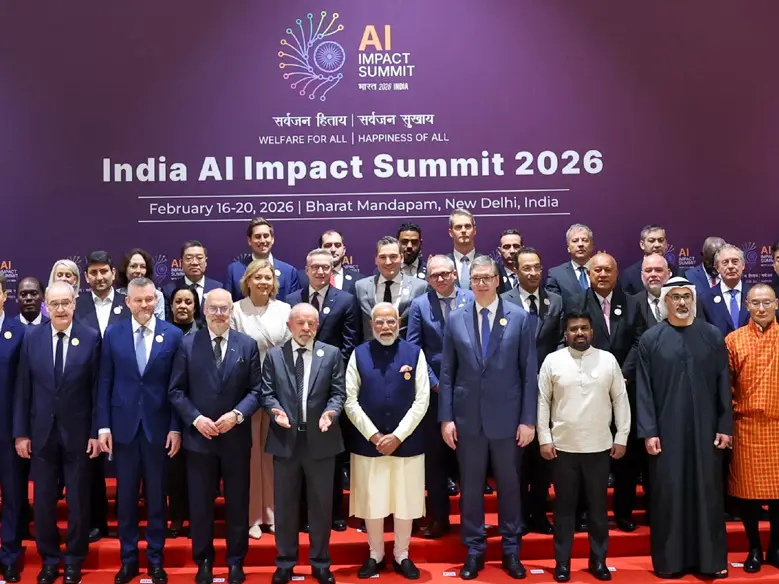
At the AI Impact Summit in February, Minister Ashwini Vaishnaw pledged 20,000 more sovereign GPUs, lifting public capacity up to 58,000 units. The government now targets 100,000 public GPUs by December 2026. Private deployments by Reliance, Tata and hyperscalers would match that, pushing total national capacity past 200,000 by year-end.
Trending Stories
)
US vs China over South China Sea: Washington backs Philippines, Beijing hits back
)
50MP vs 48MP cameras: iPhone 18 Pro Max and Pixel 11 Pro XL compared
)
Musk plans to more than double xAI's chips to over 1.2 million Nvidia GPUs by year-end
)
After JU, clash erupts at SRFTI: BJP’s ‘Dimagi Naxal’ jibe sparks political firestorm after students protest RSS-linked event
)
‘Anti-social elements spreading false rumours’: LPU issues statement amid massive unrest over alleged rape
)
LPU students go on rampage, vandalise campus amid widespread protest: What's happening
)
Trump asked Xi to pressure Iran. China did not say yes — here’s what Beijing wants
)
US Treasury Secretary Scott Bessent hails global crackdown on Iranian banks and airlines
)
An OpenAI agent escaped its locked test cage again, by hiding questions in DNS lookups
)
'Our video was trimmed': LPU girls who featured in rape-denial video make U-turn
)
3 males killed, four others injured in shooting after fight at strip club in Detroit
)
'Victory for low-budget consumers': Raghav Chadha hails 30-day telecom recharge rules
)
Claude rebuilt the 1989 game 'Prince of Persia' by reusing the original's own code
)
Beyond metros: How Tier-2 and Tier-3 cities could drive India’s next AI wave
)
Tesla builds first Cybertruck with its own refined lithium: Elon Musk's $1 billion Texas bet pays off
)
IndiGo flight suffers tail strike in Bengaluru while landing; DGCA to probe incident
)
The US and China set up an AI 'red telephone', but skipped the rulebook
)
‘Terror suspects arrested near UK air base were looking to do big damage’: Trump
)
Russian envoy claims US tactics to contain India were revealed in ‘Freudian slip’
)
Researchers rebuilt exactly how 700 AI agents hacked Hugging Face: a 900-link chain trick
)
‘Olympic inclusion is our major target’: WPA President Ishaun Singh on pool’s global ambitions
)
Nations League: Spain sink England at Wembley; Modric shines for Croatia
)
Why has Iran released no proof of life of Mojtaba Khamenei? Araghchi reveals...
)
Bank unions defer 3-day strike from tomorrow after talks with IBA, committee set up
)
'What kind of confession is this?': Pakistan PM Shehbaz Sharif’s 'terrorists would be roaming New York' remark goes viral, raises alarm online. Watch
)
Beyond BrahMos: India targets Rs 50,000 crore in defence exports with unmatched price edge
)
Sri Lankan Tamil migrant worker gets death sentence in Saudi Arabia, help sought from India
)
Muslim marriage cannot shield sex with minor wife from prosecution under POCSO: Delhi HC
)
99.9% more powerful - Scientists find boy who can recall memories from just 3 months of age
)
'FIRST LOOK from inside Noah’s Ark': Researchers share video from inside mysterious mound in Turkey
)
UNSC reform momentum grows: Russia, Portugal, Mauritius push for India's permanent seat bid
)
Man arrested after his 22-year-old girlfriend dies at homestay in Guwahati; police suspect murder over suicide claim
)
Afghanistan says 28 fighters killed in clash near Pakistan border, Islamabad denies
)
Ceuta migrant crisis: Protesters take to streets as Spain grapples with migrant challenge
)
Jaishankar at UNGA: Goodwill and friendship can't coexist with terrorism
)
New York City wants a 'kill switch' on every AI, and will pay whistleblowers who report violations
Access to compute remains cheap in India. Subsidised rates run around 65 to 150 rupees per GPU-hour, roughly 42 per cent below market. But here is the catch: Not a single one of those GPUs is designed or made in India. They are mostly NVIDIA H100, H200 and Blackwell cards.
Also read: PM Modi outlines India's AI vision at VivaTech 2026, invites global tech giants to invest
Frontier AI models and AI chips: India lags behind
India trails on frontier models and advanced chips despite the buildout. India lags in producing large-scale frontier models mainly due to a lack of access to advanced chips, the scale of modern data centres, and the complexity of training the models across India's multiple languages. Vaishnaw said India aims to attract $200 billion in data-centre investment. Reliance is building a 1-gigawatt data centre, expandable to 2GW, in Gujarat on NVIDIA Blackwell processors, at an estimated $20–30 billion cost.
How much of India's AI infrastructure is actually sovereign?
India's current AI infrastructure is mostly foreign-funded and foreign-chip-dependent. Foreign companies have, or are planning to, invest in AI in India. Microsoft pledged $17.5 billion for India on December. Google committed $15 billion for an AI hub in October. Amazon Web Services committed $12.7 billion through 2030.
Chip import dependence and slow fabrication: India's weak points
India meets close to 85 to 90 per cent of its chip needs through imports, and forms only about 3 per cent of the global market. More than 60 per cent of imported chips come from China and about a fifth from Japan. India is strong in design, holding about 20 per cent of the global semiconductor design workforce, but weak in fabrication and commercialisation. The fabrication gap will not close fast. McKinsey noted that India is pushing for fabrication at nodes above 14 nanometres by 2030, while sub-10-nanometre technology will take longer. High capital costs, limited access to advanced manufacturing technology, and supply-chain gaps in high-purity gases, special chemicals and ultrapure water are among the reasons. The India Semiconductor Mission's roughly $9.1 billion commitment has catalysed about $18.2 billion in investment. But the real movement is mainly in packaging and legacy nodes, not AI chips.
Also read: Forget building AI, India is yet to build its first fully indigenous computer or mobile phone
India's AI factories: A snapshot
Indian Budget 2026-27 allocated 8,000 crore rupees to the newly launched semiconductor mission, the largest single-year outlay yet. On the ground, the progress results are only starting to show. Micron's assembly and test facility in Sanand, Gujarat, which reached initial commercial production and was inaugurated by PM Narendra Modi on February 28, is India's first modern high-volume chip facility. But it handles assembly and packaging of memory, not wafer fabrication. Kaynes Semicon's OSAT facility in Sanand opened in March. The Tata–PSMC fab at Dholera targets first silicon by the end of this year, with capacity for 50,000 wafers a month. None of these plants targets AI chips.
AI vs jobs: What India's Chief Economic Advisor said about the nation's AI situation
AI, robotics and automation threaten entry-level service jobs, as millions of Indians with traditional degrees enter the job market each year. The remarks of India's Chief Economic Advisor V Anantha Nageswaran in the past few weeks are noteworthy in this scenario. He said AI is a growth and stability question, not just a jobs question. In his view, AI cannot be adopted passively and must be deliberately aligned with creating jobs at mass scale. Calling it a decision about the future of growth and social stability, he said the window is “open but not indefinite”. In his view, India can lead globally only by aligning AI adoption with mass employability through education reform, pedagogy change and stronger foundational skills. India must create at least 8 million jobs each year for the next 10 to 12 years to reach developed-nation status by 2047, he said.
But are Indian youth learning the AI skills required to enter such a job market? That's a story for another day.