From libraries to Assembly: J&K book withdrawal sparks political face-off

&imwidth=600&imheight=450&format=webp&quality=medium "From libraries to Assembly: J&K book withdrawal sparks political face-off")
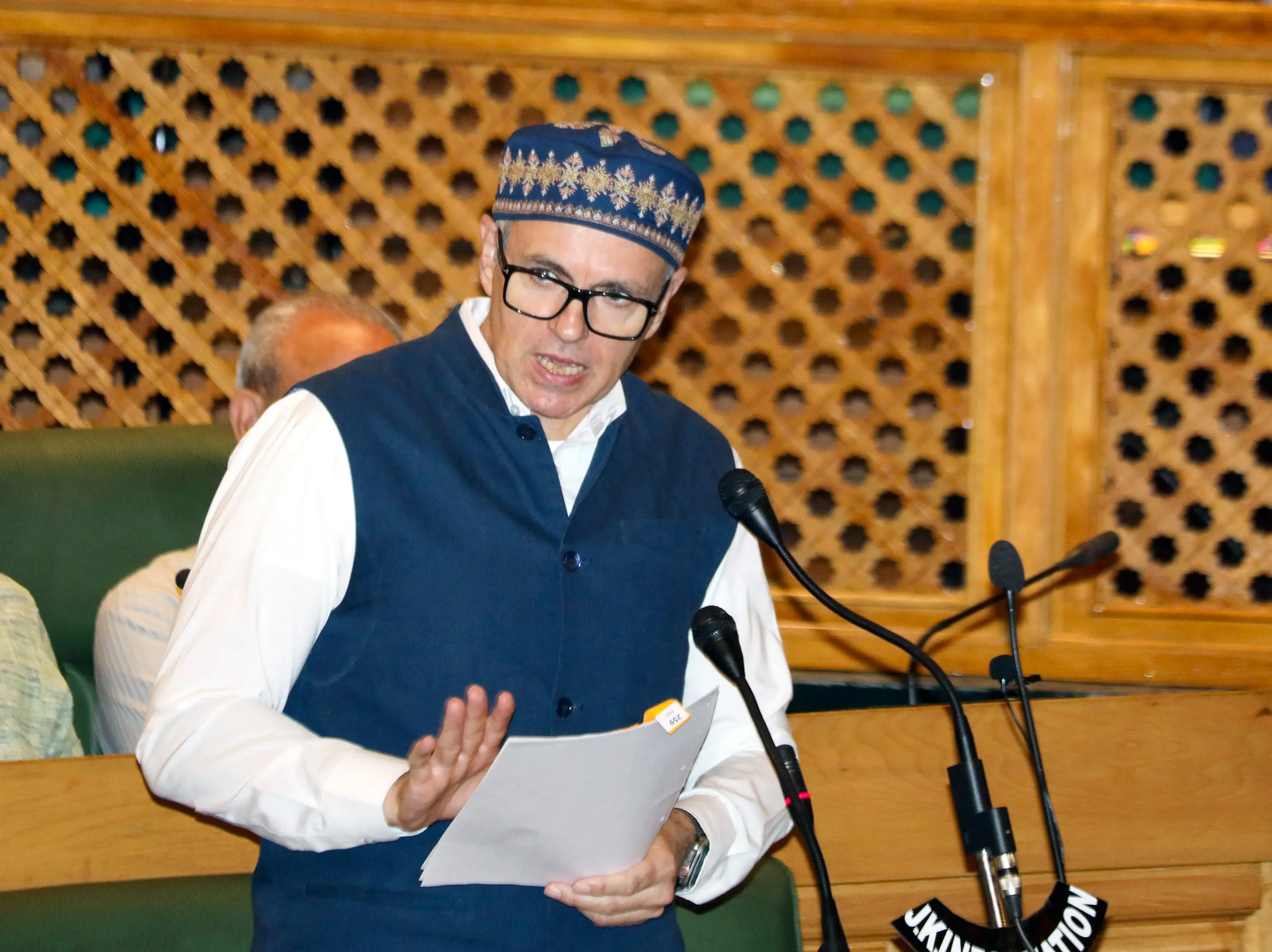
Jammu and Kashmir Chief Minister Omar Abdullah speaks on the first day of the Autumn Session of the State Assembly, in Srinagar on Monday. Photograph: (ANI)
The government said 4,249 books had so far been withdrawn, with 3,996 or nearly 94 per cent coming from institutions in the Kashmir division. In Jammu, 253 books were reported to have been withdrawn.
The withdrawal of more than 4,249 books from libraries and educational institutions across Jammu and Kashmir has snowballed into a political controversy, with the issue now reaching the floor of the Jammu and Kashmir Legislative Assembly.
Chief Minister Omar Abdullah has said that had the decision been left to him, he would not have ordered the withdrawal or banning of the books.
His remarks, however, have drawn attention to statements made by his own government in the Assembly. Education Minister Sakina Itoo, while responding to a question on the issue, informed the House that authorities had examined around 21,81,582 books and publications across Jammu and Kashmir.
''As far as banned books are concerned, there is already a committee in place to examine them. It is the committee’s responsibility to review and examine these books and take the appropriate decision. If the Chief Minister has made such a statement and it is factually correct, then there is no disagreement on that point. However, when it comes to banning a book, there is a designated committee, and its members are responsible for the decision. Examining these books and deciding whether they should be banned falls within the committee’s domain, not ours. However, if a book that the people of Jammu and Kashmir, particularly its children, want to read or see is deliberately banned by the committee members, then that would be wrong and unjust. Such decisions should not be taken without proper justification,'' said Sakina Itoo, Minister for Education, Health & Medical Education and Social Welfare, JK.
According to the figures presented in the Assembly, approximately 12,48,641 books were examined in the Kashmir division, while 9,32,941 were examined in the Jammu division.
The government said 4,249 books had so far been withdrawn, with 3,996 or nearly 94 per cent coming from institutions in the Kashmir division. In Jammu, 253 books were reported to have been withdrawn.
Trending Stories
)
)
)
)
)
)
)
)
)
)
)
)
)
)
)
)
)
)
)
)
)
&im=FitAndFill=(700,400))
)
)
)
)
)
)
)
)
&im=FitAndFill=(700,400))
)
)
&im=FitAndFill=(700,400))
)
The government also informed the Assembly that 518 copies of 19 titles that had been formally banned under S.O. 203 had been removed from circulation.
The figures and statements have triggered questions over the government's position on the withdrawal and banning of books, with opposition parties pointing to what they describe as a contradiction between the Chief Minister's remarks and the government's response in the Assembly.
The issue was raised by Sheikh Khursheed, Awami Ittehad Party MLA Langate, who sought details from the government regarding books withdrawn and banned across Jammu and Kashmir.
Khursheed questioned why the government had provided details of the withdrawals in the Assembly if the administration had no role in the decision-making process. He argued that, if the government was not involved in the decision, it should have made its position clear instead of simply furnishing the figures.
“I object to the incomplete answer given in the Assembly. I had specifically sought the titles of the books, along with the names of their authors and publishers, but those details were not provided. The Chief Minister says outside the House that, had the matter been under his control, he would not have allowed such scrutiny. But his own government has acknowledged that over 4,000 books were removed and around 23 lakh books were scrutinised. If the decision was not within the government’s control, why did the department answer my question in the House?” said Khursheed.
The controversy has also drawn criticism from the People's Democratic Party (PDP). The party has accused Chief Minister Omar Abdullah of repeatedly focusing on the restoration of statehood while, according to the PDP, other issues affecting Jammu and Kashmir require greater attention in the Assembly.
The PDP has argued that the National Conference, which has a strong presence in the Assembly, could have taken up the issue more forcefully on the floor of the House instead of allowing the statehood demand to dominate discussions.
“The BJP has consistently sought to erase or rewrite Jammu and Kashmir’s political history, and the withdrawal of books, changes to the syllabus and alleged distortion of history are part of that process. But the elected government must also accept its responsibility. The people of Jammu and Kashmir gave this Assembly a mandate, and that mandate must be respected. Instead of repeatedly saying, ‘What can I do? I don’t have statehood,’ the government should use the Assembly to raise these issues and defend the voices of the people. The Assembly is the forum available to us, and every voice connected to the people of Jammu and Kashmir must be allowed to be heard,” said Aga Muntazir, PDP MLA, BUDGAM.
Meanwhile, some political parties have challenged the withdrawal and banning of books before the High Court of Jammu and Kashmir and Ladakh, arguing that such action raises constitutional and democratic concerns. The petitioners have questioned whether the withdrawal of the books amounts to a violation of constitutional freedoms and restrictions on the circulation of ideas.
“This is not a new development. It began with the banning of important books and documents by eminent authors such as A.G. Noorani, a matter that we have already challenged in the High Court and are awaiting judgment on. Curbing voices, restricting learning and depriving people of information neither serves the country’s interests nor reflects constitutional values. The right to speak, learn and access information is fundamental. These attempts to suppress ideas cannot succeed. The voices of Jammu and Kashmir and people across society will continue to be heard. Ideas cannot be controlled,” said M Y TARIGAMI, CPI(M).
The Bharatiya Janata Party (BJP), however, has defended the action. The party has maintained that the decisions were taken by an autonomous agency and that the matter should not be politicised.
Leader of the Opposition Sunil Sharma also took a dig at Chief Minister Omar Abdullah over his comments, saying that perhaps the Chief Minister should first read the books himself before deciding whether they should be banned or withdrawn.
“I don’t know what all 4,000 books are, but whichever agencies or institutions ordered their withdrawal must have had reasons for doing so, and those decisions can be challenged on their merits. We had earlier objected to a particular book that glorified individuals who had fought against India and, in our view, insulted the country. As for Omar Abdullah, he says he has no authority over these decisions. If something is outside his control, that is one thing—but he should also explain what he is doing on matters that are within the elected government’s control,” said Sunil Sharma, LoP BJP.
The controversy has consequently brought the issue of book withdrawals, the role of government agencies and the limits of institutional autonomy into sharper focus, with the matter now playing out both inside the Legislative Assembly and before the courts.
