
&imwidth=800&imheight=600&format=webp&quality=medium "Eight cloudbursts trigger flash floods across J&K and Ladakh in 24 hours")
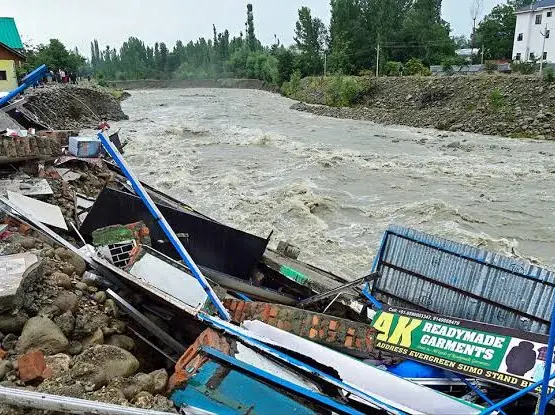
At least eight major cloudburst or cloudburst-like incidents struck Jammu & Kashmir and Ladakh within the last 24 hours as an active monsoon system unleashed intense, localised downpours across the region. The extreme weather triggered flash floods, landslides and mudslides, leaving two people dead while the State Disaster Response Force (SDRF) rescued more than 80 stranded residents.
The sudden deluge sent torrents of water rushing through several districts, causing widespread destruction. Flash floods were reported from Keller, KathoHallan and Badrahama in Shopian, Haripora in Kangan, Bandipora, Pahalgam, Kupwara and the Sarbal area of Drass in Kargil. Floodwaters entered residential homes, damaged roads, washed away agricultural land, and destroyed paddy fields and orchards.
Officials said some flooding was caused by overflowing local streams following hours of intense rainfall rather than confirmed cloudbursts, highlighting the challenge of distinguishing between cloudburst events and extremely heavy localised rain. Meanwhile, shooting stones and landslides along the Jammu-Srinagar National Highway forced authorities to close the highway from both directions.

This monsoon season has witnessed a marked increase in cloudburst and cloudburst-like incidents across Jammu & Kashmir. According to the India Meteorological Department (IMD), the Srinagar Meteorological Centre recorded more than 27 such incidents during July 2026 in Jammu & Kashmir alone, while several additional incidents occurred in Kargil and adjoining areas. Overall, around 36 cloudburst or cloudburst-like events have been reported across the region between early July and August 4.
Ajaz Rasool, a climate expert, said cloudbursts, once considered rare, are now occurring with alarming frequency across Jammu, Poonch, Rajouri, Doda, Kishtwar and several districts of Kashmir. "Cloudbursts were once rare events. Today, they are occurring much more frequently, sometimes every few days in different parts of Jammu and Kashmir. Their intensity has also increased, causing severe damage to homes, roads and livelihoods. While cloudbursts cannot be prevented, better planning can reduce their impact. Water from these events should be channelled into storage basins wherever possible instead of allowing it to cause destruction."
Rasool said the region has experienced clear signs of climate change over the past four to five decades, including rising temperatures, declining snowfall, prolonged dry spells followed by intense rainfall, droughts and changing weather patterns.
Trending Stories
)
What’s in a name? Trump’s 'Lake America' move gets a tit-for-tat response from Canada
)
Outrage erupts after 3-year-old is married to 60-year-old man in Pakistan, link to her sister's murder being probed
)
Trump gifts Xi a bald eagle sculpture at White House dinner: Here’s what it symbolises
)
‘Not just a local tragedy’: Nepal PM Shah warns UN of growing climate threat, says Nepal floods were 'a warning to the world'
)
Farhan, who went viral for AK47 celebration vs India in Asia Cup, hopes to lead Pakistan beyond Asian Games
)
CNN, Politico and MS NOW back in White House after judge blocks Trump’s media ban
)
India-New Zealand FTA is ‘an expression of trust’, NZ High Commissioner Patrick John Rata says
Don't Be Shy movie review: A frothy coming-of-age tale that is too shy to experiment
)
Park Ji Hyun makes history as first Korean actress nominated for International Emmy
)
Tesla is preparing something big for Optimus: new Gen 3 models surface in app
)
Bias or safety concerns? Bengaluru CEO says firm will not hire men from UP, Bihar, Rajasthan, MP. Here's why
)
Trump's welcome to Xi demonstrates 'attraction' to dictators: Chuck Schumer
)
Nations League: Germany draw on Klopp debut; Portugal, Norway win
)
WION Iconic Tourism Summit 2026: Union Minister Shekhawat on 'experiential travel', peace diplomacy
)
Scientists detect first radio signals directly from faraway planet
)
A seven-day roadmap? Iran proposes plan to end war, reopen Strait of Hormuz and resume nuclear talks
)
The Vvaan Review: This Ekta Kapoor's Tulsi Virani-coded world can't be saved by Sidharth Malhotra and Tamannaah Bhatia
)
China to test supersonic jet that moves at Mach 2, double the speed of sound
)
Xi Jinping's 'special plane' vs Trump's Air Force One: What's the difference?
)
Ruckus in J&K Assembly over statehood resolution; BJP leaders enter well of house
)
UNGA 2026: Israeli PM attacks Britain, France for past colonialism
)
West Indies coach Sammy looking at India series as opportunity to finetune ahead of ODI World Cup 2027 qualifiers
)
‘We’ve never gotten along better’: Trump praises Xi, jokes about White House ballroom at high-stakes state dinner
)
Air India pilot suspended after failing pre-flight alcohol test on Zurich-Delhi route
)
Yemen called Trump for US military support in fight against Houthis: Official
)
Meet Adrian Abraham: 9-year-old Indian-origin guitar prodigy aiming for a Guinness World Record
)
US faces fresh cost crunch as mortgage rates hit 7%, oil tops $107 and gas prices surge
)
'Blockbuster' nor'easter develops an eye similar to hurricanes as warnings are issued
)
WATCH: Pak PM Shehbaz Sharif refuses to answer on Hafeez Sayeed, walks away
)
OpenAI is building AI to fight cyber threats: What GPT-6 Cyber means for security
)
'Making history': Xi Jinping praises Trump as US-China leaders dine at White House
)
'What kind of confession is this?': Pakistan PM Shehbaz Sharif’s 'terrorists would be roaming New York' remark goes viral, raises alarm online. Watch
&im=FitAndFill=(700,400))
Netanyahu at UN: Mass walkout, attack on Mamdani and Iran threats | In Pics
)
'We do not wish to continue. It's America that must choose': Iran president Pezeshkian calls on US to end war
)
Bollywood mourns Mushtaq Khan: Sunny Deol, Rajpal Yadav and others pay tribute
)
Myanmar training camp case: US national, 6 Ukrainians allowed to meet their families abroad
)
'FIRST LOOK from inside Noah’s Ark': Researchers share video from inside mysterious mound in Turkey
)
'Fund people, not bombs': Hundreds take to New York streets as Netanyahu delivers speech at UN; dozens arrested
)
Susan Sarandon and Hannah Einbinder detained by NYPD outside UN Headquarters
)
He also stressed the importance of conserving wetlands, lakes, forests and river systems, saying healthy natural ecosystems help regulate temperatures, absorb excess water and reduce the impact of extreme weather.
Meteorologists say monitoring these events remains extremely difficult because cloudbursts occur over very small geographical areas and develop rapidly, making precise forecasting nearly impossible. Most of these incidents have triggered flash floods and landslides, damaging homes, roads, bridges, orchards, agricultural land and other infrastructure. July also witnessed dozens of rain-related fatalities across the region.
Meteorologists and climate scientists say the rise in cloudburst activity is being driven by a combination of climate change and the unique geography of the Himalayas. A warmer atmosphere now holds about 7 per cent more moisture for every 1°C rise in temperature, resulting in more intense short-duration rainfall. Faster warming across the western Himalayas, increased moisture from a warmer Arabian Sea, the interaction between monsoon winds and Western Disturbances, and orographic lifting over steep mountain terrain further intensify these extreme weather events.
Experts also point to prolonged dry spells since 2024 followed by intense rainfall, along with deforestation and encroachment on floodplains and natural drainage channels, which have degraded wetlands and increased surface runoff. They say these combined factors have led to more frequent cloudbursts, flash floods, landslides and debris flows, causing growing losses of life and property, and warn that without stronger climate adaptation measures and global efforts to reduce greenhouse gas emissions, the trend is likely to continue.
Senior Scientist at the Meteorological Centre Srinagar, Parveen Kumar, said the department had already forecast unstable weather from August 1 to August 4. "We had forecast erratic weather across Jammu and Kashmir with torrential rainfall in the Pir Panjal and other hilly areas. These intense showers have triggered mudslides and landslides, and the wet spell is expected to continue until August 5. Widespread rainfall is likely today and tomorrow, with isolated heavy rainfall. Weather conditions are expected to improve after August 6, although another spell of rain is possible after August 8. Farmers should closely follow local weather advisories and avoid agricultural activities during periods of heavy rainfall."
He added that intense rainfall in mountainous terrain often gets channelled into narrow valleys and streams, significantly increasing the risk of sudden flash floods.
For people living near streams, rivers and steep mountain slopes, as well as farmers and those dependent on tourism, the growing frequency of these extreme weather events underscores the urgent need for better planning and adaptation. Increasingly, experts caution, these disasters should no longer be viewed as isolated acts of nature but as manifestations of a changing climate that demand long-term policy action and resilience planning.
