Air India Kanishka bombing: Canadian authorities says there are 'no persons of interest' remain in case

&imwidth=600&imheight=450&format=webp&quality=medium "Air India Kanishka bombing: Canadian authorities says there are 'no persons of interest' remain in case")
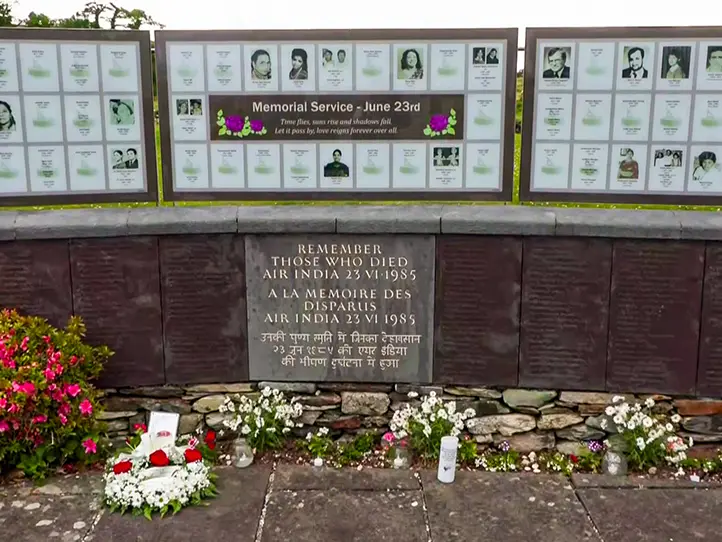
Tributes being paid to the victims on the 40th anniversary of Kanishka bombing, at the Ahakista Memorial in Cork Photograph: (ANI)
The Royal Canadian Mounted Police (RCMP) met families in Toronto on 12 September as part of what it described as a commitment to transparency in an investigation that has lasted more than four decades
Canadian police have told relatives of those killed in the 1985 Air India bombing that an individual long known as ‘Mr X’ has been identified but cannot be tied to the attack, and that no other suspects are under consideration. The Royal Canadian Mounted Police (RCMP) met families in Toronto on 12 September as part of what it described as a commitment to transparency in an investigation that has lasted more than four decades.
In a statement to WION, RCMP Federal Policing Pacific Region said investigators had, over time, identified the person who came to their attention as Mr X. “No definitive link to the events under investigation could be established,” the force said. “Today, while there are no other persons of interest or suspects under consideration, the investigation remains open,” the statement added. “If new or credible information comes forward, it will be investigated. The RCMP has always endeavoured to seek justice for the victims of Air India and that commitment stands.”
The meeting has nonetheless left many families distressed. According to Canadian reports, relatives have written to the RCMP and to Prime Minister Mark Carney expressing shock after being told that investigative avenues have been exhausted and that the case is effectively inactive, even if it has not been formally closed.
Air India Flight 182, a Boeing 747 known as the Kanishka, was destroyed by a bomb on 23 June 1985 while flying from Montreal towards London. All 329 people on board were killed- 268 of them Canadian citizens, many of Indian origin, along with British and Indian nationals. A second device exploded the same day at Tokyo’s Narita airport, killing two baggage handlers. The attack remains the deadliest terrorist incident in Canadian history.
Canadian and Indian investigators concluded the plot was carried out by Khalistani extremists and terrorists linked to the Babbar Khalsa network. Talwinder Singh Parmar was widely regarded as the mastermind; he was killed in India in 1992. The only person convicted was Inderjit Singh Reyat, who pleaded guilty to manslaughter for assembling the bombs and later served additional time for perjury. Two other men, Ripudaman Singh Malik and Ajaib Singh Bagri, were acquitted in 2005 after a lengthy and costly trial.
)
)
)
)
)
)
)
)
)
)
)
)
)
)
)
)
)
)
)
)
)
)
&im=FitAndFill=(700,400))
)
)
)
)
)
)
)
)
)
)
)
)
)
)
