
&imwidth=800&imheight=600&format=webp&quality=medium "Over 50 and on screen: How Bollywood & Hollywood are rewriting the rules for women")
"Maybe we can be something else entirely. Something new."
When Charlotte says this in And Just Like That, it’s more than a line—it’s a quiet anthem for the age of reinvention. For decades, turning 50 in the entertainment world meant slipping quietly into the shadows, where roles for women often shrank to caricatures—doting mothers, peripheral grandmothers, or wise background figures. But things are changing. Slowly, steadily, and spectacularly.
Today, women over 50 are not just appearing on screen—they’re owning it. From Manhattan to Mumbai, they're headlining shows, carrying films, and driving narratives that are complex, bold, and age-defying.
What’s Driving The Shift

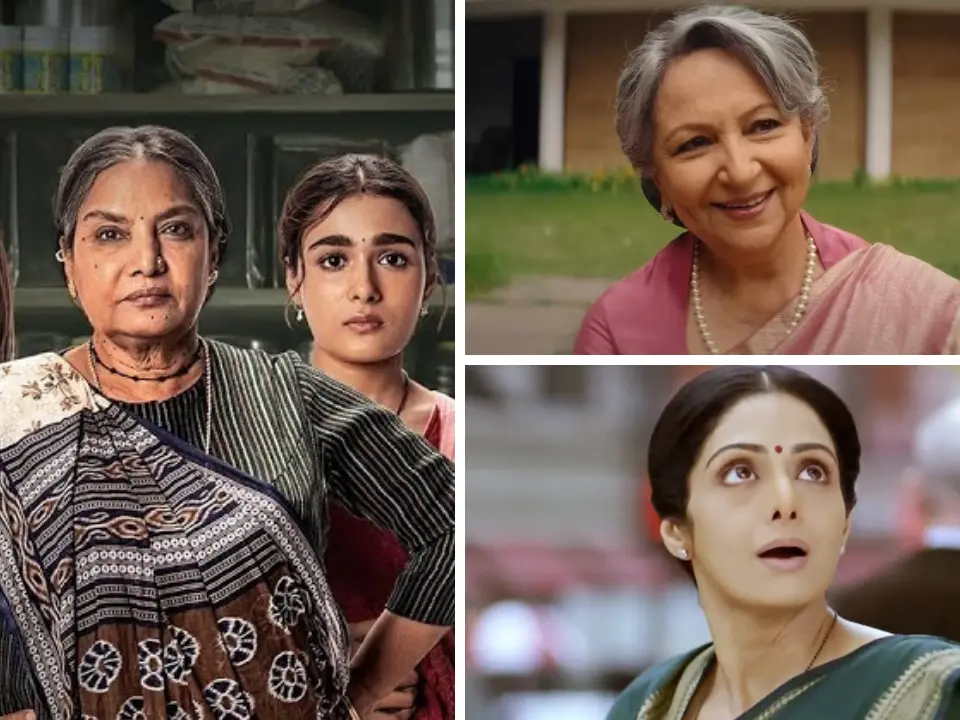
Back in 2012, English Vinglish was considered a gamble. A mid-budget film centered around a middle-aged woman finding her confidence in a New York classroom? In an era where box-office success meant young heroes and high-octane plots, Sridevi’s comeback felt like a risk. But it wasn't, it was a revelation. The film broke the mold, proving that audiences were more than ready to champion nuanced female stories.
Since then, Bollywood has seen a quiet revolution. Stories like Aarya, Gulmohar, and Saas Bahu Aur Flamingo onJioHotstar have featured powerful older women navigating layered personal and professional terrains. Sushmita Sen’s Aarya, a mother caught between morality and crime, and Dimple Kapadia’s fierce drug matriarch in SBF are roles that would have been unthinkable a decade ago.
Hollywood, in many ways, has been slightly ahead. From Sex and the City to And Just Like That, shows have long spotlighted women embracing life’s second (or third) act with clarity, confidence, and wit. Jean Smart’s razor-sharp turn in Hacks or Meryl Streep’s delightful addition to Only Murders in the Building show that age isn’t a limitation, it's leverage.
Trending Stories
)
Emmys 2026: Matthew Rhys wins Best Actor twice, sets historic 78-year record
)
3 Italians fly from Delhi to Munich without immigration clearance; Air India gets notice on major security lapse
)
Did India risk its US trade deal despite softer stance at BRICS?
)
Pakistan puts Pak Rs 70 lakh bounty on UN terrorist Masood Azhar; move draws skepticism in Delhi
)
‘US ensuring global energy supplies’: Trump demands reimbursement for securing Strait of Hormuz
)
'She married her brother': Ilhan Omar faces criminal probe over immigration fraud claims
)
'Huge destructive power': North Korea calls its latest missile launches 'live-fire drill' even as US dismisses 'immediate threat'
)
Ukraine strikes Syzran Oil Refinery deep inside Russia, fires erupt
)
‘Let’s go’: Newly declassified videos show dramatic rescue of US Air Force officers downed in Iran
)
Emmy Awards 2026: Widow's Bay and The Pitt win in lead categories- check out the complete list of winners
&im=FitAndFill=(700,400))
Why European Meteor missiles use ramjet engines compared to standard US solid rockets
)
Emmys 2026 In Memoriam: Catherine O’Hara honoured by on-screen children Macaulay Culkin, Annie Murphy, Dan Levy; Dolly Parton, Rob Reiner remembered
)
Iran, India agree to deepen humanitarian and political ties, President Pezeshkian says
)
‘Want to reset ties with India, have engagement based on mutual interests,’ says Bangladesh minister
&im=FitAndFill=(700,400))
Emmys 2026 Red Carpet: Zendaya, Nicole Kidman and Julia Garner lead the glamour peak
)
Turkish Airlines plane flies through a storm three times, triggering severe turbulence
&im=FitAndFill=(700,400))
Why Chinese PL-15 air-to-air missiles use dual-pulse motors compared to European interceptors
)
What is Hyrox, in news for athlete who soiled herself, but kept running and using common equipment?
)
Russia proposes to build 360 kmph Ivolga FG trains in India: What happened on sidelines of BRICS
)
800 million years old - Scientists discover 'fingerprints' of supercontinent Gondwana in ancient rocks
)
China discovers vast gold and silver 'mine' in the Pacific with unheard-of deposits
)
Plane carrying prominent figure crashes at Libya’s Misrata airport: Report
)
UPI payments up to Rs 2,000 to stays free, but bigger transactions may soon cost you: Govt
&im=FitAndFill=(700,400))
New OTT releases this week (September 14-20, 2026): Lust Stories 3, Waiting Hai, Irumudi- 5 new titles coming on Netflix, Prime Video and more
)
Sent home midway from UK tour, Pakistan's Salman Agha hits 300* in domestic return
)
Who is Kalyan Bainsla, accused in the Gurugram hit-and-run case involving woman biker?
)
Nigerian Navy seizes 10,000 litres of suspected illegal fuel in Rivers State crackdown
)
Saudi Arabia discovers 110 million tonnes of Uranium-rich ore in Madinah region
)
Dodgers beat Reds for playoff berth in bid for third consecutive World Series
)
Ecstasy tablets are rage in 'drug haven' Libya | Gravitas
)
'Now Trump is copying us': Shivakumar links US $5,000 plan to Congress guarantees
)
Video of Pakistani lawmaker struggling to read English tribute to Jinnah goes viral - WATCH
)
Trump downplays China's alleged 'help' to Iran in strike on Jordan base | Gravitas
)
Trump loses Supreme Court battle over mail ballots ahead of US midterms: What happened?
)
BCCI VP Rajeev Shukla says Mohsin Naqvi 'did not object' India refusing trophy from ACC chief
)
Photographs, LeT labels vanish from two 2008 Mumbai attack entries in Pakistan’s most wanted list
)
Delhi govt to roll out ₹13,820 crore development projects under Seva Sankalp Abhiyan: CM Rekha Gupta
)
UK man admits drugging, raping wife for 20 years in shocking abuse case
)
Extreme warming in Indian Ocean added 695 billion tons of ice to Antarctica ice sheet
)
China thinned Himalayan troop presence in 2025, India defence report says; terms border situation 'stable'
Platforms, Power & Possibility
Streaming platforms have played a pivotal role in this evolution. Without the pressure of opening weekend numbers or the constraints of theatrical formulas, creators are emboldened to take risks. And audiences are responding.
OTT giants like JioHotstar, Netflix and ZEE5have become fertile ground for stories with older women at the helm. Sharmila Tagore’s quiet strength in Gulmohar, Shabana Azmi’s resilience in Dabba Cartel, and the unapologetic force of Dimple Kapadia in SBF are just a few examples of this shift.
This trend isn't isolated. Across the globe, platforms are embracing similar stories. Nicole Kidman playing a tech CEO in Babygirl, or Viola Davis commanding the screen in The Woman King, reinforce that mature female characters are not only welcomed—they’re wanted.
But it’s not just about where these stories are shown. It's about why they’re finally being told.
The Internet Changed the Audience
The rise of authentic, relatable female characters can’t only be credited to bold creators—it’s also the result of a rapidly evolving audience. Thanks to the internet boom and content’s global reach, viewers today are seeking narratives that reflect their own lives, not idealized versions of them. They want mothers, bosses, fighters, survivors—women they know and admire.
In the West, this cultural recalibration happened earlier, fuelled by strong female voices both on and off the screen. There has long been an emphasis on equal representation and advocacy for authentic storytelling. In India, while the pace has been slower, the momentum is unmistakable.
The behind-the-scenes shift matters too. With more women stepping into producer and director roles, there’s a deeper commitment to portraying characters with honesty and emotional depth especially those dealing with age, reinvention, and identity.
Progress, Pushback & the Business of It All
Of course, change rarely comes without resistance. Even today, theatrical releases in Bollywood hesitate to have backstories led by older women. Ageism persists. After portraying layered roles in Maharani and Tarla, Huma Qureshi was advised to “do younger roles” to avoid being typecast. The message was clear: age still makes the industry uneasy.
Hollywood isn’t immune either. Despite notable wins, women over 50 still face fewer opportunities than their male counterparts. Casting often remains tethered to outdated ideals of youth and desirability.
But here’s the counterweight: audience demand. Films like Crew—starring Kareena Kapoor Khan, Tabu, and Kriti Sanon—are proving that female-led narratives can be both commercially viable and culturally impactful. In fact, 2024 marked the first year where over half of Hollywood’s top-grossing films featured women in leading roles.
That’s not coincidence—it’s data.
Because at the end of the day, what gets watched, gets made.
What’s Next?
We’re at a turning point. The screen is beginning to reflect women as they truly are—ambitious, vulnerable, resilient, powerful, and yes, older. But for this wave to become the norm rather than the exception, it needs consistent support from the most powerful stakeholder in the equation: the audience.
If we continue to glorify stories centered only on youth, violence, or alpha masculinity (Pushpa, Animal), we risk keeping mature female voices at the margins. But when we choose to watch, share, and champion stories that portray women across all ages with honesty and respect—we signal to the industry that we want more.
And the industry listens. Because for all its glitz, it’s still show business.