
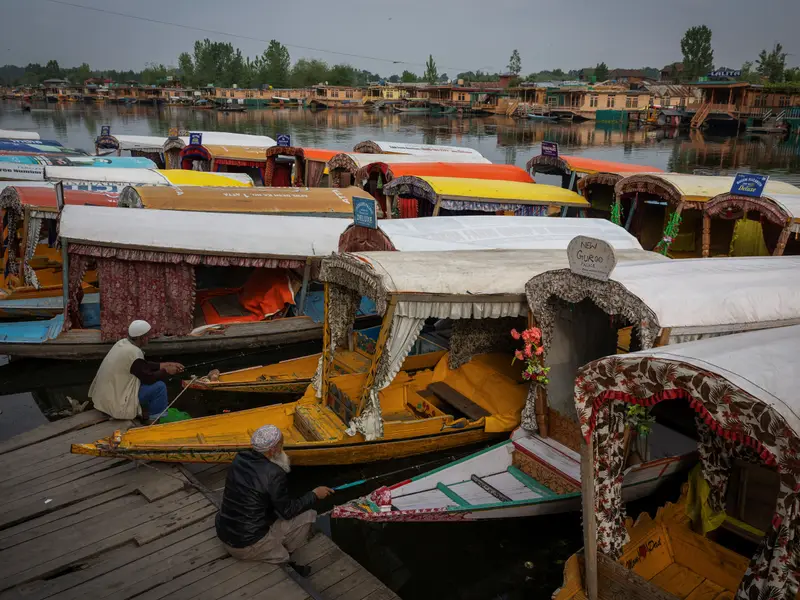
The scenic region of Kashmir, once bustling with travellers exploring alpine meadows, houseboats, and snow-capped peaks, now lies silent. Following the 22 April attack in Pahalgam that killed 26 people, fear spread rapidly through the valley.
Tens of thousands of tourists rushed to leave, triggering a wave of cancellations and paralysing the region’s fragile tourism economy.
Hotels, guesthouses, and Srinagar’s famous houseboats are now deserted. May and June which is traditionally peak months are seeing virtually no new bookings. Yaseen Tuman, a sixth-generation houseboat operator in Srinagar, told Associated Press the current situation is dire. “There is a haunting silence now. This isn’t just a seasonal slump — it’s a crisis,” he said. “If all goes well, we might start seeing tourists again in six months. Until then, it’s survival mode.”

Tourism as Kashmir’s fragile backbone
Tourism accounts for nearly seven per cent of Jammu and Kashmir’s economy, according to the Directorate of Economics and Statistics, J&K Government. In 2024, the region had seen a promising start, with over three million tourists visiting — a steady increase from 2.71 million in 2023. That influx spurred economic activity, encouraging thousands of locals to invest in family-run hotels, transport services, restaurants, and handicraft businesses.
But the optimism was short-lived.
Trending Stories
)
Emmys 2026: Matthew Rhys wins Best Actor twice, sets historic 78-year record
)
3 Italians fly from Delhi to Munich without immigration clearance; Air India gets notice on major security lapse
)
Did India risk its US trade deal despite softer stance at BRICS?
)
Pakistan puts Pak Rs 70 lakh bounty on UN terrorist Masood Azhar; move draws skepticism in Delhi
)
‘US ensuring global energy supplies’: Trump demands reimbursement for securing Strait of Hormuz
)
'Huge destructive power': North Korea calls its latest missile launches 'live-fire drill' even as US dismisses 'immediate threat'
)
‘Let’s go’: Newly declassified videos show dramatic rescue of US Air Force officers downed in Iran
)
Ukraine strikes Syzran Oil Refinery deep inside Russia, fires erupt
)
Emmy Awards 2026: Widow's Bay and The Pitt win in lead categories- check out the complete list of winners
&im=FitAndFill=(700,400))
Why European Meteor missiles use ramjet engines compared to standard US solid rockets
)
Iran, India agree to deepen humanitarian and political ties, President Pezeshkian says
)
‘Want to reset ties with India, have engagement based on mutual interests,’ says Bangladesh minister
&im=FitAndFill=(700,400))
Emmys 2026 Red Carpet: Zendaya, Nicole Kidman and Julia Garner lead the glamour peak
)
Turkish Airlines plane flies through a storm three times, triggering severe turbulence
&im=FitAndFill=(700,400))
Why Chinese PL-15 air-to-air missiles use dual-pulse motors compared to European interceptors
)
What is Hyrox, in news for athlete who soiled herself, but kept running and using common equipment?
)
Russia proposes to build 360 kmph Ivolga FG trains in India: What happened on sidelines of BRICS
)
800 million years old - Scientists discover 'fingerprints' of supercontinent Gondwana in ancient rocks
)
China discovers vast gold and silver 'mine' in the Pacific with unheard-of deposits
)
Plane carrying prominent figure crashes at Libya’s Misrata airport: Report
&im=FitAndFill=(700,400))
New OTT releases this week (September 14-20, 2026): Lust Stories 3, Waiting Hai, Irumudi- 5 new titles coming on Netflix, Prime Video and more
)
Sent home midway from UK tour, Pakistan's Salman Agha hits 300* in domestic return
)
Who is Kalyan Bainsla, accused in the Gurugram hit-and-run case involving woman biker?
)
Nigerian Navy seizes 10,000 litres of suspected illegal fuel in Rivers State crackdown
)
Saudi Arabia discovers 110 million tonnes of Uranium-rich ore in Madinah region
)
Dodgers beat Reds for playoff berth in bid for third consecutive World Series
)
Ecstasy tablets are rage in 'drug haven' Libya | Gravitas
)
'Now Trump is copying us': Shivakumar links US $5,000 plan to Congress guarantees
)
Video of Pakistani lawmaker struggling to read English tribute to Jinnah goes viral - WATCH
)
Trump downplays China's alleged 'help' to Iran in strike on Jordan base | Gravitas
)
Baba Vanga's first prophecy for 2027 is out, and straight out of science fiction
)
Trump loses Supreme Court battle over mail ballots ahead of US midterms: What happened?
)
BCCI VP Rajeev Shukla says Mohsin Naqvi 'did not object' India refusing trophy from ACC chief
)
Photographs, LeT labels vanish from two 2008 Mumbai attack entries in Pakistan’s most wanted list
)
Delhi govt to roll out ₹13,820 crore development projects under Seva Sankalp Abhiyan: CM Rekha Gupta
)
UK man admits drugging, raping wife for 20 years in shocking abuse case
)
Extreme warming in Indian Ocean added 695 billion tons of ice to Antarctica ice sheet
)
China thinned Himalayan troop presence in 2025, India defence report says; terms border situation 'stable'
“Sheer devastation,” said Sheikh Bashir Ahmed, Vice President of the Kashmir Hotel and Restaurant Association, speaking to Associated Press. “We had 12,000 hotel rooms booked till June, all have been cancelled. Tens of thousands of people in the hospitality sector are now jobless.”
The disruption goes far beyond hotels. Handicraft sellers in Srinagar’s bustling bazaars say footfall has plummeted. On Dal Lake, once filled with tourists in brightly painted shikaras, boatmen now spend their days anchored and idle. “There used to be long queues for boat rides,” said Fayaz Ahmed, a boatman. “Now there’s nothing but silence.”
Taxi drivers are facing similar hardships. Mohammed Irfan, who usually ferries tourists to Gulmarg and the Mughal gardens, told Associated Press that he hasn’t had work in two weeks. “Even a half-day break was a luxury before,” he said. “Now, my vehicle hasn’t moved.”
While Kashmir’s tourism sector has long been vulnerable to political and security shocks, it had shown surprising resilience in recent years, even after the revocation of Article 370 in 2019. The Modi government had cited the rising number of tourist arrivals as a key indicator of normalcy returning to the valley.
But the latest crisis has shattered that narrative. With tensions escalating and no clear diplomatic thaw in sight, many believe the future of Kashmir’s tourism hinges on long-term geopolitical stability.
“This will keep happening unless the core issue between India and Pakistan is resolved,” said Sheikh Bashir Ahmed. “Tourism needs peace. Without it, this cycle of revival and collapse will continue,” he told Associated Press.
India’s five big strikes after Pahalgam
In the aftermath of the 22 April terror attack, India swiftly responded with a combination of diplomatic, economic, and military measures aimed at isolating Pakistan and dismantling terror networks. According to the Associated Press, New Delhi first suspended the Indus Waters Treaty, a 1960 agreement that governs water sharing between the two countries. This move was symbolic and strategic — a direct message that all options were on the table.
India then expelled Pakistani military advisers stationed at its New Delhi mission and scaled down its diplomatic staff in Islamabad. In a significant escalation, India revoked all visas issued to Pakistani nationals and suspended the SAARC Visa Exemption Scheme, effectively closing its borders to Pakistani travellers.
On 1 May, India shut down the Attari–Wagah border crossing, the only overland trade and travel route between the two nations. The most consequential move, however, came in the form of Operation Sindoor, a military strike executed between 6 and 7 May, in which India targeted nine terror infrastructure sites in Pakistan and Pakistan-occupied Kashmir, especially in Poonch, Rajouri and Akhnoor. According to Army officials quoted by the Associated Press, six of those sites were effectively neutralised.
Tanks on the move, missiles in the sky
The situation escalated rapidly. India moved T-72 tanks and BMP-2 armoured vehicles close to the Line of Control (LoC) in a show of force. Pakistan responded with attempted drone and missile strikes on 8, 9 and 10 May, prompting further skirmishes along the LoC. However, after backchannel talks between the two militaries on 10 May, both sides agreed to a ceasefire, putting a temporary lid on hostility.