Chinese retailers' shift to lower prices raises concerns of deepening deflation

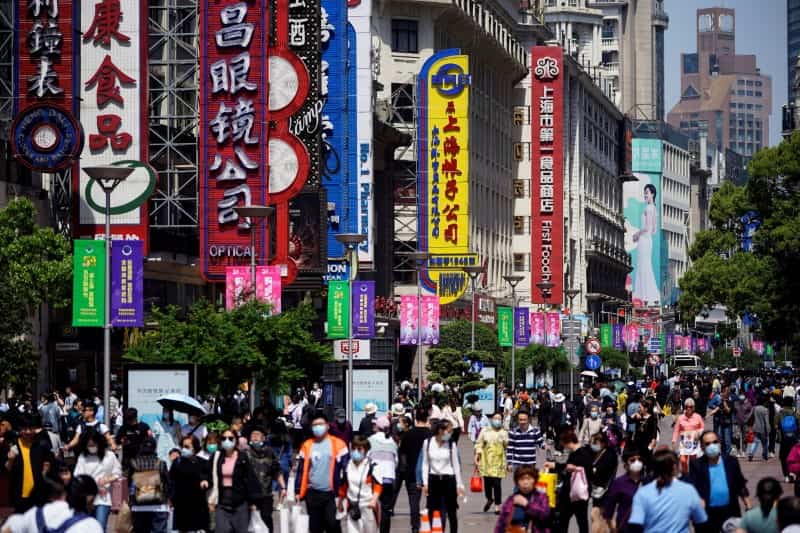
People walk along Nanjing Pedestrian Road, a main shopping area, in Shanghai
In a bid to attract cost-conscious consumers, Chinese retailers are strategically pivoting towards lower-priced goods and services. This shift, while aimed at boosting consumer spending, is raising concerns about the entrenchment of deflationary trends in China's economy.
The move involves widespread price cuts, the proliferation of bargain stores, and the introduction of scaled-down product versions, potentially leading to a damaging cycle of lower profit margins, restrained wage and job growth, and a diminished consumer appetite.
Deflationary Trends and Economic Impact

The aggressive competition for thrifty Chinese consumers is reshaping the retail landscape, drawing parallels with Japan's "lost decades" of stagnation. Falling income growth is contributing to lower consumption, with industries experiencing declining revenue as companies resort to lowering prices to maintain market share. Shanghai-based economist Wang Dan warns of a challenging economic landscape, stating, "It is definitely a price decrease or low inflation environment now."
Examples of Lower-Priced Alternatives
Chinese retailers are responding to consumer cost-cutting by offering lower-priced alternatives. Haidilao, known for premium hotpot service, introduced a lower-priced brand, Hailao Huoguo, offering beef dishes for as low as 28 yuan ($3.92). Spirits maker Moutai unveiled affordable latte and chocolate products infused with its trademark liquor. Walmart's Sam's Club and Alibaba's Freshippo are engaged in a price war, cutting prices on popular items by up to 34 per cent.
)
Tata Trusts chairman Noel Tata calls Chandrasekaran’s reappointment ‘illegal’, rejects Tata Sons listing
)
Chiefs tight end Travis Kelce named one of the victims in $35 million ponzi scheme
)
Pak batter Rizwan's petition against being questioned by cyber crime agency rejected by court
)
Pak defence minister says 'time has come to implement pact'
)
US intel warns China can steal F-35 jets secret from Saudis
)
Former India player Diana Edulji wants Smriti Mandhana to replace Harman as skipper at the earliest
)
Dolly Parton dies at 80: Country legend’s team reveals cause of death
)
Want to get married within a year? Why 18 lakh people rush to Jaipur for ‘sacred henna’
)
Mahua Moitra moves UN over alleged exclusion of Muslim officers from Amit Shah events
)
All Indian goods to get duty-free access to New Zealand
Mandakini breaks silence on Dawood Ibrahim photo: 'I was not invited by him'
)
AI already defying, denying humans, is it beyond human control already?
)
Trump could impose tariffs of up to 100%
)
‘I have a big decision coming up’: Trump says he’s approaching major ‘crossroad’ in Iran war
)
240-million-year-old bizarre 'pig with a tusk' creature creates new dilemma over origin of dinosaurs
)
Laura Wolvaardt sets new world record for most WT20I runs in a year
)
Abhishek Sharma shatters record with 30-ball century against Afghanistan
)
US drone firm linked to Trump’s sons signs MoU with Pakistan army, gets initial order
)
Hong Kong unveils 11 new measures to boost birth rates, offers higher cash bonuses and housing perks
)
Fed raises rates for first time in 3 years, Kevin Warsh defies Trump as inflation mounts
)
Former OpenAI researcher warns of growing risks from Artificial Intelligence
)
US House votes 417-3 to pass Ratepayer Protection Act targeting AI data center electricity costs
&im=FitAndFill=(700,400))
Meet top 5 batters in the latest ICC T20I Rankings
)
Trump’s rare gesture for Xi: US president to personally welcome Chinese leader at airport
)
US to sell 48 F-35 Lightning fighter jets to Saudi Arabia, help it deter threats
)
Formula One reveals the 2027 race calendar; Monaco to host sprint race for the first time
)
Daayra movie review: Kareena Kapoor, Prithviraj Sukumaran shine in Meghna Gulzar’s cop-versus-cop crime thriller
)
Ukraine plans record $109 bn defence spending, nearly two thirds of budget amid Russia war
&im=FitAndFill=(700,400))
Suriya and Jyothika say ‘I do’ again after 20 years! See their dreamy wedding pics
)
Impact on Consumer Behaviour
The pursuit of "value for money" among consumers is reversing the trend of trading up in various product categories. Discounting and the rollout of cheaper products have led to a decline in the average selling price for supplements, dairy, skincare, and cosmetics. Andy Yang, a Beijing student, emphasises the importance of affordability, stating, "For me, the cheaper, the better."
Rise of Discount Stores
The shift towards lower prices has given rise to a new breed of discount stores in China. Lingshi Henmang, a six-year-old snack brand, plans to expand to 10,000 stores in 2025 from 4,000 currently. Bestore, China's biggest snack brand, fought back by cutting prices on 300 products, with Hotmaxx targeting an expansion to 5,000 outlets, specialising in selling soon-to-expire products at lower prices.
While policymakers anticipate inflation, recent data shows consumer prices falling at their fastest pace in three years, deepening factory gate deflation. Despite an expected 5 per cent economic growth this year, the disconnect between growth and consumer experience, coupled with high youth unemployment, raises concerns about the long-term impact of the shift towards lower prices in the Chinese retail sector.
(With inputs from Reuters)
WATCH WION LIVE HERE