China's declining birth rate puts teachers' jobs at risk: Millions face uncertain future by 2035

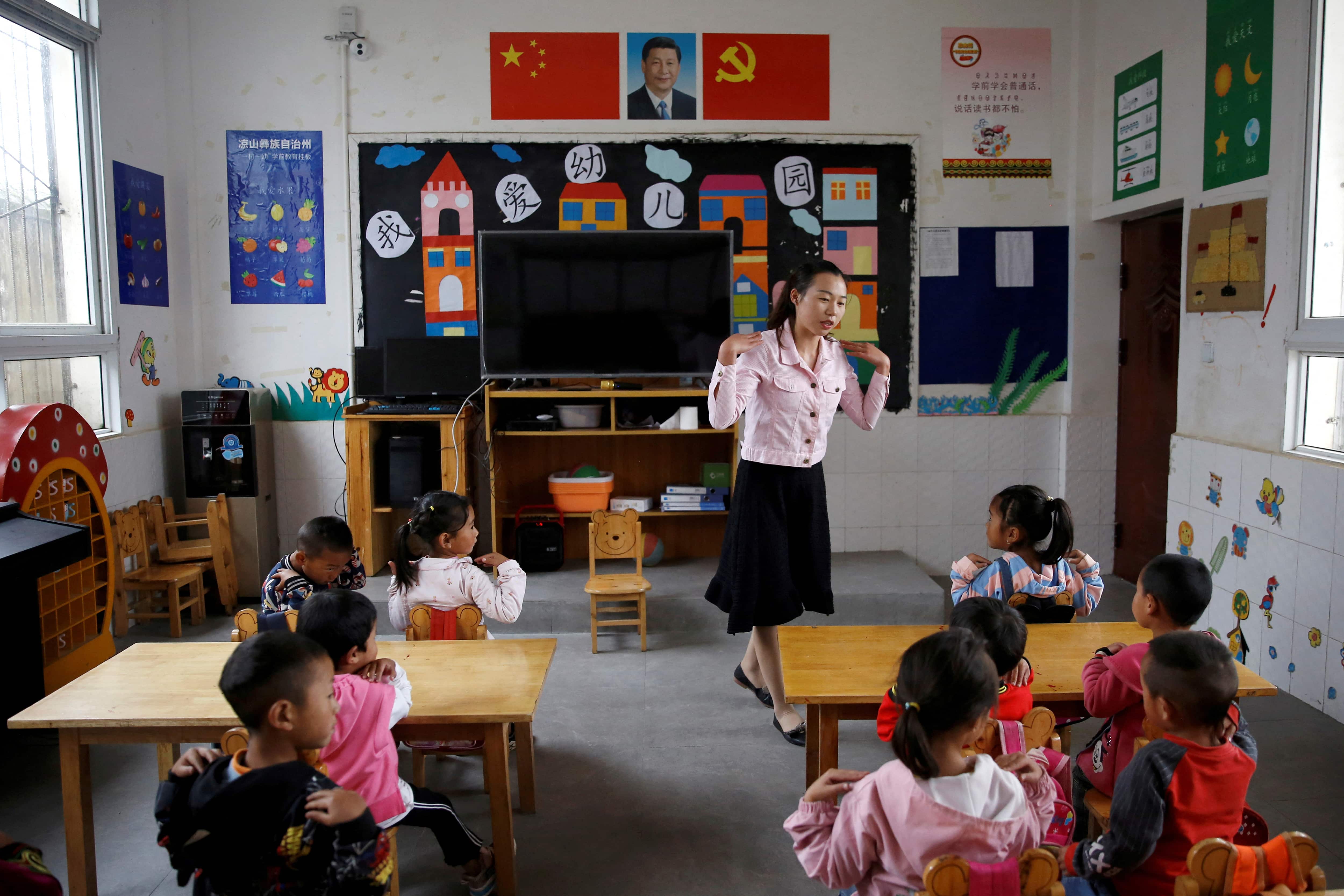
A teacher gives a class to children at a preschool in Xujiashan village
In the wake of China's plummeting birth rate, the future of teaching, once considered a steadfast career choice in the nation, is now cast in uncertainty, the South China Morning Post (SCMP) reported.
The iconic "iron rice bowl" concept, symbolising guaranteed job security, may no longer hold true as demographic shifts pave the way for an estimated surplus of 1.9 million teachers by 2035.
This sudden change poses significant challenges, not just for educators but for the broader societal and economic landscape of the country.

Demographic transition and educational implications
The dramatic decline in newborns since 2017, coupled with dwindling kindergarten and primary school enrolments, paints a sobering picture of China's demographic future.
The SCMP report cited Chu Zhaohui, a senior researcher at the China National Academy of Educational Sciences, who warned, "With fewer students, there will inevitably be redundancies at schools within a certain period or a certain region."
)
Sikh driver attacked in Wyoming in US, suffers 17 stab wounds
)
‘I have a big decision coming up’: Trump says he’s approaching major ‘crossroad’ in Iran war
)
US intel warns China can steal F-35 jets secret from Saudis
)
Former India player Diana Edulji wants Smriti Mandhana to replace Harman as skipper at the earliest
)
Pak defence minister says 'time has come to implement pact'
&im=FitAndFill=(700,400))
Meet top 5 batters in the latest ICC T20I Rankings
)
Formula One reveals the 2027 race calendar; Monaco to host sprint race for the first time
)
All Indian goods to get duty-free access to New Zealand
)
AI already defying, denying humans, is it beyond human control already?
)
US F-16 fighter jet crashes in Michigan during training mission, pilot ejects safely
)
240-million-year-old bizarre 'pig with a tusk' creature creates new dilemma over origin of dinosaurs
)
US to sell 48 F-35 Lightning fighter jets to Saudi Arabia, help it deter threats
)
Hong Kong unveils 11 new measures to boost birth rates, offers higher cash bonuses and housing perks
)
Former OpenAI researcher warns of growing risks from Artificial Intelligence
)
Australian athlete, who soiled herself during Hyrox race, apologises for continuing
)
Tata Trusts chairman Noel Tata calls Chandrasekaran’s reappointment ‘illegal’, rejects Tata Sons listing
)
Dolly Parton dies at 80: Country legend’s team reveals cause of death
)
Fed raises rates for first time in 3 years, Kevin Warsh defies Trump as inflation mounts
)
US drone firm linked to Trump’s sons signs MoU with Pakistan army, gets initial order
)
Pak batter Rizwan's petition against being questioned by cyber crime agency rejected by court
)
Daayra movie review: Kareena Kapoor, Prithviraj Sukumaran shine in Meghna Gulzar’s cop-versus-cop crime thriller
)
Epstein files: Judge warns Trump Attorney General Todd Blanche of contempt over DOJ delays
)
At least 48 dead, 100 hospitalised in Nigeria after drinking suspected methanol-laced alcohol
)
US-Iran War: Trump says ‘big decision’ on Iran ahead, weighs possible fresh military action
)
Trump could impose tariffs of up to 100%
)
US new military base in Poland: US President Donald Trump eyes military base in Poland
)
Putin 'is plotting something bad': Russia may launch 'accidental' strikes on NATO countries supporting Ukraine, Poland PM warns
&im=FitAndFill=(700,400))
Suriya and Jyothika say ‘I do’ again after 20 years! See their dreamy wedding pics
)
Laura Wolvaardt sets new world record for most WT20I runs in a year
)
Mahua Moitra moves UN over alleged exclusion of Muslim officers from Amit Shah events
)
Pezeshkian, Araghchi set to attend UNGA 2026 in New York amid ongoing conflict as US-imposed travel curbs remain
This trend, if unabated, could lead to a surplus of 1.5 million primary school teachers and 370,000 middle school teachers by 2035.
Government response and local initiatives
Local authorities are feeling the strain, grappling with fiscal pressures exacerbated by economic challenges.
In response, regions like Hunan province have begun strategising for the long term, urging better allocation of education resources based on birth rates and urbanisation.
Furthermore, several governments have curtailed the supply of teachers by discontinuing major degree programs related to education at certain universities.
Educational quality and opportunities for improvement
Amidst these challenges lies an opportunity for China to enhance the quality of its education system.
The SCMP report mentioned Huang Bin, a professor at Nanjing University’s Institute of Education, who emphasised the importance of upgrading rural teachers and improving educational standards.
Additionally, Maggie Chen, a veteran teacher in Zhejiang province, suggested that smaller class sizes could enable teachers to provide better individual attention to students.
Parental concerns and societal implications
Despite government measures to alleviate educational pressures, parental anxiety over children’s education remains high, as highlighted in a survey by youth36kr.
This pervasive stress, coupled with broader societal trends of declining birth rates, underscores the multifaceted challenges facing China's educational landscape and society at large.