

&imwidth=800&imheight=600&format=webp&quality=medium "What are Abraham Accords? The countries that joined, those that refused and why they matter today")
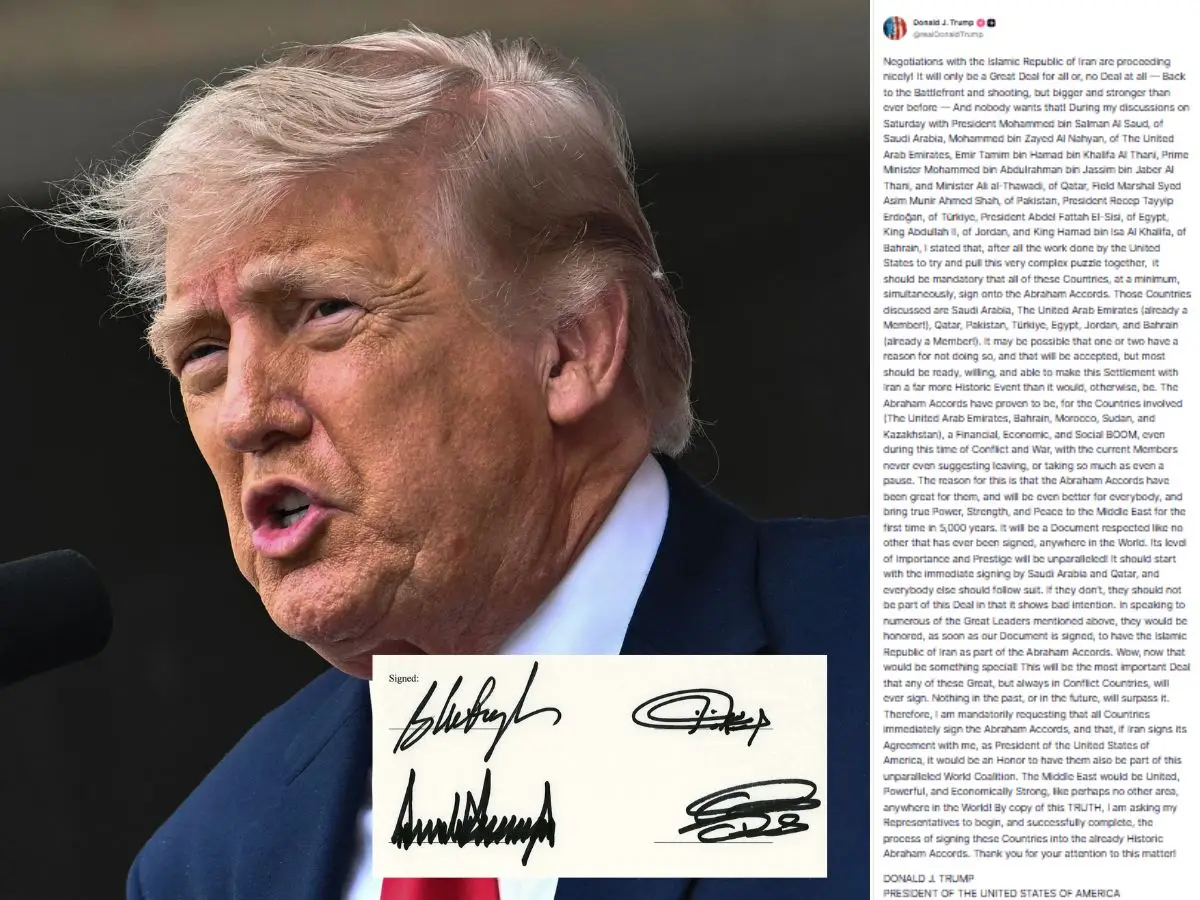
As negotiations over a possible US-Iran agreement continue, Donald Trump has once again pushed for the expansion of the Abraham Accords, the diplomatic agreements that reshaped relations between Israel and parts of the Arab world in 2020. In a post on Truth Social, Trump said he had urged Saudi Arabia, Qatar, Pakistan, Turkey, Egypt and Jordan to join the accords, adding that if Iran reached an agreement with Washington, “it would be an Honor to have them also be part of this unparalleled World Coalition”, adding that, “The Abraham Accords have been great for them, and will be even better for everybody, and bring true Power, Strength, and Peace to the Middle East.” His remarks have renewed attention on an initiative that remains one of the most consequential diplomatic shifts in the modern Middle East. Trump has repeatedly said he wants to expand the accords that he brokered during his first term in the White House.
What exactly are the Abraham Accords?
The Abraham Accords were a series of agreements brokered by the United States during Trump’s first term to normalise diplomatic relations between Israel and several Arab nations. The United Arab Emirates and Bahrain signed first in September 2020, becoming the first Arab states in a quarter century to formally recognise Israel. Morocco and Sudan later followed in 2020 and 2021 respectively. The accords were heavily shaped by Trump’s son-in-law Jared Kushner and focused not only on diplomacy, but also on trade, investment, tourism and security cooperation.
According to the US State Department, the accords were built on “mutual understanding and coexistence” and sought to advance “peace, security, and prosperity in the Middle East and around the world”.
Why some countries joined the accords
Kazakhstan joined the accords last year, becoming the first post-Soviet state to join the pact with Israel.For countries such as the UAE and Bahrain, the accords opened opportunities for economic partnerships, technology cooperation and closer security ties with both Israel and the United States. Trade between Israel and Gulf states expanded rapidly after the agreements were signed, particularly in sectors such as defence, tourism, energy and artificial intelligence. Washington also viewed the accords as a strategic regional realignment aimed at countering Iranian influence while integrating Israel more deeply into the Middle East.
Why others still refuse to join
Despite US pressure, several major Muslim-majority nations have refused to join. Saudi Arabia has repeatedly insisted that there can be no normalisation with Israel without a ‘clear path’ towards the creation of a Palestinian state, a demand strongly opposed by Israel’s current government. Pakistan, which has never formally recognised Israel since 1948, swiftly rejected Trump’s latest proposal. On Tuesday, Pak Defence Minister Khawaja Asif said joining the accords would contradict Pakistan’s ‘fundamental ideals’.
Palestinian leaders have also criticised the agreements, arguing that Arab nations normalised ties with Israel without securing meaningful progress on Palestinian statehood.
Why the accords matter today
Five years after they were signed, the Abraham Accords remain central to Middle Eastern diplomacy. Supporters view them as a rare framework for regional cooperation in a deeply fractured region. Critics argue they bypassed the Palestinian issue without resolving it.
Trending Stories
&imwidth=180&imheight=135&format=webp&quality=medium)
US troop deaths in Iran war on rise? Pentagon reveals latest toll
&imwidth=180&imheight=135&format=webp&quality=medium)
Lula campaign accuses Meta of election interference after social media content blocked
&imwidth=180&imheight=135&format=webp&quality=medium)
PM Modi inaugurates Rs 4,900 crore Chennai Metro Phase II stretch, takes ride with CM Vijay: VIDEO
&im=FitAndFill=(700,400)&imwidth=180&imheight=135&format=webp&quality=medium)
Navratri 2026: 9 days, 9 forms of Goddess Durga and 9 colours- Check the complete list
&imwidth=180&imheight=135&format=webp&quality=medium)
100,000 strikes in 3 years: How October 7 redefined Israel's war
&imwidth=180&imheight=135&format=webp&quality=medium)
‘Your people don’t even let us near it’: IAF chief’s blunt response on US F-35; India yet to decide on Russia’s Su-57
&imwidth=180&imheight=135&format=webp&quality=medium)
Trump claims ‘energy ceasefire’ between Russia and Ukraine; Zelensky says ‘news for me’
&imwidth=180&imheight=135&format=webp&quality=medium)
Saudi Arabia's King Khalid International Airport attack kills 12, injures 309; India calls it 'unacceptable'
&imwidth=180&imheight=135&format=webp&quality=medium)
HYBE’s Weverse Con India sets ticket sale date for March 2027 festival
&imwidth=180&imheight=135&format=webp&quality=medium)
Amitabh Bachchan celebrates birthday with fans at Jalsa during Sunday darshan | Watch
&imwidth=180&imheight=135&format=webp&quality=medium)
Messi scores twice in Inter Miami return following final match for Argentina
&imwidth=180&imheight=135&format=webp&quality=medium)
'Unwarranted interference': India slams UN human rights office over remarks on Delhi protests
&imwidth=180&imheight=135&format=webp&quality=medium)
'Jantar Mantar not the story of India': BJP's Sambit Patra claims 'anarchists' tried to hold Delhi captive
&im=FitAndFill=(700,400)&imwidth=180&imheight=135&format=webp&quality=medium)
Meet top 5 right-hand batters with most international runs
&imwidth=180&imheight=135&format=webp&quality=medium)
3rd T20I Preview: Another run-fest on cards as India face West Indies in Indore
&imwidth=180&imheight=135&format=webp&quality=medium)
Nicolas Cage refuses AI waiver for Spider-Noir, hints at Amazon exit and True Detective role
&imwidth=180&imheight=135&format=webp&quality=medium)
At least 109 migrants, including 15 children dead as boat sinks off Djibouti, 116 go missing
&imwidth=180&imheight=135&format=webp&quality=medium)
Riyadh airport hit in missile attack, dozens injured; 5 in intensive care
&imwidth=180&imheight=135&format=webp&quality=medium)
Powerful 7.7 magnitude earthquake strikes Panama, tsunami warning issued
&imwidth=180&imheight=135&format=webp&quality=medium)
US mid-term elections: What are PACs - Unique American System that lets corporates shape voting
&imwidth=180&imheight=135&format=webp&quality=medium)
Imran Khan released hours after Mumbai Police detain him during CJP protest
&imwidth=180&imheight=135&format=webp&quality=medium)
Nathan Lyon completes 1,000 Test runs at No. 10 to script rare cricket feat
&imwidth=180&imheight=135&format=webp&quality=medium)
CJP leaders claim their phones may be ‘hacked or cloned’ after 24-hour detention
&imwidth=180&imheight=135&format=webp&quality=medium)
Nepal flash floods swallow homes and bridges a month after devastating disaster
&imwidth=180&imheight=135&format=webp&quality=medium)
Sehwag sees reflection of himself in Sooryavanshi: ‘His thinking is similar to mine’
&imwidth=180&imheight=135&format=webp&quality=medium)
'Ouch!!! That must hurt': Kangana Ranaut hails Kamal Haasan's sharp reply to Elon Musk over Starlink row
&imwidth=180&imheight=135&format=webp&quality=medium)
Sidhu Moose Wala’s younger brother wins hearts by recreating late singer’s signature move at Toronto Hologram Show
&imwidth=180&imheight=135&format=webp&quality=medium)
Barry Manilow cuts short Las Vegas comeback show, cancels next concert over Bronchitis
&imwidth=180&imheight=135&format=webp&quality=medium)
UK school ditches technology, shifts from screen to pen and paper for learning
&imwidth=180&imheight=135&format=webp&quality=medium)
IND vs WI, 3rd T20I: Abhishek Sharma smashes 18-ball fifty, sets record for fastest to 2,000 T20I runs
&imwidth=180&imheight=135&format=webp&quality=medium)
Hamas used double agents, deceived Israel to carry out October 7 massacre
&imwidth=180&imheight=135&format=webp&quality=medium)
Bigg Boss 20: Who is Manish Goel? Meet the new wild card contestant on Salman Khan’s show
&imwidth=180&imheight=135&format=webp&quality=medium)
Portugal Federation confirms Cristiano Ronaldo’s return to national team despite suspension
&imwidth=180&imheight=135&format=webp&quality=medium)
Ganesh Dust To Stardust trailer: Ganesh Acharya directs a tale of dreams and sacrifice | Watch
&imwidth=180&imheight=135&format=webp&quality=medium)
BTS’ RM raises privacy concerns over drones, lasers outside hotel amid Lima concert, urges fan respect
&imwidth=180&imheight=135&format=webp&quality=medium)
The street cannot govern India, but the government cannot ignore it either
&imwidth=180&imheight=135&format=webp&quality=medium)
Thai queen becomes first reigning monarch to fly jet solothailand #queen #wion
&im=FitAndFill=(700,400)&imwidth=180&imheight=135&format=webp&quality=medium)
Food shortages, suicide attempts and more: USS Abraham Lincoln returns to US after 321 day deployment — What happened aboard the US carrier?
&imwidth=180&imheight=135&format=webp&quality=medium)
Rahul Gandhi calls Modi, Shah ‘cowards’ amid CJP protest crackdown in Delhi
&imwidth=180&imheight=135&format=webp&quality=medium)
Nana Patekar's cause of death confirmed; here's what his postmortem report says
&imwidth=180&imheight=135&format=webp&quality=medium)
Delhi Police arrest 4 men seen in viral video allegedly assaulting women protesters during CJP protest
&imwidth=180&imheight=135&format=webp&quality=medium)
Where are Abhijeet Dipke, Ashutosh Ranka, Saurav Das? CJP gives big update after flight detention
&im=FitAndFill=(700,400)&imwidth=180&imheight=135&format=webp&quality=medium)
Amitabh Bachchan turns 84: A look at Big B’s iconic dialogues that continue to win hearts
Trump’s latest attempt to revive and expand the accords amid negotiations with Iran reflects a broader US strategy: reducing conflict through regional alliances while reshaping the balance of power in the Middle East. Whether more countries eventually join may depend less on Washington’s pressure and more on whether the region’s unresolved political conflicts can be addressed.

