UN flags need to cut meat to curb land use impact on global warming

Global warming
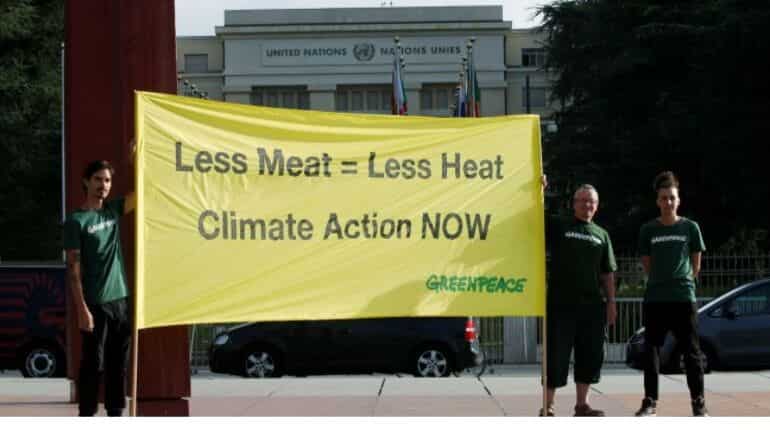
Globalmeatconsumption must fall tocurbglobalwarming, reduce growing strains onlandand water and improve food security, health, and biodiversity, a United Nations report on the effects of climate change concluded.
Although the report stopped short of explicitly advocating goingmeat-free, it called for big changes to farming and eating habits to limit theimpactof population growth and changing consumption patterns on stretchedlandand water resources.

Plant-based foods and sustainable animal-sourced food could free up several million square kilometers oflandby 2050 andcut0.7-8.0 gigatonnes a year of carbon dioxide equivalent, theU.N.'s Intergovernmental Panel on Climate Change (IPCC) said.
"There are certain kinds of diets that have a lower carbon footprint and put less pressure onland," Jim Skea, professor at London's Imperial College, said on Thursday.
The IPCC met this week in Geneva, Switzerlandto finalize its report which should help to guide the government's meeting this year in Chile on ways to implement the 2015 Paris Agreement.
&imwidth=180&imheight=135&format=webp&quality=medium)
US troop deaths in Iran war on rise? Pentagon reveals latest toll
&imwidth=180&imheight=135&format=webp&quality=medium)
Lula campaign accuses Meta of election interference after social media content blocked
&imwidth=180&imheight=135&format=webp&quality=medium)
PM Modi inaugurates Rs 4,900 crore Chennai Metro Phase II stretch, takes ride with CM Vijay: VIDEO
&imwidth=180&imheight=135&format=webp&quality=medium)
100,000 strikes in 3 years: How October 7 redefined Israel's war
&im=FitAndFill=(700,400)&imwidth=180&imheight=135&format=webp&quality=medium)
Navratri 2026: 9 days, 9 forms of Goddess Durga and 9 colours- Check the complete list
&imwidth=180&imheight=135&format=webp&quality=medium)
‘Your people don’t even let us near it’: IAF chief’s blunt response on US F-35; India yet to decide on Russia’s Su-57
&imwidth=180&imheight=135&format=webp&quality=medium)
Saudi Arabia's King Khalid International Airport attack kills 12, injures 309; India calls it 'unacceptable'
&imwidth=180&imheight=135&format=webp&quality=medium)
‘Never-ending flow of cheap labour’: JD Vance hits back at Indian-origin Congresswoman over US green card curbs for major tech companies
&imwidth=180&imheight=135&format=webp&quality=medium)
HYBE’s Weverse Con India sets ticket sale date for March 2027 festival
&imwidth=180&imheight=135&format=webp&quality=medium)
Messi scores twice in Inter Miami return following final match for Argentina
&imwidth=180&imheight=135&format=webp&quality=medium)
CJP's Abhijeet Dipke, Ashutosh Ranka, Saurav Das released 22 hours after flight detention
&imwidth=180&imheight=135&format=webp&quality=medium)
'Unwarranted interference': India slams UN human rights office over remarks on Delhi protests
&imwidth=180&imheight=135&format=webp&quality=medium)
'Jantar Mantar not the story of India': BJP's Sambit Patra claims 'anarchists' tried to hold Delhi captive
&imwidth=180&imheight=135&format=webp&quality=medium)
3rd T20I Preview: Another run-fest on cards as India face West Indies in Indore
&imwidth=180&imheight=135&format=webp&quality=medium)
Nicolas Cage refuses AI waiver for Spider-Noir, hints at Amazon exit and True Detective role
&imwidth=180&imheight=135&format=webp&quality=medium)
At least 109 migrants, including 15 children dead as boat sinks off Djibouti, 116 go missing
&imwidth=180&imheight=135&format=webp&quality=medium)
Riyadh airport hit in missile attack, dozens injured; 5 in intensive care
&imwidth=180&imheight=135&format=webp&quality=medium)
Powerful 7.7 magnitude earthquake strikes Panama, tsunami warning issued
&imwidth=180&imheight=135&format=webp&quality=medium)
US mid-term elections: What are PACs - Unique American System that lets corporates shape voting
&imwidth=180&imheight=135&format=webp&quality=medium)
Imran Khan released hours after Mumbai Police detain him during CJP protest
&imwidth=180&imheight=135&format=webp&quality=medium)
Nathan Lyon completes 1,000 Test runs at No. 10 to script rare cricket feat
&imwidth=180&imheight=135&format=webp&quality=medium)
Nepal flash floods swallow homes and bridges a month after devastating disaster
&imwidth=180&imheight=135&format=webp&quality=medium)
Sehwag sees reflection of himself in Sooryavanshi: ‘His thinking is similar to mine’
&imwidth=180&imheight=135&format=webp&quality=medium)
'Ouch!!! That must hurt': Kangana Ranaut hails Kamal Haasan's sharp reply to Elon Musk over Starlink row
&imwidth=180&imheight=135&format=webp&quality=medium)
Sidhu Moose Wala’s younger brother wins hearts by recreating late singer’s signature move at Toronto Hologram Show
&imwidth=180&imheight=135&format=webp&quality=medium)
Barry Manilow cuts short Las Vegas comeback show, cancels next concert over Bronchitis
&imwidth=180&imheight=135&format=webp&quality=medium)
Hamas used double agents, deceived Israel to carry out October 7 massacre
&imwidth=180&imheight=135&format=webp&quality=medium)
Bigg Boss 20: Who is Manish Goel? Meet the new wild card contestant on Salman Khan’s show
&imwidth=180&imheight=135&format=webp&quality=medium)
Portugal Federation confirms Cristiano Ronaldo’s return to national team despite suspension
&imwidth=180&imheight=135&format=webp&quality=medium)
Kim Kardashian brings glamour to Singapore Grand Prix while supporting boyfriend Lewis Hamilton
&imwidth=180&imheight=135&format=webp&quality=medium)
Ganesh Dust To Stardust trailer: Ganesh Acharya directs a tale of dreams and sacrifice | Watch
&imwidth=180&imheight=135&format=webp&quality=medium)
‘Time for Ukraine to get a new president’: Trump lashes out at Zelensky over Russia strikes
&imwidth=180&imheight=135&format=webp&quality=medium)
BTS’ RM raises privacy concerns over drones, lasers outside hotel amid Lima concert, urges fan respect
&imwidth=180&imheight=135&format=webp&quality=medium)
Thai queen becomes first reigning monarch to fly jet solothailand #queen #wion
&im=FitAndFill=(700,400)&imwidth=180&imheight=135&format=webp&quality=medium)
Food shortages, suicide attempts and more: USS Abraham Lincoln returns to US after 321 day deployment — What happened aboard the US carrier?
&imwidth=180&imheight=135&format=webp&quality=medium)
Rahul Gandhi calls Modi, Shah ‘cowards’ amid CJP protest crackdown in Delhi
&imwidth=180&imheight=135&format=webp&quality=medium)
Delhi Police arrest 4 men seen in viral video allegedly assaulting women protesters during CJP protest
&imwidth=180&imheight=135&format=webp&quality=medium)
Where are Abhijeet Dipke, Ashutosh Ranka, Saurav Das? CJP gives big update after flight detention
&imwidth=180&imheight=135&format=webp&quality=medium)
Putin conveys Iran’s proposal to Trump, offers to take Tehran’s enriched uranium
&im=FitAndFill=(700,400)&imwidth=180&imheight=135&format=webp&quality=medium)
Amitabh Bachchan turns 84: A look at Big B’s iconic dialogues that continue to win hearts
"The IPCC does not recommend people's diets ... Dietary choices are very often shaped or influenced by local production practices and cultural habits," Skea, who is one of the report's authors, told reporters in Geneva.
Landcan be both a source and sink of carbon dioxide, the main greenhousegas blamed forglobalwarming, and betterlandmanagement can help to tackle climate change, the IPCC said.
But it is not the only solution andcutting emissions from all sectors is essential to quickly curtailglobalwarming.
"The window for making these changes is closing fast. If there is a further delay in reducing emissions, we will miss the opportunity to successfully manage the climate change transition in thelandsector," it said.
Since the pre-industrial era, the landsurface air temperature has risen by 1.53 degrees Celsius, twice as much as theglobalaverage temperature (0.87C), causing more heatwaves, droughts, and heavy rain, as well aslanddegradation and desertification.
Humanusedirectly affects more than 70 per cent of theglobal, ice-freelandsurface and agriculture accounts for 70 per cent of freshwateruse, the IPCC added in the report.
Agriculture, forestry and otherlanduseactivities accounted for 23 per cent of total net man-made greenhousegas emissions from 2007-2016. When pre- and post-production activities in the food system are included, that rises to up to 37 per cent .
Last year the IPCC's first special report warned that keeping the Earth's temperature rise to 1.5 degrees Celsius (2.7 degrees Fahrenheit), rather than the 2C target agreed under the Paris accord, required rapid change across society.
FOOD SECURITY
The IPCC warned of more disruption toglobalfood chains as extreme weather becomes more frequent due to climate change and said environmental costs should be factored into food.
It projects a median increase of 7.6 per cent in cereal prices by 2050, meaning higher food prices and an increased risk of hunger.
While an estimated 821 million people are undernourished, changing consumption habits have already contributed to about 2 billion adults being overweight or obese.
Per capita supply of vegetable oils andmeathas more than doubled based on data since 1961 but 25-30 per cent of the total food produced is still lost or wasted.
Yields of crops such as maize and wheat have declined in some regions, while those of maize, wheat, and sugar beets have increased in others in recent decades.
FOREST FACTOR
While forests can soak up heat-trapping gases from the atmosphere, desertification and deforestation can amplifywarmingdue to the loss of vegetation cover and soil erosion.
Measures tocutemissions, such as the production of biofuels, biochar - made from biomass - as well as planting trees, will also increase demand forlandconversion.
Reducing deforestation and forest degradation could result in a reduction of 0.4-5.8 gigatonnes of CO2 equivalent, the report said.
The Amazon, about 60 per cent of which lies in Brazil, is sometimes called the "lungs of the world" due to the amount of CO2 it can absorb but it was not directly mentioned in the IPCC's summary for policymakers.
Brazil's President Jair Bolsonaro has supported opening up protected areas of the world's largest tropical rainforest to facilitate agriculture and mining since taking office in January.
The report text is prepared by over 100 scientists but has to be approved by governments. In those discussions, Brazil and India were very active to protect their national agro-industrial interests, a source familiar with the talks said.