&imwidth=800&imheight=600&format=webp&quality=medium "Oil tanker, with Indian captain, went ‘dark’ to cross high-risk Strait of Hormuz, reach Mumbai")
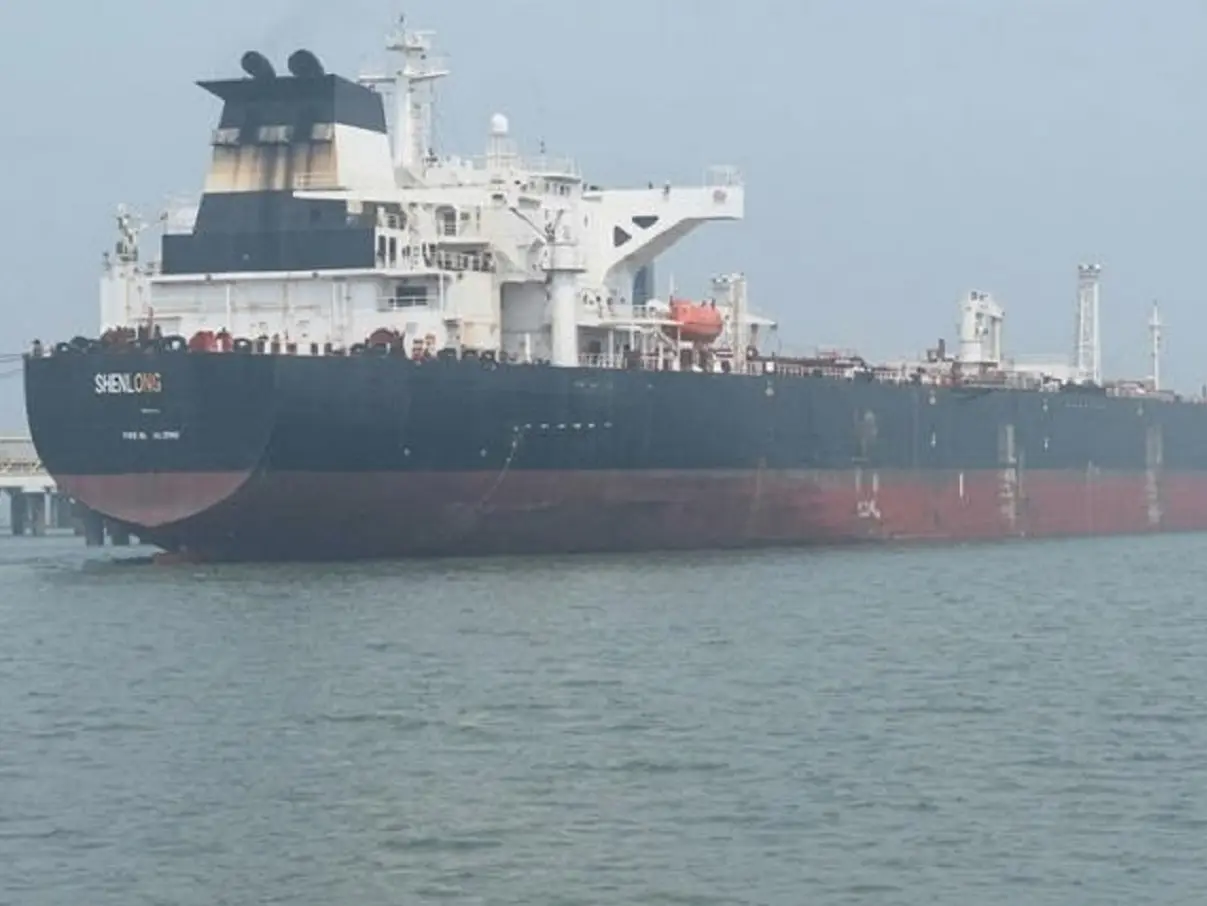
A crude oil tanker captained by an Indian successfully navigated through the war-hit Strait of Hormuz and reached Mumbai by switching off its tracking system to enter “dark mode” while crossing the high-risk zone amid the ongoing conflict in the Middle East and Iran's warning to target vessels and not allow passage to oil tankers. Maritime tracking data showed the vessel’s signals were last visible on monitoring systems inside the Strait of Hormuz on March 8 before they disappeared.
The Liberia-flagged tanker, Shenlong Suezmax, carrying crude oil loaded from Saudi Arabia’s Ras Tanura Port, arrived at Mumbai Port on Wednesday. It was carrying 135,335 metric tonnes of crude oil and has begun discharging the crude, which will be transported to refineries. The tanker had loaded crude at Ras Tanura Port in Saudi Arabia on March 1 and sailed two days later.

Liberian-flagged oil tanker is first vessel to safely transit Hormuz amid war
The Liberian-flagged oil tanker became the first vessel to safely transit the Gulf waterway and arrive in India amid the US-Israeli war against Iran.
According to tanker-tracking platforms, Shenlong Suezmax’s last recorded signal in the Strait of Hormuz appeared on March 8, after which it switched off its Automatic Identification System (AIS) while passing through the strait. The vessel reappeared on tracking systems a day later before docking in Mumbai on Wednesday.
TankerTrackers.com, a tanker tracking platform, shared that two Very Large Crude Carriers (VLCCs), three Suezmax tankers, capable of transiting the Suez Canal fully loaded, and a Panamax tanker designed to meet the maximum dimensions allowed for the original Panama Canal locks went offline from AIS tracking for at least 48 hours. The destinations of these ships were China, India, and Japan.
AIS automatically transmits info about vessel’s identity, position, and movement
The Automatic Identification System (AIS) is used on ships to automatically transmit information about a vessel’s identity, position, and movement to other ships and coastal authorities. It is primarily meant to enhance navigation safety, prevent collisions, and support maritime monitoring. Turning off the system makes the vessel effectively untraceable at sea.
Shipping companies often use this tactic, also known as “going dark”, to avoid the risk of being targeted or tracked by hostile forces. However, the strategy is used only in exceptional circumstances, as international maritime rules require AIS to remain active for safety and tracking.
At least 16 ships attacked by Iran in past two weeks
The Iranian military effectively closed the strategically vital Strait of Hormuz that handles more than 20 million barrels of crude oil per day after the US and Israel launched a military campaign against Iran.
Trending Stories
)
Why asking questions could be more important than memorising answers
)
BRICS Summit 2026 full schedule: Day-wise agenda, timings and key issues - All you need to know
)
BRICS Summit 2026: Iran's Pezeshkian praises PM Modi at BRICS
)
BRICS rejects EU carbon tax as ‘punitive’, ‘discriminatory’; warns of burden on Global South
)
'Iran won't surrender': Pezeshkian sends blunt message to US while attending BRICS Summit in India
)
Why dehydration is the hidden cause of travel fatigue on long flights
)
Top 5 places to visit in Goa beyond its famous beaches
)
'He is popular...': Malaysian PM Anwar Ibrahim's praise for PM Modi during bilateral meeting | WATCH
)
BRICS Summit 2026: 30+ countries seek BRICS membership
)
Frustrated man demolishes his kitchen after thousands flock to see Mother Mary his wife spotted on the wall
)
BRICS Summit 2026: PM Modi, Xi reach key consensus on ties, China to assume BRICS chairmanship in 2027
)
Trump says Canada eager to reach a deal, it could come ‘fairly soon’ if Ottawa treats US farmers better
)
From drones to KAAN fighters: Turkey outlines 229% surge in defence spending amid regional shifts
)
‘Partners, not rivals’: Xi outlines four point plan for stronger India-China ties
)
Could staying indoors all day affect your health?
)
Bigg Boss 20: Uditi Singh reacts to ex Karan Wahi’s possible wildcard entry
)
Why going digital does not always mean becoming more efficient
)
800 million years old - Scientists discover 'fingerprints' of supercontinent Gondwana in ancient rocks
)
Israel spent nearly $470,000 on PM's hair, makeup since 2019, data shows
)
From severe mobility problems to recovery: Madhuri the elephant’s journey of wildlife care
)
BRICS Summit day 1: New Delhi declaration adopted with full consensus, big diplomatic win for India
)
From India, Putin warns Europe against sending troops to Ukraine, Zelensky expresses willingness to meet him at G20 Summit
)
Did Iran President Pezeshkian touch feet of Hindu spiritual leader at Delhi event as shown in viral video?
)
9-year-old Chennai prodigy clears Cambridge IGCSE grade 10 exams
)
Reacher actor Alan Ritchson, wife Catherine part ways after 20 years of marriage
)
Why does your body need time to adjust after a long journey?
)
Baba Vanga's first prophecy for 2027 is out, and straight out of science fiction
)
Why does your skin need protection from UV rays?
)
How does the loss of forests affect the way wildlife lives and moves?
)
IND vs AFG, 1st T20I: When and where to watch live streaming in India?
)
Anthropic is giving Claude to schools free, and the reason is not philanthropy
)
BRICS Summit: China resumes Guangzhou-New Delhi flight, issues 'good-neighbourliness' remark ahead of Xi-Modi meet
)
Why do wild animals need quiet places to survive?
)
Humans may lose control of AI: Anthropic CEO calls for slowdown, Altman, Musk back him
At least 16 ships have been attacked by Iran over the past two weeks, with Tehran warning of further strikes on vessels operating in the region.
Meanwhile, the Indian government has said that 28 Indian-flagged vessels are currently operating in the Persian Gulf region. Of these vessels, 24 carrying 677 Indian seafarers are located west of the Strait of Hormuz, while four vessels with 101 Indian seafarers are positioned east of the strait.
Also Read: ‘Govt won’t leave Indians stranded,’ says PM Modi, slams Congress for politicising Iran War
A Thai vessel bound for Kandla port in Gujarat was attacked in the strait on Wednesday, drawing strong criticism from New Delhi.
Unrelenting attacks on shipping traffic and energy infrastructure pushed oil above $100 a barrel on Thursday.
India, which is Asia’s third-largest economy, relies heavily on the Strait of Hormuz, as more than half of its crude oil and natural gas imports pass through the narrow maritime corridor.