
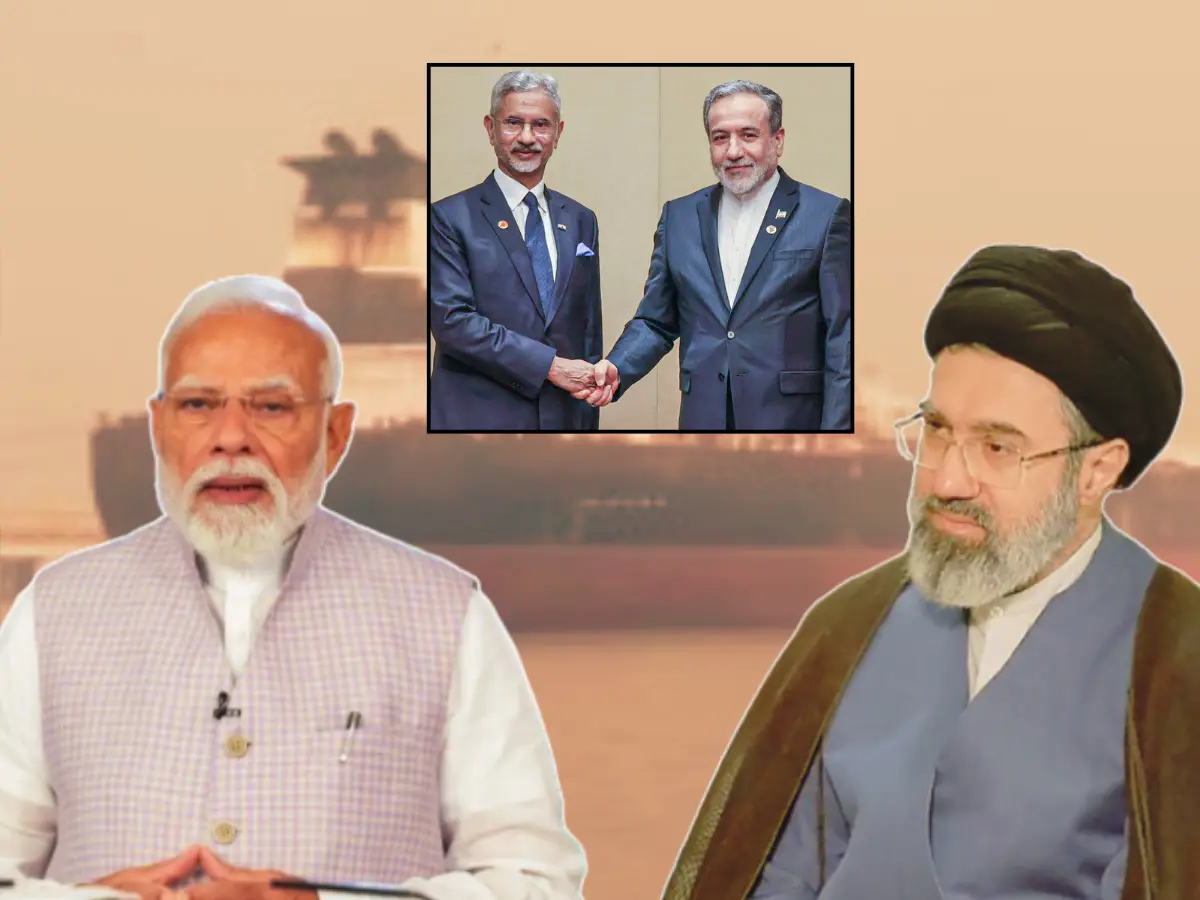
&imwidth=800&imheight=600&format=webp&quality=medium "India's crude vessel reaches Mumbai port after Iran's nod, MEA says 'shipping safety was discussed' in call with Iran FM, Jaishankar")
In a big development, Iran has allowed India's crude vessel to pass through Strait of Hormuz and the tanker has reached Mumbai Port. This came a day after Indian Foreign Minister S Jaishankar held detailed conversation with Iranian counterpart Abbas Araghchi. The Ministry of External Affairs (MEA) said in its briefing on Thursday (Mar 12) that in the last conversation between the two leaders the safety of shipping was discussed. Iran has closed the Strait of Hormuz, after the US and Israel launched pre-emptive attack on the Islamic Republic on Feb 28. It has declared that any vessel passing through the passage would require Iran's prior approval, with Iranian Revolutionary Guard stating that it would "not allow a single drop of oil to leave the region to the US" through the strait. Brent Crude is trading around $100.25 per barrel as of Mar 12. The closure of Strait of Hormuz has raised global fears for energy and oil needs as it is one of the world’s most important maritime chokepoints, through which a significant portion of global crude oil and natural gas shipments transit. The latest development may be termed as India's Iran diplomacy paying off amid heightened tensions in the region.
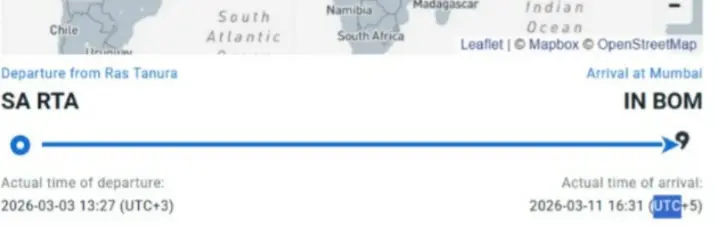

The crude vessel that reached the Mumbai port was Liberian flagged tanker captained by an Indian. It became the first India-destined vessel to safely transit the waterway, where maritime traffic has all but halted since the US and Israel attacked Iran. Liberia-flagged tanker ship was named 'Shenlong' and was captained by an Indian and was loaded with crude oil from the Saudi port Ras Tanura.
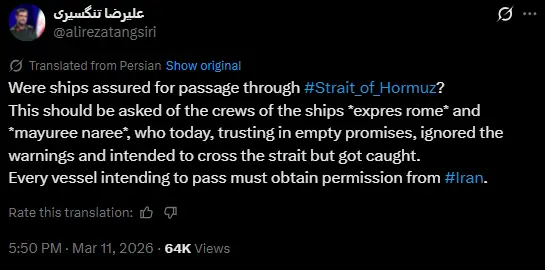
Earlier, the Islamic Revolutionary Guard Corps Navy (IRGCN) Rear Admiral Alireza Tangsiri said that two ships that had ignored Iran's warnings were targeted in the Strait. "Were the ships assured of safe passage through the Strait of Hormuz? This should be asked from the crews of the vessels Express Rome and Mayuree Naree, who today, trusting in empty promises, ignored the warnings and intended to cross the Strait, but were caught. Any vessel intending to pass must obtain permission from Iran," the Iranian general said in a post on X.
On March 5, the Islamic Revolutionary Guard Corps (IRGC) said that the passage is closed to vessels from the United States, Israel, Europe and their Western allies. Modifying its order on March 10, IRGC said that it will grant those countries “unrestricted passage” through the Strait of Hormuz, that expel Israeli and American ambassadors from their territory.
Moreover, Iranian sources denied any transit being allowed though Strait of Hormuz to every Indian flagged ships.

