
&imwidth=800&imheight=600&format=webp&quality=medium "Claude Mythos found a flaw in 60 hours that cryptographers missed for 2 years")
A cryptographic scheme designed to withstand quantum computers had been picked over by expert cryptographers worldwide for roughly two years without anyone finding a serious flaw. An unreleased Anthropic model found one in about 60 hours.
What Was Found
Anthropic disclosed that its Claude Mythos Preview model identified a previously unknown weakness in HAWK, a digital signature scheme submitted as a candidate in the US National Institute of Standards and Technology's post-quantum cryptography evaluation process.

The finding is mathematical rather than a software bug. The model identified a nontrivial automorphism — a structural symmetry — in the lattice mathematics that HAWK's security depends on. That symmetry enables a faster enumeration attack, cutting the cost of recovering HAWK's smallest key from roughly 2^64 operations to 2^38.
The practical consequence for the scheme is that HAWK's key sizes would need to roughly double to deliver the level of security its designers intended. Separately, the model also improved a known attack against a weakened variant of AES, the encryption standard used across the internet.
What It Does Not Mean
Trending Stories
)
Africa is splitting, and a lot sooner than estimated, giving way to a new ocean
)
Indian activist-lawyer Prashant Bhushan's post brings focus on ‘conflict of interest’ appointments of ex-govt officials at Reliance, Adani groups
)
Trump bans CNN, MS NOW and Politico from White House over ‘FAKE NEWS’
)
Shivakumar attends 79th Kalyana Karnataka Utsav in Kalaburagi
)
A first in 100 years: New cat species discovered in Bolivia is incredibly tiny
)
Hong Kong extends newborn cash support scheme by three years
)
Pentagon revives mandatory testosterone testing for male troops aged 30 and above
)
Ukraine plans record $109 bn defence spending, nearly two thirds of budget amid Russia war
)
Three labourers killed as DU student loses control of his car, rams into them on Dwarka Expressway
&im=FitAndFill=(700,400))
From Abhishek Sharma to Sahil Chauhan, 5 batters with fastest T20I hundreds
&im=FitAndFill=(700,400))
Meet top 5 bowlers in latest ICC T20I rankings
)
Drone strikes cooling tower at Russia's Kursk Nuclear Plant, IAEA confirms
)
Cristiano Ronaldo returns to Portugal squad for Nations League under new coach
)
India ‘deeply concerned’ as Houthi strikes hit Saudi civilian & energy sites
)
The Verdict | When precision fails: US commits war crime in Minab school strike, UN finds
)
How did an Australian river with 500 crocodiles pass the Olympic test? Here's how
)
UNGA 2026 theme explained: What does ‘Restoring trust, managing transformation: A United Nations that delivers for all’ mean?
)
'Gangsta' crab shoves knife blade at man and his dog in Florida - Watch
)
US F-16 fighter jet crashes in Michigan during training mission, pilot ejects safely
&im=FitAndFill=(700,400))
New Friday OTT releases (September 18, 2026): Lust Stories 3, You+Me, Best of the Best- 8 new titles coming on Netflix, Prime Video and more
)
Trump 2.0: Dark days ahead for America’s ‘imperial presidency’
&im=FitAndFill=(700,400))
Meet top 5 Indian batters with fastest T20I centuries
)
‘Will go to any extent’: Pakistan vows to defend Saudi Arabia amid Houthi attacks
)
India seeks to build a full semiconductor supply chain
)
Laura Wolvaardt sets new world record for most WT20I runs in a year
)
'He will always be ahead': India coach Gambhir says Sooryavanshi won't walk into team ahead of Samson
)
Xi-Trump summit may boost military links
)
Former India player Diana Edulji wants Smriti Mandhana to replace Harman as skipper at the earliest
&im=FitAndFill=(700,400))
Which country has the most F-35s outside America?
&im=FitAndFill=(700,400))
Meet top 5 batters in the latest ICC T20I Rankings
)
Who is Khalilur Rahman? All you need to know about 81st UN General Assembly President
)
Godfather of AI Geoffrey Hinton gives US lawmakers a one-year warning on AI
)
FACT CHECK: Why did PM Modi ask Xi ‘is it okay’ at BRICS Summit? New video reveals...
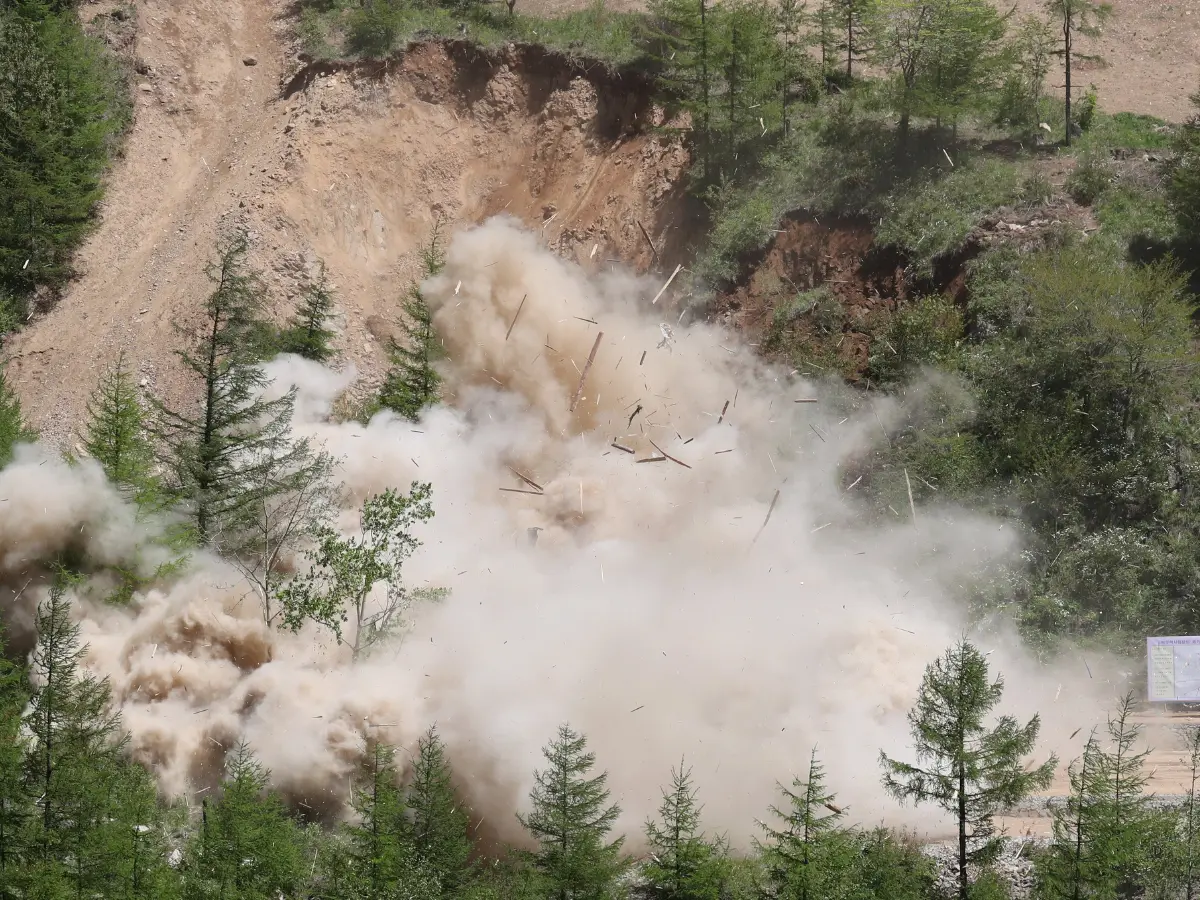)
North Korea's last nuclear test in 2017 set off 1,399 earthquakes over 8 years, each stronger than previous
This is important to state clearly, because the finding is easy to overstate: no deployed encryption has been broken, and no software needs to be changed.
HAWK is a candidate standard undergoing evaluation, not a deployed system — it is not protecting anyone's data today. The AES result applies to a deliberately weakened version used for research, not the full-strength algorithm securing live traffic. Anthropic itself framed the results as improving understanding of the security margins in modern cryptographic designs rather than as breaking anything in production.
Why It Matters Anyway
The significance lies in the process, not the immediate security impact.
Post-quantum cryptography candidates are subjected to years of adversarial review precisely because the cost of standardising a flawed scheme is catastrophic — it would be deployed globally, then discovered to be broken. That review process is the discipline's central safeguard, and it depends on the assumption that if a serious structural weakness exists, sustained expert attention will surface it.
HAWK received that attention for two years. The weakness was there the entire time. A machine found it in under three days.
That inverts a long-standing assumption about where AI is useful in security. AI has been positioned largely as a defensive tool — scanning code, flagging anomalies, patching known vulnerability classes at scale. Finding a novel mathematical attack against a scheme built by expert cryptographers and vetted by their peers is a different capability entirely: original adversarial reasoning in a domain where human expertise was considered the hard constraint.
The Wider Context
The disclosure arrives in the same period that Google restricted its Gemini 3.5 Flash Cyber model — a system that autonomously finds vulnerabilities and writes working exploits — to governments and trusted partners only, citing the technology's dual-use nature.
The pattern across both is the same. AI systems are now capable enough at offensive security work that the labs building them are treating the capability itself as the sensitive asset. For cryptography specifically, the implication cuts in both directions: every candidate scheme now needs to survive machine review as well as human review — and whoever runs that review first has a considerable advantage.
