Explained: Nagorno-Karabakh's decade-long conflict that has kept Armenia and Azerbaijan on edge

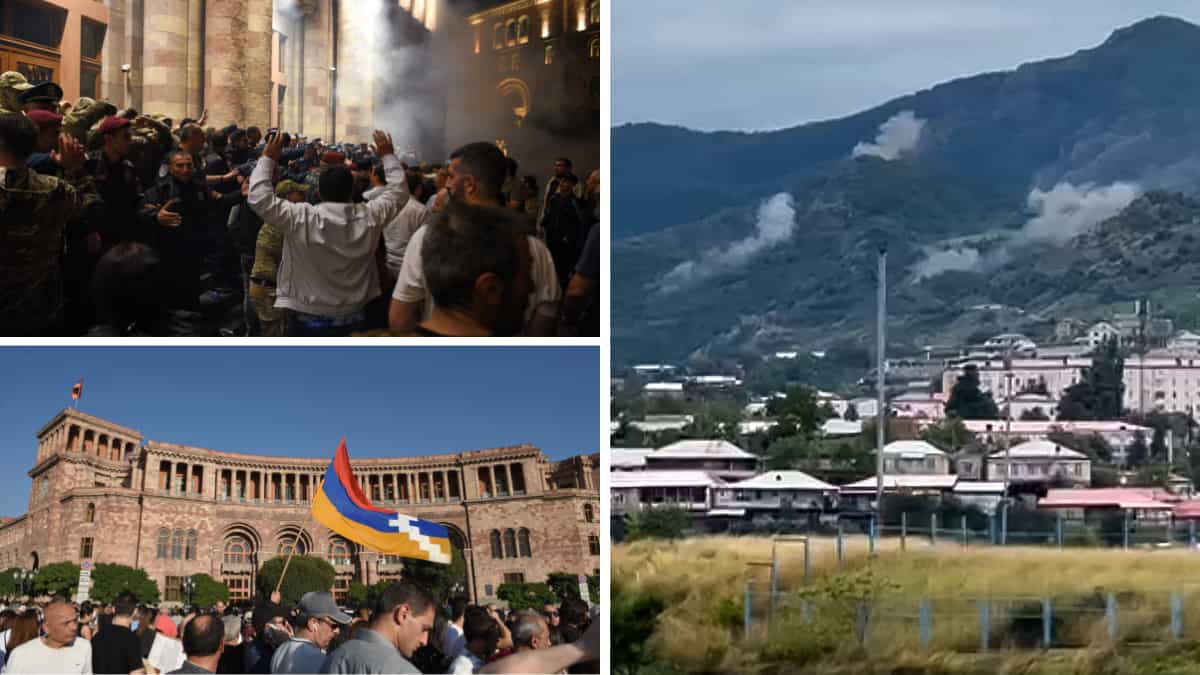
Armenia-Azerbaijan conflict
Azerbaijan, on Tuesday (September 19), launched a military operation against the Armenian-controlled Karabakh regionin a bid to bring the breakaway region under its control by force, sparking fears of another war with its neighbouring Armenia in the volatile Caucasus region.
Azerbaijani strikeshave reportedly killed dozens and injured hundreds and garnered criticism from the United States, France, Germany and so on. Russia, the traditional power broker in the region, has been accused of being too distracted by its own war in Ukraine.
While Karabakh is internationally recognised as Azerbaijani territory, part of it is run by separatist Armenian authorities who have claimed the area as their ancestral homeland.

Azerbaijani strikes affect thousands
According to the separatist officials more than 7,000 people from 16 villages had been evacuated since the strikes began.
“Over 7,000 people have been evacuated from 16 civilian communities of Askeran, Martakert, Martuni, Shushi regions of Artsakh/Nagorno-Karabakh,” said Gegham Stepanyan, Karabakh’s rights ombudsman, on X.
)
Pentagon revives mandatory testosterone testing for male troops aged 30 and above
)
FACT CHECK: Why did PM Modi ask Xi ‘is it okay’ at BRICS Summit? New video reveals...
)
India seeks to build a full semiconductor supply chain
&im=FitAndFill=(700,400))
From Abhishek Sharma to Sahil Chauhan, 5 batters with fastest T20I hundreds
)
Pyongyang dismisses US, western pressure over nuclear programme
)
US And Denmark reach Greenland deal, Trump announces expanded military presence
)
Google’s Gemini AI hacks real systems by guessing passwords during security test
)
US hiding troop deaths in Iran war? Toll higher than Pentagon count, claims report
)
China may have gained access to US's classified F-35 jets; parts meant for repairs diverted to Hong Kong, sparking Pentagon inquiry
)
NASA research plane reaches 61,000 feet over Panama
)
Godfather of AI Geoffrey Hinton gives US lawmakers a one-year warning on AI
)
Shivakumar attends 79th Kalyana Karnataka Utsav in Kalaburagi
)
Trump signs Russia sanctions law: India faces fresh 100% tariff threat over Russian oil
)
Brigitte Bardot’s private collection set for Paris auction; key items and prices revealed
)
Why Ranveer Singh’s Dhurandhar missed India’s Oscar entry; FFI jury member reveals what happened
)
Zendaya and Tom Holland step out for a low-key date in Los Angeles
)
‘Will go to any extent’: Pakistan vows to defend Saudi Arabia amid Houthi attacks
)
The Verdict | When precision fails: US commits war crime in Minab school strike, UN finds
)
Trump signs Russia sanctions bill into law, targets Moscow’s energy sector
&im=FitAndFill=(700,400))
New Friday OTT releases (September 18, 2026): Lust Stories 3, You+Me, Best of the Best- 8 new titles coming on Netflix, Prime Video and more
)
Pak: A series of counter terrorism operations in Khyber Pakhtunkhwa
)
Fast bowler Brydon Carse faces no charges over Derby nightclub incident
)
Flying cars in UAE: Ras Al Khaimah signs deal with Chinese company to test new transport
)
Africa is splitting, and a lot sooner than estimated, giving way to a new ocean
)
'Gangsta' crab shoves knife blade at man and his dog in Florida - Watch
)
Trump bans CNN, MS NOW and Politico from White House over ‘FAKE NEWS’
)
Trump 2.0: Dark days ahead for America’s ‘imperial presidency’
)
Trump's Greenland dream comes true? POTUS announces 'Infinite Life' deal with Denmark, claims permanent US control
)
Who is Khalilur Rahman? All you need to know about 81st UN General Assembly President
)
Tirupati Laddu ghee adulterated with chemicals, says ED, supplier arrested
)
IIT Bombay student dies by suicide, was caught seeking AI help during exams
&im=FitAndFill=(700,400))
Meet top 5 bowlers in latest ICC T20I rankings
)
Indian Cinema bets big on mythology, brings ancient stories to modern audiences
)
Ukraine plans record $109 bn defence spending, nearly two thirds of budget amid Russia war
)
Russia holds first parliamentary elections since the beginning of the Ukraine war
&im=FitAndFill=(700,400))
Meet top 5 Indian batters with fastest T20I centuries
Media reports citing Karabakh separatist authorities said that at least 25 people had been killed, including two civilians and 138 others had been injured after Baku launched the military strikes. However, these claims could not be independently verified.
Ruben Vardanyan, a top official in Karabakh’s ethnic Armenian administration until February, said, “A really serious situation has unfolded here…Azerbaijan has started a full-scale military operation against 120,000 inhabitants, of which 30,000 are children, pregnant women and old people.”
The officials in Karabakh also claimed that Azerbaijan pounded the territory with artillery, combat aircraft and attack drones and said that their forces were “trying to advance” into the territory.
Baku about the military operation
Hikmet Hajiyev, foreign policy adviser to Azerbaijani President Ilham Aliyev, said that they have deployed ground forces and broken through Armenian lines in several places. The claim has been denied by Armenian separatists saying that “fighting continues along the entire line of contact.”
Azerbaijan intends to “close a chapter of animosity and confrontation,” said Hajiyev, adding that they no longer tolerate having armed forces on their territory which “on a daily basis, challenges the security and sovereignty of Azerbaijan.”
The Azerbaijani defence ministry also claimed that their forces have seized more than 60 military posts and destroyed up to 20 military vehicles with other hardware.
“Illegal Armenian armed forces” must surrender, said Azerbaijan’s presidency, adding that “Otherwise, the anti-terrorist measures will continue until the end.”
It was not immediately clear if Armenia would intervene or if Baku’s actions would trigger a full-scale conflict dragging in Yerevan.
The two countries have fought two wars since 1991 – the fall of the Soviet Union – over the disputed territory, with themost recent one being in 2020 which ended after a Russia-brokered ceasefire.
Unrest and calls for coup in Armenia
Armenia is dealing with unrest as angry protesters clashed with police in Yerevan calling for Prime Minister Nikol Pashinyan to resign. More than 30 people were injured in the clashes, with 16 people hospitalised, said the Armenian health ministry.
“We must not allow certain people, certain forces to deal a blow to the Armenian state,” said the Armenian PM, in a televised address. He added, “There are already calls, coming from different places, to stage a coup in Armenia.”
He also accused Azerbaijan of engaging in “ethnic cleansing of Karabakh Armenians” and said that the Armenian army was not involved in the fighting and described the situation at the border between the two countries as “stable”.
How have countries reacted?
Azerbaijan’s military strikes have been condemned by the US, European Union, France and Germany asking Baku to return to talks on the future of Karabakh with Armenia. Yerevan has called on members of the UN Security Council to help and Russian peacekeepers on the ground to intervene.
Kremlin spokesman Dmitry Peskov, on Tuesday, said Russia is in touch with both Azerbaijan and Armenia and has urged negotiations, adding that Moscow considered ensuring civilian safety the most important issue.
Meanwhile, Turkey said it supported Baku’s drive to preserve its territorial integrity.
What led to conflict?
Nagorno-Karabakh, an area controlled by Azerbaijan has a majority ethnic-Armenian population.
During the Soviet days, the was an autonomous region inside the Azerbaijani Soviet Socialist Republic.
Though the region didn’t gain much attention due to the absence of international borders, all that changed after Moscow lost control of its peripheral republics, and Nagorno-Karabakh was formally left inside Azerbaijan’s internationally recognized territory.
During the collapse of the USSR from 1988 to 1994, Armenian and Azerbaijani forces fought a gruelling series of battles over the region, with the Armenians taking control of swathes of land and forcing the mass exodus of hundreds of thousands of ethnic Azerbaijanis.
Since then, citing a 1991 referendum — boycotted by Azerbaijanis — the Karabakh-Armenians have unilaterally declared independence and maintained a de facto independent state.
For nearly three decades that situation remained stable, with the two sides locked in a stalemate that was maintained by a line of bunkers, landmines and anti-tank defences, frequently given as an example of one of the world’s few “frozen conflicts.”
However, that all changed in 2020, when Azerbaijan launched a 44-day war to regain territory, conquering hundreds of square kilometres around all sides of Nagorno-Karabakh. That left the ethnic Armenian exclave connected to Armenia proper by a single road, the Lachin Corridor — supposedly under the protection ofRussian peacekeepers as part of a Moscow-brokered ceasefire agreement.
(With inputs from agencies)
WATCH WION LIVE HERE
You can now write for wionews.com and be a part of the community. Share your stories and opinions with us here.