&imwidth=800&imheight=600&format=webp&quality=medium "AI, machines and human deminers lead Ukraine’s prolonged battle to clear vast minefields")
In central Ukraine, near Myrotske, deminers advance in careful formation, sweeping metal detectors across ground that remains contaminated with mines and unexploded ordnance left behind after Russian occupation early in the invasion. The work reflects a broader national challenge: clearing land that remains dangerous years after active fighting has moved on. Alongside manual clearance teams, Ukraine’s demining effort now increasingly relies on drones, artificial intelligence and remote-controlled machinery to manage a task described as among the largest in the world.
A Country Defined by Contamination
UNDP said that Ukraine is now the most heavily mined country globally, with around 23 percent of its territory potentially affected by landmines and unexploded ordnance, according to a 2024 analysis. State-run Demine Ukraine estimates more than 1,32,000 square kilometres remain contaminated, while nearly 42,000 square kilometres have already been cleared.

The scale carries both human and economic consequences, with clearance costs projected at about $34.6 billion and as many as 1,286 civilian victims recorded by August 2024. Olena Shustova of HALO Trust told Reuters, “Unfortunately, Ukraine is the most heavily mined country in the world,” adding, “Ukraine will not be demined in less than 10 years.” She also noted, “Everywhere where there was occupation, there are minefields and explosive ordnance.”
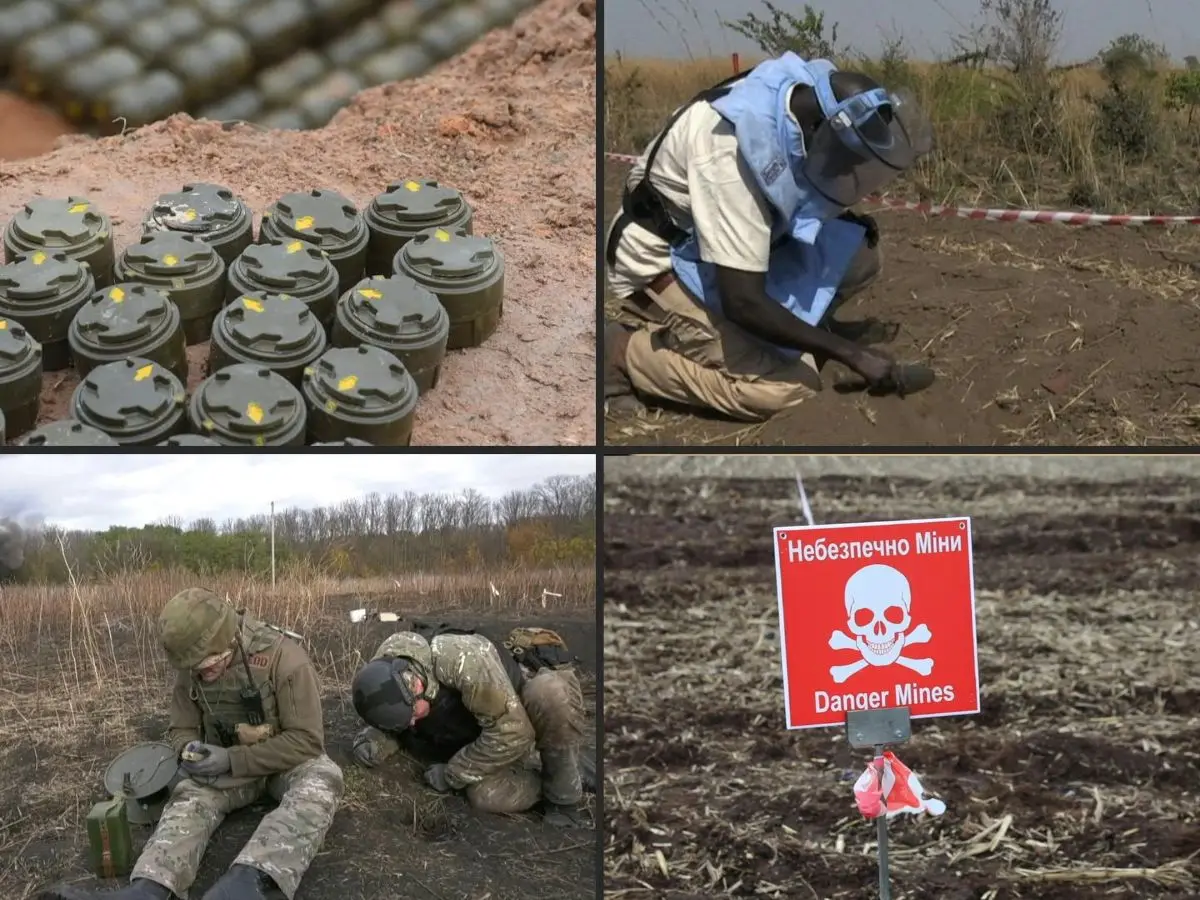)
AI, Robotics and Deminers Combine in Ukraine’s Long Battle to Clear War Contamination Photograph: (AFP)
Drones, Data and Artificial Intelligence
Huge areas of Ukraine are littered with mines and other discarded ordnance after years of fighting. To accelerate progress, HALO Trust has expanded the use of UAVs to capture high-resolution aerial imagery of suspected minefields, helping identify surface-level threats such as trip wires, improvised explosive devices and fragmentation mines. The organisation also applies artificial intelligence to process drone data, with systems reaching around 70 percent accuracy in detecting explosive remnants. UNDP has noted that veterans affected by ordnance are being trained in drone operation and imagery analysis, highlighting a growing reliance on technical expertise. Shustova said, “The process may take decades, but advances in technology are helping to accelerate it.”
Machines on the Front Line of Clearance
Using the newest technology and innovations speeds up the process. At a demining site north of Kyiv, Oleksandr Liatsevych operates a modified excavator remotely from a reinforced steel shelter, using virtual reality goggles and a joystick to guide its movements as it breaks down contaminated soil.
“The difference between driving from a cabin and driving a remote joystick is big,” he said, according to Reuters. Nearby, deminer Olha Kava continues manual clearance in full protective gear, searching for buried explosives by hand. “Of course, there is fear,” she said, adding that it “motivates you to do your job correctly and responsibly.” Together, human labour and machine assistance are reshaping how Ukraine approaches one of its most dangerous post-war tasks. Ukraine is advancing new technologies for mine clearance, but removing contamination across affected areas remains a complex and lengthy process.
Trending Stories
&im=FitAndFill=(700,400))
National Handloom Day 2026: From Alia Bhatt to Samantha Ruth Prabhu; Actresses who celebrated India's textile heritage as brides
)
The Royals enter the Doctor Who universe: King Charles and Queen Camilla beam into Commonwealth Games in TARDIS
)
Unitree Robotics targets $9 billion valuation in landmark IPO backed by DeepSeek and Tencent
)
India names 27 sites in Arunachal Pradesh
)
Bharat Bhhagya Viddhaata OTT: When will Kangana Ranaut's film stream online?
&im=FitAndFill=(700,400))
How many soldiers operate one S-400 battery?
)
Shakib Al Hasan ready to return to Bangladesh—under one condition
)
‘Fake news’: MEA rejects report claiming India sought defence pact with Israel after Pakistan, Saudi Arabia, Turkey deal
)
Rockstar to unveil GTA 6 extended look ahead of November launch
)
Russia forms Ukrainian Volunteer Spetsnaz Brigade to fight Ukraine
)
Drug-resistant fungus that hides in hair and enters bloodstream reported in 23 US states
)
Technology transfer deal boosts India's defence manufacturing ambitions
)
Border row erupts in Europe after Ceuta crossings, Spain imposes border controls on Italy
)
Morale plummets on USS Abraham Lincoln: Are US sailors reaching a breaking point? | GRAVITAS
)
'Security can't be bought with Pakistan, Turkey deal': Iran tells Saudi Arabia
)
Baba Vanga's 2026 prophecy: 2 predictions 'already came true', 3 terrifying ones remain. Details inside
)
Colombia’s new president Abelardo de la Espriella vows to ‘defeat narco-terrorists’, signals hardline shift
&im=FitAndFill=(700,400))
New Friday OTT releases (August 7, 2026): Operation Safed Sagar, Vadhandhi, Main Vaapis Aaunga- 6 movies and TV shows on Netflix, Prime Video and more
)
Squadron Leader Bhawana Kanth scripts history as Indian Air Force gets its first woman ‘Top Gun’ pilot
)
RSS says Gen Z protests reflect genuine distress
)
Trump says Iranian school bombing photos could be AI-generated - 'I don’t think...'
)
IAF officer held for sharing sensitive information in 'honey trap' case, booked under Official Secrets Act
)
Stray Kids under scrutiny? Fans react to Grammy submission silence after BTS boycott
&im=FitAndFill=(700,400))
Why the Su-30MKI doesn't need external fuel tanks to fly vast distances
)
Jugal Hansraj reunites with Shekhar Kapur after 40 years for Masoom: The Next Generation
)
New speed limits, automatic challans: Big traffic change coming to Delhi-Meerut Expressway. All you need to know
)
India officially names 27 places in Arunachal to counter China's renaming claims
)
Trump calls White House ballroom ruling a 'national disgrace' as court says Congress approval needed
)
US sanctions Iran’s crypto network after Strait of Hormuz attacks, offers $15m bounty for intel on IRGC finance
&im=FitAndFill=(700,400))
Why the Su-30MKI is one of the heaviest fighters ever built
)
Uttarakhand young innovator builds India's own flying vehicle, conducts first test flight: WATCH
)
Chilling video shows students take cover as teen opens fire at Thai school
)
Reese Witherspoon's father hospitalised after poolside incident in Nashville: Report