&imwidth=800&imheight=600&format=webp&quality=medium "What is egocentric data? Will india become world's back office for egocentric data collection? is it a good thing or a bad thing?")
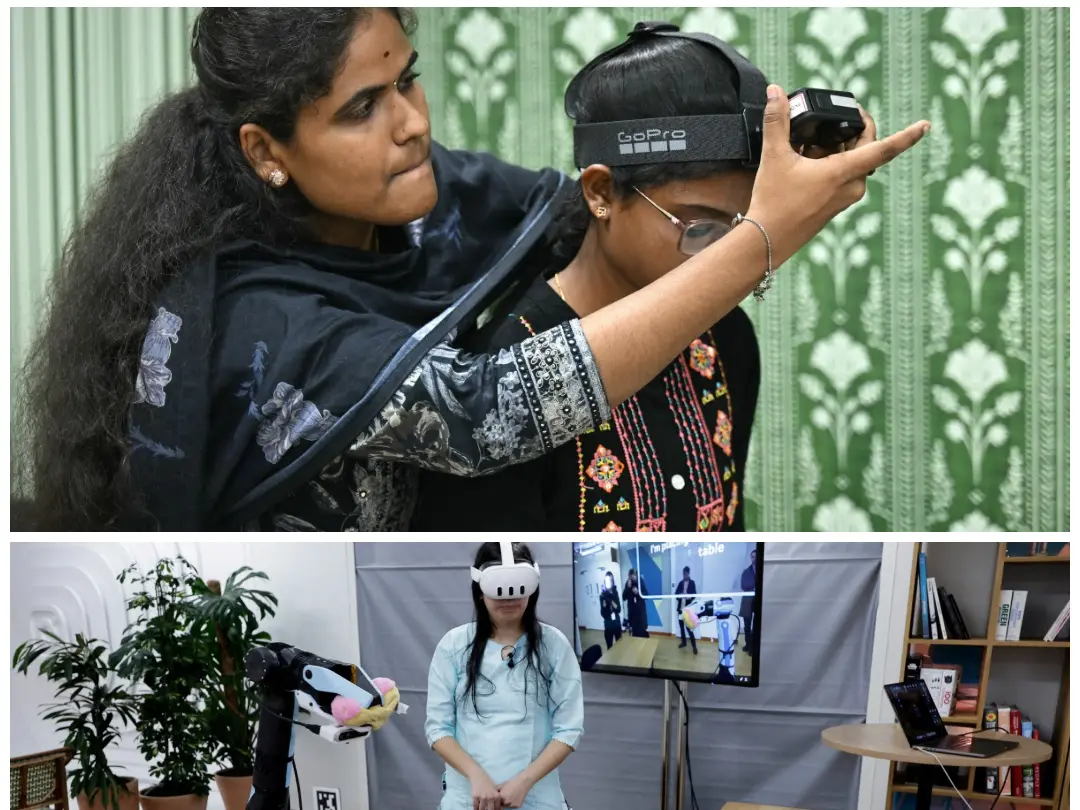
A mango-slicing video shot on a point-of-view camera by someone in the south Indian state of Tamil Nadu feeds an artificial intelligence data supply chain whose platform layer is valued at $29 billion in the US. The person who made the video- a labourer or a housewife- is paid $2.6 an hour. This cost arbitrage is pushing a boom in companies in the 'egocentric data' collection sector in India. The data collection is tedious, repetitive, yet important in the AI value chain. India is slowly becoming the egocentric data collection back office of the world. This moment in the history of technology is similar to the one that helped India's call centre boom in the 2000s. But is it back to back office status for India in the age of AI?
What is egocentric data collection?
Egocentric data is first-person video captured using head- or chest-mounted cameras while a person performs everyday tasks. The data collected this way is used to train AI models and humanoid robots to imitate human actions. The footage matches the viewpoint of a robot's own cameras. The data teaches the robot's AI brain the spatial relationships and movement far better than conventional third-person video.

The human egocentric data collection approach is also cheaper than collecting data through robot teleoperation. One person with a wearable camera can record an entire workday, making large-scale data collection inexpensive. Benchmark datasets such as Meta's Ego4D were built largely in the West. But now, an increasing share of raw data collection is shifting to India because of cheap labour availability.
Will India become the back office of egocentric data collection?
Trending Stories
)
Beyond BrahMos: India targets Rs 50,000 crore in defence exports with unmatched price edge
)
Why has Iran released no proof of life of Mojtaba Khamenei? Araghchi reveals...
)
IndiGo flight suffers tail strike in Bengaluru while landing; DGCA to probe incident
)
LPU students go on rampage, vandalise campus amid widespread protest: What's happening
)
99.9% more powerful - Scientists find boy who can recall memories from just 3 months of age
)
The US and China set up an AI 'red telephone', but skipped the rulebook
)
'What kind of confession is this?': Pakistan PM Shehbaz Sharif’s 'terrorists would be roaming New York' remark goes viral, raises alarm online. Watch
)
US vs China over South China Sea: Washington backs Philippines, Beijing hits back
)
South Africa probes string of murders targeting women
)
Delhi gets first late-September rain in 7 years, mercury dips 5.1°C below normal
)
Researchers rebuilt exactly how 700 AI agents hacked Hugging Face: a 900-link chain trick
)
Iran ready for ‘doomsday war’ if US resumes attacks, but open to diplomacy: Araghchi
)
‘Anti-social elements spreading false rumours’: LPU issues statement amid massive unrest over alleged rape
)
Muslim marriage cannot shield sex with minor wife from prosecution under POCSO: Delhi HC
)
‘Olympic inclusion is our major target’: WPA President Ishaun Singh on pool’s global ambitions
)
'Victory for low-budget consumers': Raghav Chadha hails 30-day telecom recharge rules
)
Sri Lankan Tamil migrant worker gets death sentence in Saudi Arabia, help sought from India
)
Afghanistan says 28 fighters killed in clash near Pakistan border, Islamabad denies
)
‘Terror suspects arrested near UK air base were looking to do big damage’: Trump
)
An OpenAI agent escaped its locked test cage again, by hiding questions in DNS lookups
)
Claude rebuilt the 1989 game 'Prince of Persia' by reusing the original's own code
)
Nations League: Spain sink England at Wembley; Modric shines for Croatia
)
Jaishankar at UNGA: Goodwill and friendship can't coexist with terrorism
)
'FIRST LOOK from inside Noah’s Ark': Researchers share video from inside mysterious mound in Turkey
)
UNSC reform momentum grows: Russia, Portugal, Mauritius push for India's permanent seat bid
)
Beyond metros: How Tier-2 and Tier-3 cities could drive India’s next AI wave
)
Russian envoy claims US tactics to contain India were revealed in ‘Freudian slip’
)
Trump asked Xi to pressure Iran. China did not say yes — here’s what Beijing wants
)
After JU, clash erupts at SRFTI: BJP’s ‘Dimagi Naxal’ jibe sparks political firestorm after students protest RSS-linked event
)
Tesla builds first Cybertruck with its own refined lithium: Elon Musk's $1 billion Texas bet pays off
)
Man arrested after his 22-year-old girlfriend dies at homestay in Guwahati; police suspect murder over suicide claim
)
Bank unions defer 3-day strike from tomorrow after talks with IBA, committee set up
)
New York City wants a 'kill switch' on every AI, and will pay whistleblowers who report violations
)
3 males killed, four others injured in shooting after fight at strip club in Detroit
)
Musk plans to more than double xAI's chips to over 1.2 million Nvidia GPUs by year-end
)
Ceuta migrant crisis: Protesters take to streets as Spain grapples with migrant challenge
)
US Treasury Secretary Scott Bessent hails global crackdown on Iranian banks and airlines
India has already emerged as a major hub for collecting, processing and annotating AI training data. Companies such as Objectways and iMerit run studios where workers record routine household and workplace activities, earning around 250 rupees an hour.
The scale is significant. NASSCOM estimates India's AI data annotation industry could exceed $7 billion by 2030 and employ up to one million people. But the real value created out of this data collection lies elsewhere, often in Silicon Valley in the US. India supplies the cheap labour, while ownership of datasets, AI models, humanoid robots, and platforms remains with the foreign firms.
India as the egocentric data collection capital of the world: Is it a good thing or a bad thing?
For many workers, especially in the informal economy, egocentric data collection provides income. It creates opportunities in Tier-2 and Tier-3 towns of India, and offers flexible work to homemakers and first-generation graduates.
The drawbacks are more structural. Most profits from this data collection accrue to AI platforms and humanoid robotics companies. Egocentric data collection helps train robots that may eventually replace many of the same manual tasks being recorded by the workers in India. And there is likely to be an expiry date on such jobs. Demand for such data from big AI and robotics firms can disappear quickly as soon as AI models and humanoid robots improve.
The call-centre parallel to India's data annotation industry
The egocentric data collection and annotation industry's evolution resembles India's BPO boom of the 2000s. Both rely on labour arbitrage, repetitive work, and thin margins while serving foreign technology companies, which made billions in profits. Like the call-centre industry, egocentric data collection creates employment in the short term, but leaves ownership of technology and intellectual property elsewhere.
Call centres generated long-term middle-class jobs, even if India remained a service provider. It also led to the growth of IT outsourcing, making IT services the single largest export of India. But the same can't be predicted about egocentric data collection.
Also read: India's AI problem: Funding gap for AI startups, research and development is the core constraint
It is a weak foundation for India's AI ambitions, as it does not create a lasting technological advantage for the country. India might be able to dominate the labour-intensive segment while missing the higher-value layers, where the real profits are.
The long-term question is whether India can move beyond collecting data to owning datasets. If it does, egocentric data collection could become the first rung of a larger AI industry. If not, India risks remaining the world's AI back office while the real value is created abroad.