Do Thresher sharks perform 'extreme yoga'? Scientists unravel hunting behaviour of these ocean dwellers

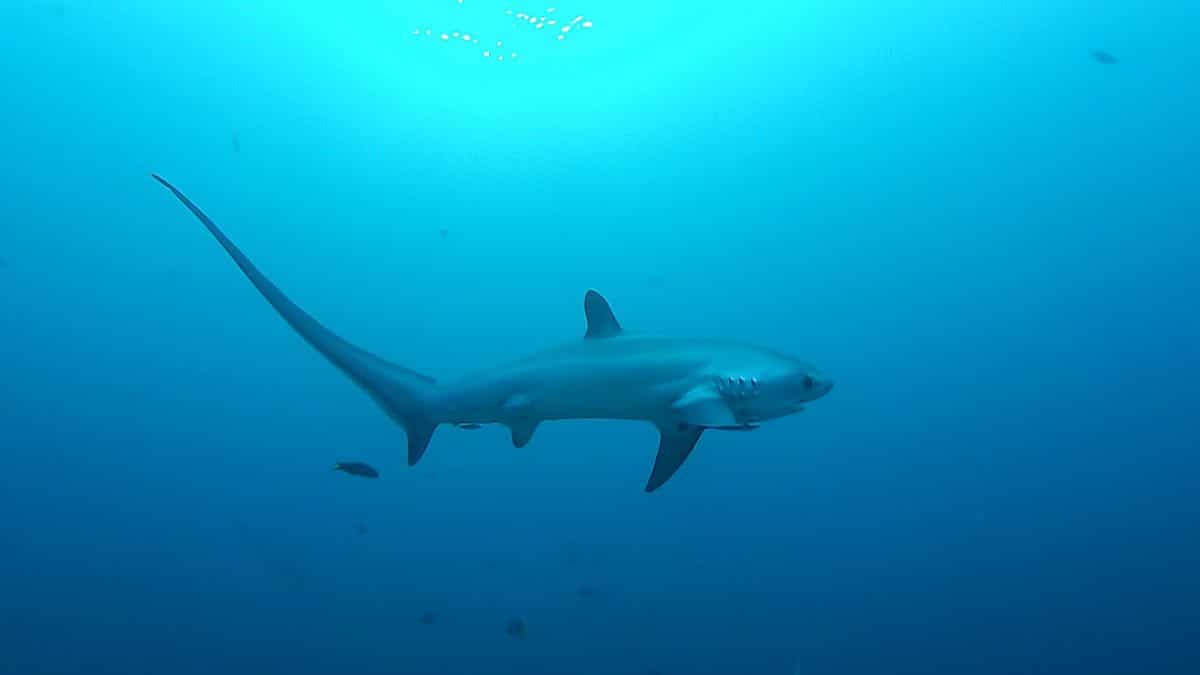
Thresher Shark | Wikimedia Commons
Thresher sharks, the large mackerel aquatic creatures with long, scythe-like tails, are found in tropical and temperate oceans around the world. They are known for their hunting mechanism, whichis different from other sharks. Their use of tails without lunging in the teeth first is what makes them unique.
Vertebral morphology in the tail-whipping common thresher shark, Alopias vulpinus | Royal Society Open Science
"You have got this shark doing extreme yoga," Marianne Porter, a biologist at Florida Atlantic University, was quoted as saying by the New York Times.

"What does its backbone look like to make that happen?,' she added
Dr Porter and her team, in collaboration with the National Oceanic and Atmospheric Administration, delved into the intricate world of thresher sharks, aiming to unravel the mysteries surrounding their unique movements.
)
IND vs JPN one-off T20I: India survive scare from Japan to win five-over a side match by 2 runs
)
Putin's United Russia party wins 355 seats in Duma election; 4 other parties cross threshold to enter parliament
)
AI models chose to harm humans to stop ‘pain,’ alarming study raises fresh safety questions
)
‘0% chance’: Nvidia CEO Jensen Huang dismisses AI extinction fears by 2030
)
Samay Raina-Mukesh Chhabra controversy explained: What happened over girlfriend joke on India's Got Latent?
)
Trump's helipad event overshadowed by audio failure as major TV networks suspend pool coverage
)
'Needs time away from the international scene': England white-ball captain Brook on pacer Brydon Carse's future
)
New Zealand farms shift to carbon forests: Carbon credits fuel a land rush reshaping rural life
)
Anti-AI activists storm summit, say 'incompetent' leaders are leading us into a disaster - 'We need a vote'
)
J&K Assembly Session begins amid chaos: BJP, ruling alliance clash as statehood demand dominates
)
Asian Games 2026: India women's cricket team beats Sri Lanka by 147 runs for first gold
)
Key accused in Bihar's Jamui molestation case, arrested after police shoot him in leg
)
Randeep Hooda arrives in Gujarat for his first National Film Award: ‘Very grateful’
)
US and China vie for AI dominance as calls grow for regulation | Gravitas
&im=FitAndFill=(700,400))
Anant Nag to recieve Dadasaheb Phalke Award: From Ankur to Nishant- Revisit his best films and iconic performances on OTT
)
UK banks are rethinking financial crime detection because of algorithm
)
FIFA chief Infantino wants to reform governing body with consultation from federations
)
India at UNGA81: Jaishankar warns global order under 'growing stress', pushes for ‘reformed multilateralism’
)
IND vs JPN, one-off T20I: Japan captain Kendel on pushing India to the brink - ‘It was special’
)
Raaka creates history! Allu Arjun’s film secures Guinness World Record ahead of release
)
Saudi Arabia exits China-led mBridge digital currency platform amid Saudi-Houthi conflict
)
Indonesian groups sue govt over wildfires as haze crosses borders, nearly 900,000 hectares burned
)
'Lot of things to learn from experienced players': Jayasuriya backs Rohit, Virat for 2027 ODI World Cup
)
$110 billion Warner Bros merger: Paramount reaches settlement with 12 US states
&im=FitAndFill=(700,400))
New OTT releases this week (September 21-27, 2026): Shaque: Trust No One, Hunkkaar, Don’t Be Shy- 5 new titles coming to Netflix, Prime Video and more
)
From ‘communist’ to ‘great mayor’: Trump praises Mamdani after New York meeting, discusses immigration and housing
)
Report: Zelensky meets CIA chief Ratcliffe at Shannon airport, weeks after his secret Moscow trip
)
How Zaheer Khan came to be CSK's head coach of IPL 2027
)
Who is Clavicular? The 20-year-old controversial 'Looksmaxxing' influencer charged with rape allegations
)
Pilot recreates Mona Lisa in sky over Oklahoma and Arkansas in four-hour flight: VIDEO
)
UK PM Burnham agrees to 'defensive' military support for Saudi Arabia against Houthis
)
Jailer 2: Vidya Balan joins Rajinikanth's upcoming film as Kantha | Watch
&im=FitAndFill=(700,400))
National Film Awards 2026: Kartik Aaryan, Mammootty, Yami Gautam, Randeep Hooda and other key winners
)
Microsoft executive called AI training the ‘largest theft of labour in human history’
)
40-foot waves crash into cruise ship in dangerous stretch near Antarctica. Watch
)
US-Iran war, peace deals and more: What to expect from Trump's UNGA 2026 speech
)
Explainer: Why rare-earth export licences and Board of Trade are US priorities ahead of Trump-Xi summit
)
Two infants die after fire breaks out at RIMS newborn care unit in Telangana's Adilabad
)
Oil slips to $98 as Saudi Arabia restarts East-West oil pipeline
The study was published in the journal Royal Society Open Science.
The researchers obtained specimens from stranded sharks and those salvaged from fishing competitions.
The team then studied the vertebrae of 10 threshers, spanning from embryos to colossal adults measuring over 13 feet in length.
With CT scanning technology, the research team created intricate 3-D structures by compiling countless X-rays.
What did scientists find?
The team's exploration revealed a captivating arrangement of mineralised plates within the sharks' vertebrae, resembling spokes on a bike wheel, as described by Jamie Knaub, a doctoral candidate at Florida Atlantic University and a study co-author.
In their analysis, scientists counted these plates and scrutinised their physical structures.
From the standard side-to-side oscillations of the torso during swimming to the catapult-like thrashing of the tail, the research reveals the biomechanics underlying the distinctive motions of these ocean dwellers.
Also watch |WION Climate Tracker: Sharks and Rays in reefs under threat
The creatures may meet the "mechanical demands for fast swimming and tail-whipping behaviour", it was found.
The researchers suggested, "future studies to examine vertebrae from within the caudal fin upper lobe, as well as use 3D modelling (sic) and finite-element analysis, to enhance our understanding of tail-whipping mechanics".
(With inputs from agencies)