

&imwidth=800&imheight=600&format=webp&quality=medium "People shouldn't be afraid of their government. Governments should be afraid of their people: Lessons from South Asia")
The first part of this article's headline is a quote from the 2005 movie V for Vendetta, based on the graphic novel of the same name by Alan Moore and David Lloyd. The line is spoken by V, the masked anarchist titular character fighting a fascist regime in a dystopian future Britain. When one looks at the recent mass protests that toppled governments in South Asia, the crux of these lines is being proven again: that the people are the sovereigns, and the power of the government is derived from the consent of the governed. When regimes tinker with that consent for too long with impunity, eruptions will happen, as the people have the right, and responsibility, to overthrow them. It is not uncommon for governments to forget that they exist to serve the people, and not the other way round. They can be overthrown – by ballots or bullets – if they violate people's trust. Unchecked authoritarianism and corruption will be met with often unexpected levels of resistance and violence.
What should the governments of the region and further afield learn from the Nepal protest?
When people rise up against their government: The tipping point
There is always a cocktail of causes that lead to a tipping point: collective action follows when fear, repression, or economic hardship become so unbearable that people are willing to die to make their nations a better place. In South Asia, this idea manifested vividly in recent protests across Nepal, Bangladesh, Sri Lanka, Myanmar, Afghanistan, and Pakistan. Some of these movements were successful, some led to further chaos and uncertainty, while others are still evolving.
Also read: Guns fired, weapons seized, buildings burnt: The deadly day of violence in Nepal protest IN PICS
But the causes are similar: economic hardship marked by high cost of living and unemployment, authoritarian overreach, social injustices. That’s when ordinary citizens, particularly the youth, roam the streets in defiance of state control, forcing regime changes, government backdowns, or ongoing armed struggles. The outcomes vary by country, but the essence remains the same: when governments consistently instil fear, something breaks in people. In fact their anger makes them fearless.
Trending Stories
&imwidth=180&imheight=135&format=webp&quality=medium)
'Hell of a beautiful a**': Trump compliments Nicki Minaj as rapper joins him in Michigan rally
&imwidth=180&imheight=135&format=webp&quality=medium)
'Hire the robot, fire the human': Bill Gates's words hint at a bleak future
&imwidth=180&imheight=135&format=webp&quality=medium)
'Lousy president': Trump hits back at Obama over 'cheesecake factory' White House jibe
&imwidth=180&imheight=135&format=webp&quality=medium)
Jordan strikes 'terrorist organisations' in Syria after deadly church attack as Damascus shuts main border crossing
&imwidth=180&imheight=135&format=webp&quality=medium)
Microsoft offers voluntary exit packages to 60,000 employees in India, US, UK and Canada
&imwidth=180&imheight=135&format=webp&quality=medium)
WATCH | Virat Kohli returns to training ahead of New Zealand ODI series
&imwidth=180&imheight=135&format=webp&quality=medium)
'He is a red flag': Ex-India strength and conditioning coach on Rohit's fitness regime
&imwidth=180&imheight=135&format=webp&quality=medium)
One dead, six injured in Elizabeth, New Jersey mass shooting; suspect flees
&imwidth=180&imheight=135&format=webp&quality=medium)
Maurene Comey, daughter of ex-FBI director James Comey, was unlawfully fired as federal prosecutor, judge rules
&imwidth=180&imheight=135&format=webp&quality=medium)
Hijack scare unfolds on United flight over suspicious text message. Here is what happened
&imwidth=180&imheight=135&format=webp&quality=medium)
‘That is a miss’: Ravi Ashwin questions Sooryavanshi’s demotion to No. 3 in 2nd T20I vs NZ
&imwidth=180&imheight=135&format=webp&quality=medium)
Pakistan airline PIA unveils new crew uniforms, faces online criticism
&imwidth=180&imheight=135&format=webp&quality=medium)
Police called after 3-year-old scores 10 goals in 12 minutes at Florida youth soccer game
&imwidth=180&imheight=135&format=webp&quality=medium)
Trick or Treat -Anthropic's IPO sales pitch is the perfect Halloween scare for AI enthusiasts
&im=FitAndFill=(700,400)&imwidth=180&imheight=135&format=webp&quality=medium)
New OTT releases this week (October 26-November 1, 2026): Baththa, Akka, The One About Matthew Perry- 7 titles coming on Netflix, Prime Video and more
&imwidth=180&imheight=135&format=webp&quality=medium)
Mohra re-release in 4K: Akshay Kumar, Raveena Tandon’s film to clash with Ranbir Kapoor’s Ramayana
&imwidth=180&imheight=135&format=webp&quality=medium)
US Midterms 2026: Last leg polls and forecasts indicate Democratic momentum, but Senate control remains uncertain
&imwidth=180&imheight=135&format=webp&quality=medium)
'Already tired of his 9-to-5': Baby born with a moustache becomes internet sensation, video goes viral | Watch
&imwidth=180&imheight=135&format=webp&quality=medium)
Zimbabwe slips four places to 14th out of 29 in Africa’s Digital Rights and Inclusion ranking
&imwidth=180&imheight=135&format=webp&quality=medium)
Storm Boelo’s fierce winds push passenger plane onto grass in UK, terrifying landing caught on cam
&imwidth=180&imheight=135&format=webp&quality=medium)
Democrats allege 'desperate efforts to cover up' Trump's involvement in Jeffrey Epstein sex crimes, release 50-page report
&imwidth=180&imheight=135&format=webp&quality=medium)
'She is a beautiful woman': Trump mocks Mexican President Sheinbaum, mimics her voice at US Midterms rally
&imwidth=180&imheight=135&format=webp&quality=medium)
Uttarakhand innovator Ravi Tamta builds flying car without any formal engineering degree
&imwidth=180&imheight=135&format=webp&quality=medium)
US midterms 2026: Democrat Annie Andrews gains bipartisan backing against Trump's pick Darline Graham in South Carolina Senate race
&imwidth=180&imheight=135&format=webp&quality=medium)
Chris Brown given suspended eight-month jail term for London nightclub attack
&imwidth=180&imheight=135&format=webp&quality=medium)
Shah Rukh Khan unveils new poster of King, Internet reacts
&imwidth=180&imheight=135&format=webp&quality=medium)
'Shove that ballroom up your a**': Trump heckled at Mississippi rally over White House ballroom renovations | WATCH
&imwidth=180&imheight=135&format=webp&quality=medium)
Trump accused of 'brutal' rape by ex-Miss Switzerland; Beatrice Keul alleges 'Don's best friend' Epstein facilitated assault in 1993
&imwidth=180&imheight=135&format=webp&quality=medium)
Meta’s AI bet is getting more expensive: What its $95 billion share plan means
&imwidth=180&imheight=135&format=webp&quality=medium)
Trump’s oil and gas holdings surge to $81.6 million amid Iran war as Americans face rising fuel costs
&imwidth=180&imheight=135&format=webp&quality=medium)
'I've done my work sincerely': AR Rahman on facing backlash over Ramayana soundtrack
Nepal: Youth-led uprising against corruption and censorship morphs into mayhem
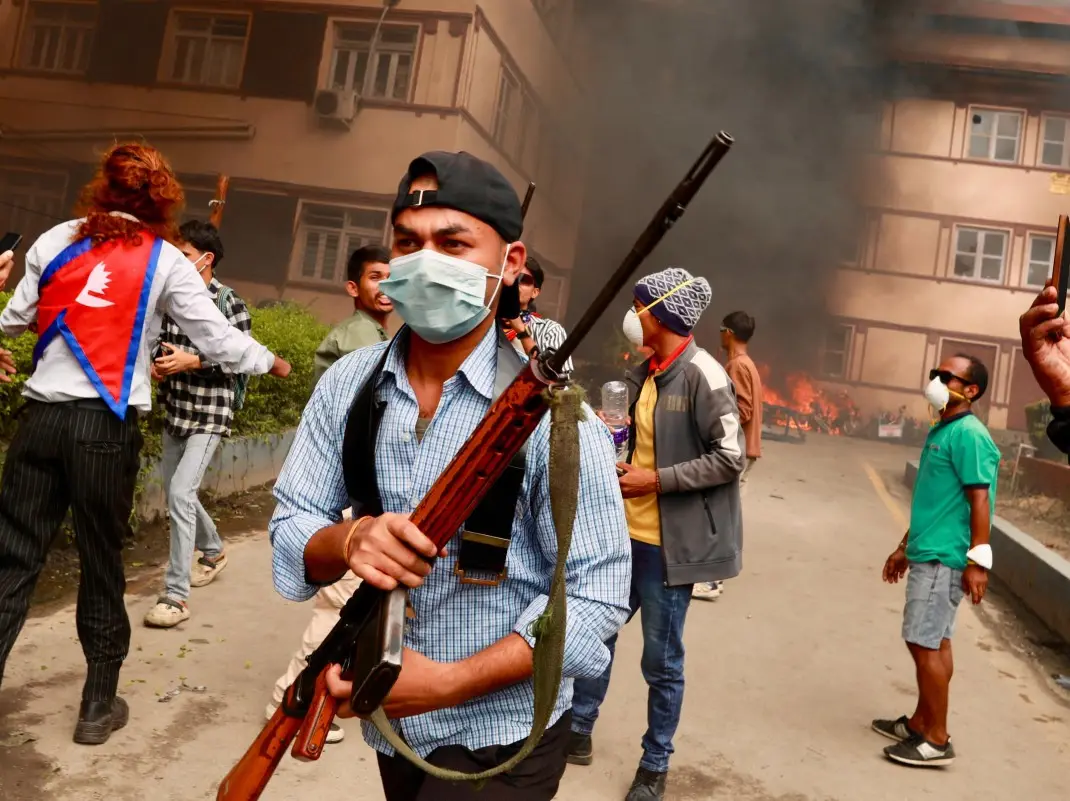
In a matter of a week this month, Nepal erupted in widespread "Gen Z" protests triggered by a government ban on social media platforms like Facebook, YouTube, and X. The ostensible reason was the platforms’ alleged failure to register under a new law, but the protests against it went beyond the youth and became an expression of fury over rampant corruption, nepotism ("nepo kids" of elites flaunting luxury amid poverty), and economic stagnation. As youth unemployment hit 20.8 per cent, the protesters – mostly teenagers and young adults – defied curfews, set fire to government buildings like Parliament and the Supreme Court, and targeted politicians' homes, reportedly leading to at least 22 deaths.
The government's violent response – deploying the army and imposing curfews – was evidence of how much it feared its own people. The fragility of the government was evident when Prime Minister KP Sharma Oli resigned and was seen boarding a chopper just two days into the protests, after four cabinet ministers stepped down. The social media ban was lifted, and President Ram Chandra Paudel invited Gen Z leaders for talks, exposing the regime's vulnerability.
Bangladesh: Student-led revolution topples a government
The 2024 student-led "July Revolution" in Bangladesh started as a protest against the reinstatement of a 30 per cent job quota for descendants of 1971 war veterans, even as the youth were reeling under high unemployment. Peaceful demonstrations soon spiralled into a mass uprising against Prime Minister Sheikh Hasina's 15-year rule. Hasina faced allegations of corruption, media suppression, and election rigging of the 2024 polls which the opposition had boycotted. Protesters, joined by parents and opposition parties like BNP and Jamaat-e-Islami, stormed Hasina's residence on August 5, forcing her to flee the country.
The protests were fanned by the government's brutal crackdown ordered by Hasina, which reportedly resulted in 1,400 deaths, mostly at the hands of security forces. The "Long March to Dhaka" defied curfews, leading to Hasina's ouster and the taking over of an interim government led by Nobel laureate Muhammad Yunus.
Even though that 'revolution' soon spiralled into attacks on Awami League supporters and its ban, this was another instance of how the people showed that the government should fear them.
Sri Lanka's Aragalaya: A loud cry against years of family rule
The 2022 Aragalaya ("struggle") in Sri Lanka was the people’s collective response to the worst economic crisis since the South Asian island’s independence. In the post-pandemic world, the country defaulted on international debt, causing inflation and fuel shortages. The people were already opposed to the corruption under the Rajapaksa family. Days of protests and violence eventually forced President Gotabaya Rajapaksa to flee the country and resign in July. The protesters occupied the seats of power like the presidential palace. Their demand was a "system change", as poverty doubled to 25 per cent. Even today, the crisis's aftermath lingers, with IMF-mandated austerity measures still sparking smaller protests against high taxes and inequality.
The Sri Lankan government initially responded with brutal force and the weaponisation of repressive laws like the Prevention of Terrorism Act. But the people refused to leave the streets, and the struggle led to a different electoral result in 2024 that saw the left-leaning Anura Kumara Dissanayake's NPP alliance winning by a landslide. That was a repudiation of the elite that occupied power for decades. Here also, people made the government afraid of them, paving the way for a democratic renewal without full-scale violence.
Myanmar: From protests to armed people's war
Myanmar’s 2021 military coup and its aftermath is, however, a more nuanced story. After the removal of Aung San Suu Kyi's elected government and installation of a military junta, a massive civil disobedience and protest followed. It was met with lethal force, with at least 2,500 civilians reportedly killed. In the past two years, the civilian protests died down, with the resistance evolving into a civil war. The National Unity Government (NUG) and ethnic armed groups like the Arakan Army and Kachin Independence Army have captured territories like Lashio and Ann, controlling 42 per cent of the country.
The junta responded with airstrikes, torture, and civilian killings – reportedly 6,486 deaths by April 2025. The People's Resistance Force, which emerged as a response to the coup, has grown from 65,000 fighters in 2022 to 85,000 by 2024, even as 93 per cent of the public is estimated to be supporting the NUG. The events have displaced some 3.5 million, and the chaotic situation continues, with people continuing to resist the government.
Pakistan and Afghanistan: The story is still evolving
Similar protest movements are taking place against the Taliban regime in Afghanistan, and the current dispensation in Pakistan. In spite of the jailing of former prime minister Imran Khan, his Pakistan Tehreek-e-Insaf party led protests. In these marches, thousands defied barricades and prohibitory orders, with nearly 1,000 people arrested and at least six people killed.
The government has shut down the internet several times, used Section 144 for bans and curfews, and made mass arrests of more than 500 in August. Some 108 PTI members were jailed in 2025, often on anti-terrorism convictions. The government clearly fears PTI's mobilisation. But how far Khan can survive and succeed depends on a number of factors. The powerful army-intelligence nexus has been running Pakistan for years. It is not easy to topple that regime. But one day, things could change dramatically.
A regional tide of defiance
The pattern across these nations is clear: people protest, and governments afraid of loss of control and power respond with violence, censorship, or repression. But that often backfires very quickly. Economic crises (Nepal, Bangladesh, Sri Lanka) and authoritarianism (Myanmar, Afghanistan, Pakistan) are fuelling youth-led resistance, leading to resignations (Nepal, Bangladesh), electoral shifts (Sri Lanka), or sustained warfare (Myanmar). In the case of Myanmar, Afghanistan, and Pakistan, the story is still unfolding: defiance persists, but at a heavy cost.
The results are not always rosy
It has been seen that the final results of any mass movement are not perfect. It is messy, often transitional. Sometimes such movements only replace one repressive regime with another. External influences and games in the chess of global influence complicate these people’s movements. But they all point to a lesson that the powerful often forget: when pushed to the brink, people shed fear, making governments deal with the power of their collective action.
Disclaimer: The views of the writer do not represent the views of WION or ZMCL. Nor does WION or ZMCL endorse the views of the writer

