Presence of Chinese 'research' ship Shi Yan 6 in Colombo is problematic for India. Here's why

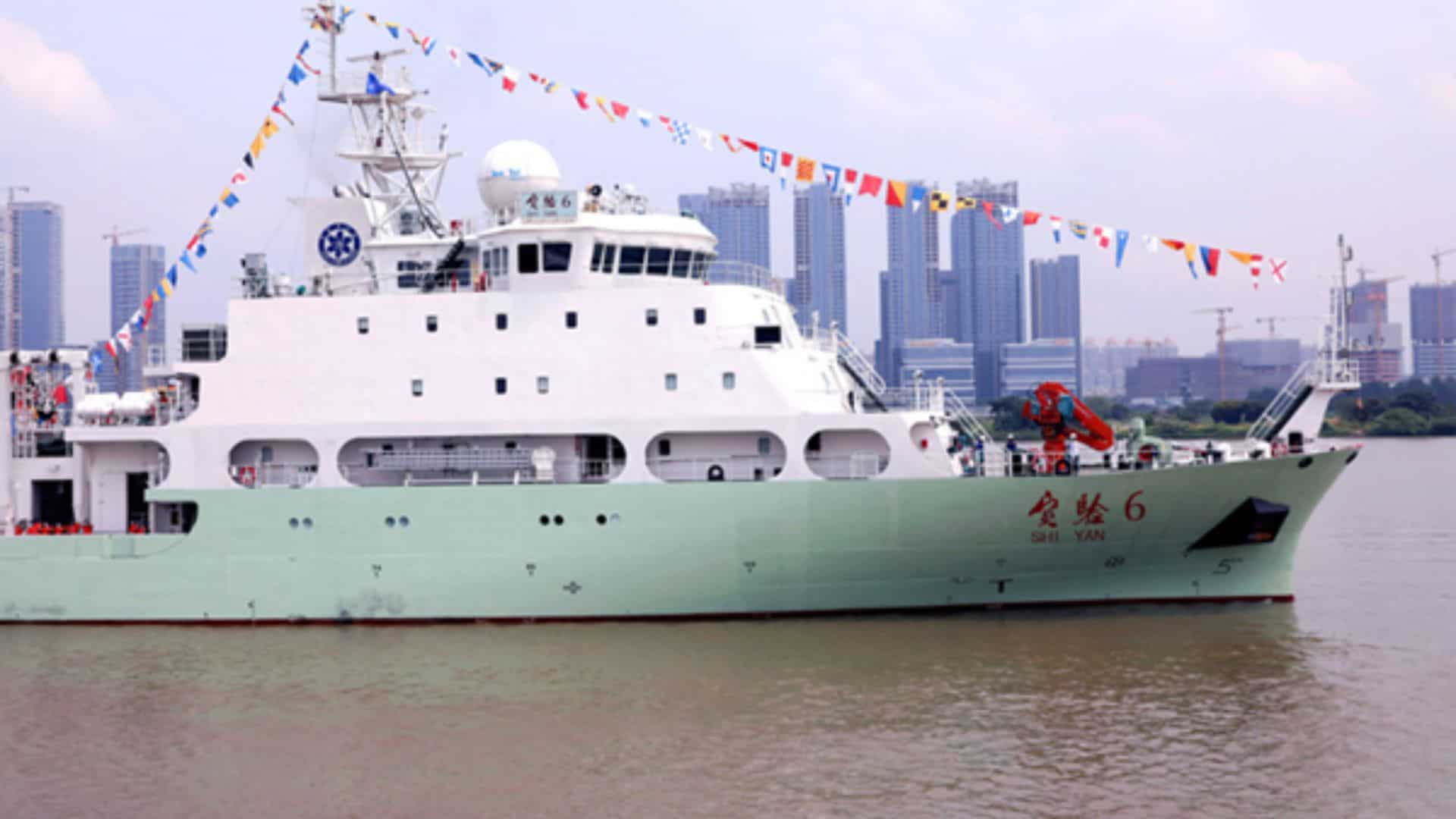
Shi Yan 6
Disguised as conducting scientific examinations in the Indian Ocean, Chinese vessels are presently engaged in extensive surveys across vast regions of the Indian Ocean Region.
The data collected is of immense significance for Chinese submarines manoeuvring through the shallow waters of the Malacca Strait and traversing the Eastern Indian Ocean, a situation causing significant apprehension for India.
The latest addition to the sequence of Chinese Oceanographic survey vessels embarking on a three-month mission in the area is the Shi Yan 6, which is currently moored at Sri Lanka's Hambantota Port, located in close proximity to India.

It's noteworthy that China has held control of the Hambantota port since 2017, having secured a 99-year lease for a sum of just US $1.12 billion, a substantially smaller amount than the US $1.4 billion that Sri Lanka paid to a Chinese company for its construction.
Chinese media refers to the Shi Yan 6 as a "scientific research vessel," and it is crewed by 60 people, equipped to conduct a variety of oceanographic, marine geology, and marine ecology experiments.
Also read |US echoes India’s security concerns over China’s Shi Yan 6’s port call to Sri Lanka: Report
)
India ‘deeply concerned’ as Houthi strikes hit Saudi civilian & energy sites
)
Three labourers killed as DU student loses control of his car, rams into them on Dwarka Expressway
)
Pentagon revives mandatory testosterone testing for male troops aged 30 and above
)
FACT CHECK: Why did PM Modi ask Xi ‘is it okay’ at BRICS Summit? New video reveals...
)
India seeks to build a full semiconductor supply chain
)
North Korea's last nuclear test in 2017 set off 1,399 earthquakes over 8 years, each stronger than previous
&im=FitAndFill=(700,400))
From Abhishek Sharma to Sahil Chauhan, 5 batters with fastest T20I hundreds
)
Indian activist-lawyer Prashant Bhushan's post brings focus on ‘conflict of interest’ appointments of ex-govt officials at Reliance, Adani groups
)
Former India player Diana Edulji wants Smriti Mandhana to replace Harman as skipper at the earliest
&im=FitAndFill=(700,400))
Meet top 5 batters in the latest ICC T20I Rankings
)
UNGA 2026 theme explained: What does ‘Restoring trust, managing transformation: A United Nations that delivers for all’ mean?
)
Godfather of AI Geoffrey Hinton gives US lawmakers a one-year warning on AI
)
US F-16 fighter jet crashes in Michigan during training mission, pilot ejects safely
)
A first in 100 years: New cat species discovered in Bolivia is incredibly tiny
)
Shivakumar attends 79th Kalyana Karnataka Utsav in Kalaburagi
)
Xi-Trump summit may boost military links
)
Hong Kong extends newborn cash support scheme by three years
)
‘Will go to any extent’: Pakistan vows to defend Saudi Arabia amid Houthi attacks
)
'He will always be ahead': India coach Gambhir says Sooryavanshi won't walk into team ahead of Samson
)
The Verdict | When precision fails: US commits war crime in Minab school strike, UN finds
&im=FitAndFill=(700,400))
New Friday OTT releases (September 18, 2026): Lust Stories 3, You+Me, Best of the Best- 8 new titles coming on Netflix, Prime Video and more
&im=FitAndFill=(700,400))
Which country has the most F-35s outside America?
)
Africa is splitting, and a lot sooner than estimated, giving way to a new ocean
)
'Gangsta' crab shoves knife blade at man and his dog in Florida - Watch
)
Trump bans CNN, MS NOW and Politico from White House over ‘FAKE NEWS’
)
Trump 2.0: Dark days ahead for America’s ‘imperial presidency’
)
Laura Wolvaardt sets new world record for most WT20I runs in a year
)
Drone strikes cooling tower at Russia's Kursk Nuclear Plant, IAEA confirms
)
Who is Khalilur Rahman? All you need to know about 81st UN General Assembly President
&im=FitAndFill=(700,400))
Meet top 5 bowlers in latest ICC T20I rankings
&im=FitAndFill=(700,400))
Suriya and Jyothika say ‘I do’ again after 20 years! See their dreamy wedding pics
)
Cristiano Ronaldo returns to Portugal squad for Nations League under new coach
&im=FitAndFill=(700,400))
Meet top 5 Indian batters with fastest T20I centuries
)
Ukraine plans record $109 bn defence spending, nearly two thirds of budget amid Russia war
India's worries grow over Chinese vessel Shi Yan 6's 'research' mission in Colombo
Indian naval officials assert that there's limited action they can take until Chinese vessels engage in overtly hostile actions. This is because the ship in question is technically categorised as a surveyor ship and doesn't fall under the warship classification.
A similar episode of tension unfolded in August of the previous year when the Chinese 'spy ship' Yuan Wang 5 docked at Sri Lanka's Hambantota port, despite India's concerns.
Yuan Wang 5 is a cutting-edge dual-purpose vessel designed for tracking satellites, rockets, and intercontinental ballistic missiles. It boasts a crew of 400 members and is equipped with advanced electronic gear, sensors, and antennae.
A statement from the Chinese state broadcaster, China Global Television Network (CGTN), indicates that the Shin Yan 6 is intended to enhance scientific research cooperation and exchanges with countries along the Maritime Silk Road, further integrating science and education into the Belt and Road Initiative. The vessel has a complement of 60 crew members.
The research initiative has been organised by the South China Sea Institute of Oceanology (SCSIO), a division of the Chinese Academy of Sciences. The vessel is slated to undertake 28 scientific research projects, involving 13 research teams on board, covering a distance exceeding 12,000 nautical miles (approximately 22,200 km).
Lin Qiang, the project leader and deputy director of SCSIO, anticipates that this voyage will bolster scientific research collaboration and exchanges with countries along the Maritime Silk Road, contributing to the integration of science and education to support the Belt and Road Initiative.
Indian military strategists point out China's long-term plan to operate in the Indian Ocean Region (IOR). China has established a submarine base in Bangladesh in exchange for providing two submarines to Dhaka, reported India Today.
Also watch |Is Sri Lanka veering towards China?
Additionally, China has supplied an older submarine to Myanmar. With a submarine base in the Bay of Bengal and the supply of eight submarines to Pakistan in the Arabian Sea, China has significantly expanded its operational capabilities in these critical areas.
Indian External Affairs Minister S Jaishankar expressed that over the last two to two and a half decades, there has been a consistent rise in the Chinese naval activity within the Indian Ocean.
He noted that there has been a significant expansion in the size of the Chinese Navy during this period. He said that with a substantially larger navy, its presence and deployments become more conspicuous, referring to instances such as China's construction of ports in Gwadar, Pakistan, and Hambantota, Sri Lanka, reported ANI.
(With inputs from agencies)
WATCH WION LIVE HERE: