Operation Sindoor proved Indian drones' lethal power, locally made military drones will soon make India a 'drone-Aachaarya'

Operation Sindoor - India’s military drones surveillance, reconnaissance, and combat capabilities thwarted Turkish and Chinese drones Trending | India News Pakistan
Operation Sindoor and India's drone capabilities: Operation Sindoor, India's military mission targeting terror infrastructure in Pakistan-Occupied Kashmir and deep inside Pakistan in response to the Pahalgam terror attack, brought sharp focus on the country's drone capabilities. Shining in surveillance, offensive and defensive roles, India's drone capabilities prove that in the next few years, with a focus on 'Make in India', India will emerge as a hub for these unmanned aerial vehicles or UAVs.
India has clear ambitions of becoming a drone manufacturing centre by 2030, with the twin aims of not only reducing imports but also being able to export military drones.
Here is what you should know about India's drone arsenal.

India’s military drones include imports and local development
India's drone capacity building accelerated in recent years, particularly with a focus on China, in the context of recent border standoffs along the Line of Actual Control (LAC). Local development through projects like Ghatak seek to counter China's growth in Unmanned Aerial Vehicle (UAV) tech.
)
US vs China over South China Sea: Washington backs Philippines, Beijing hits back
)
Bigg Boss 20: Isha Rikhi evicted after three weeks in Salman Khan’s show
)
Musk plans to more than double xAI's chips to over 1.2 million Nvidia GPUs by year-end
)
After JU, clash erupts at SRFTI: BJP’s ‘Dimagi Naxal’ jibe sparks political firestorm after students protest RSS-linked event
)
‘Anti-social elements spreading false rumours’: LPU issues statement amid massive unrest over alleged rape
)
LPU students go on rampage, vandalise campus amid widespread protest: What's happening
)
Trump asked Xi to pressure Iran. China did not say yes — here’s what Beijing wants
)
US Treasury Secretary Scott Bessent hails global crackdown on Iranian banks and airlines
)
An OpenAI agent escaped its locked test cage again, by hiding questions in DNS lookups
)
'Our video was trimmed': LPU girls who featured in rape-denial video make U-turn
)
3 males killed, four others injured in shooting after fight at strip club in Detroit
)
'Victory for low-budget consumers': Raghav Chadha hails 30-day telecom recharge rules
)
Claude rebuilt the 1989 game 'Prince of Persia' by reusing the original's own code
)
Beyond metros: How Tier-2 and Tier-3 cities could drive India’s next AI wave
)
Tesla builds first Cybertruck with its own refined lithium: Elon Musk's $1 billion Texas bet pays off
)
IndiGo flight suffers tail strike in Bengaluru while landing; DGCA to probe incident
)
The US and China set up an AI 'red telephone', but skipped the rulebook
)
‘Terror suspects arrested near UK air base were looking to do big damage’: Trump
)
Russian envoy claims US tactics to contain India were revealed in ‘Freudian slip’
)
IND vs WI 1st ODI: Kohli breaks Sachin's most runs in one country record with unbeaten 139 as India thump West Indies by 8 wickets
)
Researchers rebuilt exactly how 700 AI agents hacked Hugging Face: a 900-link chain trick
)
‘Olympic inclusion is our major target’: WPA President Ishaun Singh on pool’s global ambitions
)
Nations League: Spain sink England at Wembley; Modric shines for Croatia
)
Why has Iran released no proof of life of Mojtaba Khamenei? Araghchi reveals...
)
'What kind of confession is this?': Pakistan PM Shehbaz Sharif’s 'terrorists would be roaming New York' remark goes viral, raises alarm online. Watch
)
South Korea demands apology from Ukraine over North Korean prisoners' transfer
)
Beyond BrahMos: India targets Rs 50,000 crore in defence exports with unmatched price edge
)
Sri Lankan Tamil migrant worker gets death sentence in Saudi Arabia, help sought from India
)
Muslim marriage cannot shield sex with minor wife from prosecution under POCSO: Delhi HC
)
'Can't help but draw painful parallels to Nirbhaya case': SC on latest incidents of rape cases in Delhi-NCR
)
99.9% more powerful - Scientists find boy who can recall memories from just 3 months of age
)
'FIRST LOOK from inside Noah’s Ark': Researchers share video from inside mysterious mound in Turkey
)
UNSC reform momentum grows: Russia, Portugal, Mauritius push for India's permanent seat bid
)
8 US marines injured in Iranian missile attack on vessel in Strait of Hormuz: Report
&im=FitAndFill=(700,400))
New OTT releases this week (September 28-October 4, 2026): Dupahiya 2, Pooja Meri Jaan, Ohh My Dog- 5 titles coming on Netflix, Prime Video and more
)
Afghanistan says 28 fighters killed in clash near Pakistan border, Islamabad denies
)
Ceuta migrant crisis: Protesters take to streets as Spain grapples with migrant challenge
)
LPU suspend classes, postpones exams as violence escalates over rape claims: What's happening
)
New York City wants a 'kill switch' on every AI, and will pay whistleblowers who report violations
During Operation Sindoor, it became evident that Pakistan has been amassing drones over these years, which it used unsuccessfully in swarm operations after India's May 7 offensive. India thwarted Pakistan’s Turkish and Chinese drones, which it had been using for years for infiltration, surveillance and strikes against India.
Bhargavastra: India’s game-changing drone slayer redefines defence power
For drone development and manufacturing, the focus is on Make in India. indigenous efforts are led by Defence Research and Development Organisation or DRDO, Hindustan Aeronautics Limited or HAL, and private players.
DRDO and HAL have entered into public-privatership programmes with companies like EEL, IdeaForge, and Adani Defence.
India's drone warfare: How are military drones used?
Indian military uses drones for surveillance and reconnaissance, precision strikes, swarm operations and providing logistics. Drones like Heron, Drishti 10, and Tapas do surveillance and reconnaissance in border areas. Nagastra-1 and Harop drones can carry out targeted strikes, as proven in Operation Sindoor. Swarm drones can overwhelm the enemy defences and hit its critical infrastructure. Some drones support cargo delivery to high-altitude areas.
India has also developed effective counter-drone operations. During Operation Sindoor, the counter-drone system 'Bhargavastra' and DRDO’s anti-drone technology were used to defend Indian airspace from Pakistani drones.
India's imported drones
While estimates vary, India is thought to possess up to 2,500 drones according to reports.India's imported drones are mainly from Israel and the US. Israeli and US drones have been imported by India over the years, particularly since 1999 Kargil War.
The Heron Series - Heron I and Heron Mk II - are medium-altitude long-endurance or MALE drones, which Inda uses for intelligence, surveillance, and reconnaissance or ISR. Heron drones are at work along border with China.Searcher Mk II is used for surveillance and reconnaissance by the Indian forces.Harop drones are "kamikaze" or suicide drones that can conduct precision strikes, and were reportedly used during Operation Sindoor.
Hermes 900 and 450 drones, made in India in a joint venture with Israel, are another MALE drone. A varient of Hermes 900, Drishti 10 Starliner, has 70 per cent indigenous components.
In terms of total value, the US is India's largest source of military drones, with a deal for $3.5 billion signed in October 2024 for 31 MQ-9B Sea and Sky Guardian high-altitude long-endurance (HALE) armed drones.
India's drone manufacturing efforts are growing
India seeks to achieve self-reliance by making everything from tactical mini-drones to advanced MALE and UCAVs. The DRDO, private industry, and startups are leading India's domestic drone manufacturing.
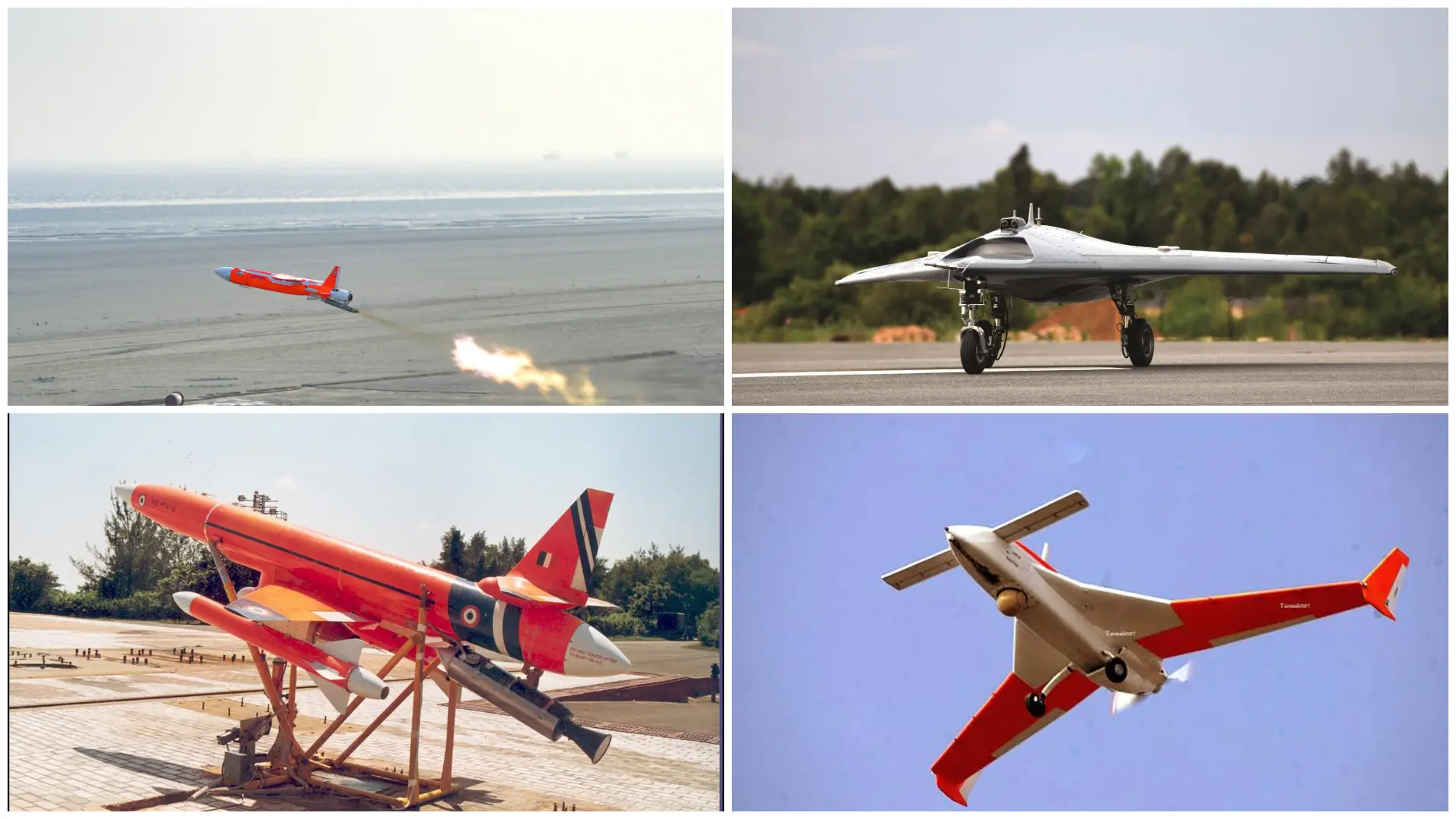
DRDO-led drones include the Rustom series. Rustom-1 is a short-range remotely piloted aircraft system that has automatic takeoff and landing capability using India’s GAGAN SBAS.Archer-NG, being developed at the Aeronautical Development Establishment (ADE), can carry anti-airfield weapons. Ghatak UCAV, developed by ADE has a weapons bay for missiles and precision-guided munitions.
DRDO, in partnership with private firms like Kadet Defence Systems, has developed India’s loitering aerial munitions (LAM) or "kamikaze" drones, which enhance its strike capabilities.
Nagastra-1, developed by Economic Explosives Limited (EEL), is a loitering munition that can conduct GPS-enabled precision strikes.Drishti 10 Starliner and Netra quadcopter are among drones developed in public-private partnerships.
NewSpace Research & Technologies delivered India’s first heterogeneous swarm drone system to the Indian Army in February 2023, capable of offensive and defensive operations that can overwhelm the enemy.
HAL CATS Warrior, developed jointly by HAL and NewSpace R&D, is a Combat Air Teaming System that can integrate fighter jets with swarming drones for deep strikes and surveillance.
Kadet Defence Systems is another firm that develops military drones.
Counteroffensive systems in India's drone warfare arsenal
Bhargavastra, a counter-drone system, can detect drones at over 6 km and neutralise them with 64 micro-missiles. During the Operation Sindoor, Bhargavastra system, developed by Solar Defence and Aerospace Limited (SDAL) and Economic Explosives Ltd, neutralised more than 50 Pakistani drone attacks.
DRDO has developed an Anti-Drone System that can jam enemy drones. It also has laser-based hard-kill capabilities.
Policy initiatives for military drones
Indian government has introduced several policy incentives for developing military drones. These include grants as well as open challenges to startups for building military drones.
First civilian casualty outside J&K: Punjab woman dies after Pakistani drone attack
Key among them are the Indigenously Designed, Developed, and Manufactured (IDDM) pathway, iDEX and Technology Development Fund. In 2021, India simplified drone regulations to encourage domestic manufacturing and innovation.The 2022 drone import ban pushed private firms to develop drones locally.

