

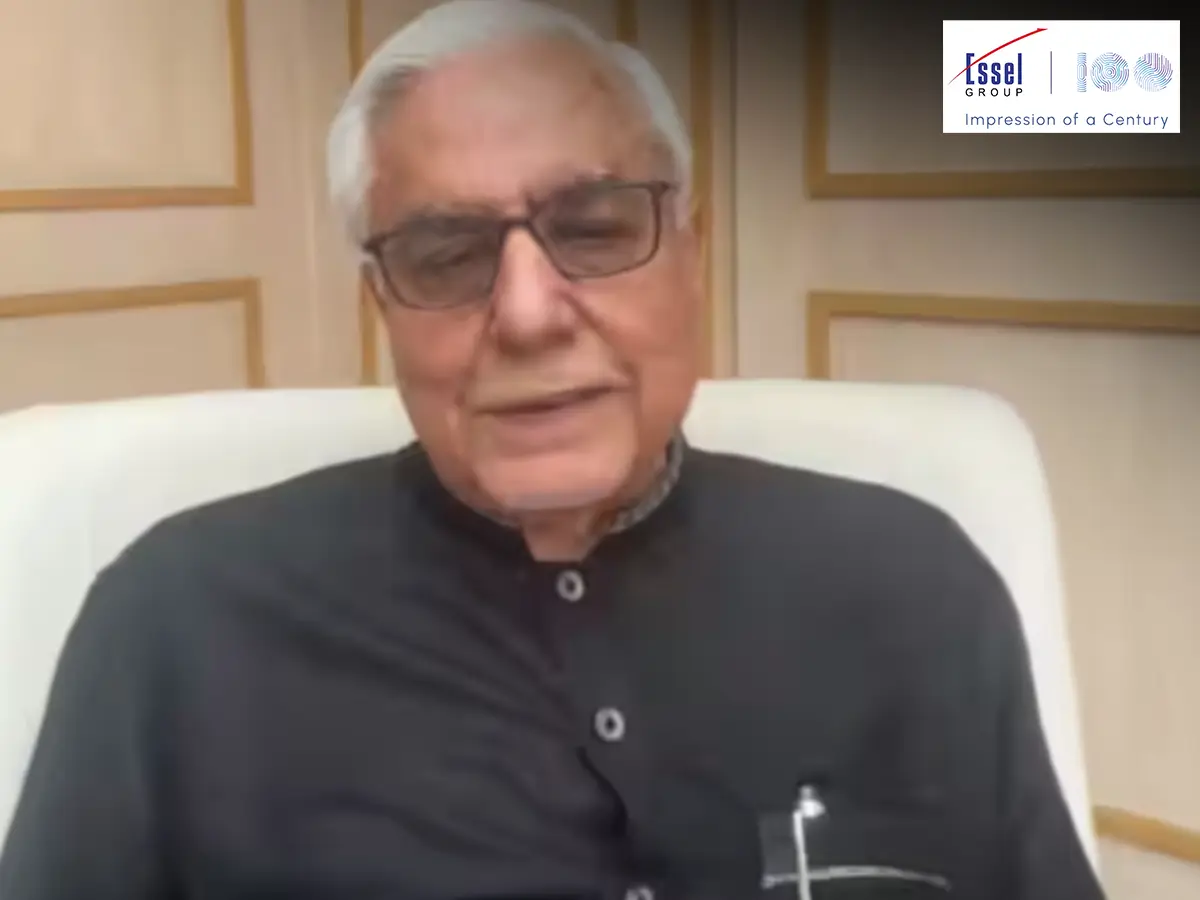
&imwidth=800&imheight=600&format=webp&quality=medium "My destiny is to keep moving: Chairman Dr Subhash Chandra's inspiring speech at the 100th anniversary of Essel Group")
At the landmark celebration of 100 years of the Essel Group on Thursday (May 21), Dr Subhash Chandra delivered an inspiring and reflective speech tracing the Indian conglomerate’s extraordinary journey through enterprise, setbacks, resilience, and renewal. Addressing the nearly 10,000 employees and associates, the Essel Group Chairman said he felt “fortunate to have reached this podium” as he looked back at a century-long legacy built across generations.
He divided the group’s 100-year journey into three broad themes — businesses, financial impact, and the emotional lessons accumulated over the decades.
While acknowledging that the influence of Zee News and Entertainment is widely recognised, Chandra emphasised that several Essel businesses before Zee had already touched millions of lives across India. He recounted how the group evolved from supplying food grains to the Indian Army to building storage capacity for millions of tonnes of food grains at a time when the country lacked such infrastructure. He also highlighted Essel’s diversification into telecom pole fabrication, laminated tube manufacturing, and entertainment ventures like EsselWorld, all of which helped the group establish deep public connect.
Chandra recalled how the exports of food grains to the erstwhile Soviet Union generated the maximum capital for the group during its formative years.
Calling it “the story of a family from united Punjab pre-partition starting business from zero,” he recalled how the original trading firm, Messrs Ramgopal Indraprasad, founded in 1926 by Jagannath Goenka in Adampur, Haryana, remained vibrant for nearly four decades before slipping into negative capital.
He reflected on the first major family separation, when his grandfathers parted ways with their brothers, and spoke about how the business was later reconstituted, and how the next generation took charge later. Recalling a key milestone, Chandra said the group first crossed Rs 100 crore in annual turnover in 1981. “At the time, a colleague asked, what about next year? And I said, ‘We will find many things, will never be below Rs 100 crore.’ And that is what happened,” he said.
The Essel Group later rose dramatically in stature, with Chandra noting that the group was once described among the richest Indians by The Wall Street Journal in 1998 and 1999. Yet, he admitted that the journey had been “exciting but like a rollercoaster.” He reflected on the second family separation during 2008–09 and acknowledged that the group hit a low point in 2019 due to debt carry-forward and “my wrong decisions.” Despite the setbacks, Chandra asserted that the group is once again on an upward trajectory, "moving towards creating a new peak.”
Trending Stories
On the emotional aspect of the journey, Chandra described the experience as “interesting, challenging, with ups and downs which happens in large families.”
“Lots can be learnt from these aspects of life,” he said.
The Essel Group chairman also spoke candidly about personal resilience and inner discipline, crediting his long-standing practice of Vipasana meditation for helping him remain steady during difficult periods. “I was least affected by negative standpoints because of my consistent Vipasana meditation practice. I’m conscious and sympathise with those who were negatively affected due to my actions,” he said.
In one of the central messages of his speech, Chandra urged employees and colleagues to continue moving forward with conviction. “Your fate is to move. Keep moving with certainty. Certainty is the keyword,” he said. “I assure you it’s happening irrespective of the odds we face in life at such challenging times.” Chandra also stated that he never pursued wealth for personal gain. “I’ve not personally created any wealth for myself,” he said.
Addressing criticism and controversies surrounding the group over the years, the Essel chief acknowledged that adversaries had attempted to project a negative corporate image. “Many adversaries tried to accuse me and project negative image…But the same people praise the group’s persistence, vision, ability to fight well and long-lasting impression of a century. They privately acknowledged it.”
Reflecting on the broader lessons of the Essel journey, Chandra said there was “a lot to be absorbed from the highs and lows of this 100 years.”
“In this journey, you will find that often the greatest impact in life starts with the simple acknowledgement that another human being matters,” he said.
“When kindness combines with trust…one life uplifted can uplift many.”
He added that the Essel story demonstrates how success finds its highest purpose when it creates opportunities for others. “This story will remind you that success reaches its highest purpose when it becomes a bridge for someone else’s future. That’s the Essel story. There are hundreds of thousands of examples,” he said.
Chandra also referred to long-serving employees who retired from Zee or spent nearly 50 years with the group. He urged senior leaders across divisions to identify similar individuals and document their experiences for younger employees. “That will be a great learning for younger generations,” he said.
Chandra observed that while some employees may view their role merely as a job, many others remain deeply proud to be associated with the institution. He urged employees to internalise the meaning of the century-long journey and continue building upon it. “It’s our collective responsibility to carry this pattern forward. Not just grow existing business, but create new. Celebrate glorious milestones and keep building new,” he said.
Describing Essel as an entrepreneurial institution long before the term “startup” became fashionable, Chandra said the group has always embraced innovation-led thinking. “The group has been and will remain India’s early startup when no one knew the word startup,” he said. “We should continue to work in a startup culture. This is our mantra for being creative, energetic 24/7 and 365 days without feeling tired.”
“This will bring sense of ownership and create more enjoyable workplace,” he added.