&imwidth=800&imheight=600&format=webp&quality=medium "Moon treasure hunt: India finds the perfect location on the map")
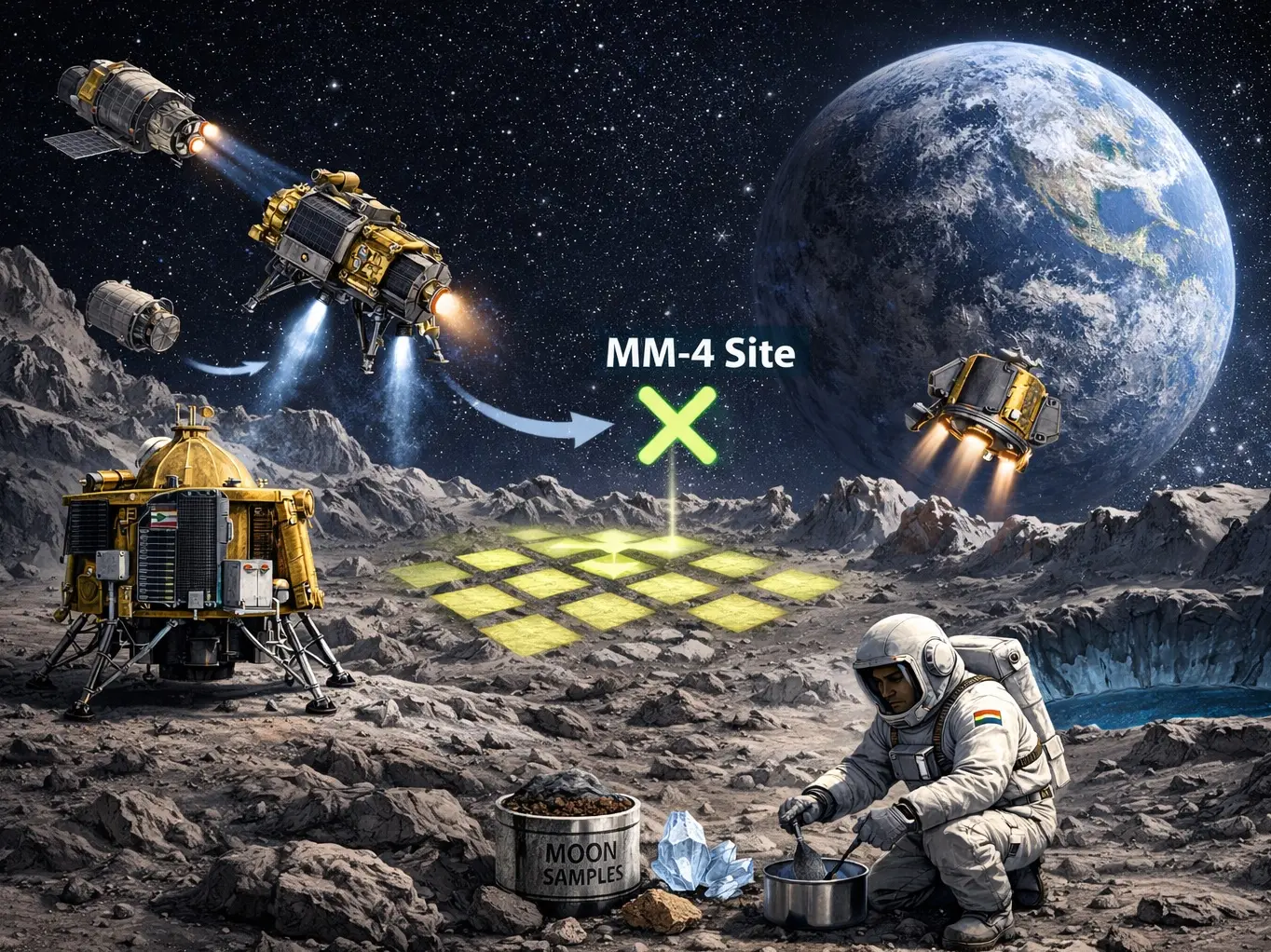
Imagine our scientists at ISRO like detectives searching for the perfect place to dig treasure on the Moon. Well, they just found it! They have identified a special location called MM-4 in the Mons Mouton area, right near the Moon’s South Pole. This is where India’s next big space mission, called Chandrayaan-4, will land around 2028. It is like finding the perfect address for your new home—everything has to be just right.
Mons Mouton (MM) is a mountain-like highland area near the Moon’s South Pole, and it is considered important because this region may have water ice and safer terrain for future missions.
Now, why is this Chandrayaan-4 mission so special and exciting for all of us? Think of it this way: our earlier Moon missions were like sending a camera to take pictures and send them back. But Chandrayaan-4 is different. It is India’s first mission that will actually collect Moon soil and rock pieces and bring them back to Earth. Yes, you read it right—we will have real Moon samples in our Indian laboratories! Scientists will study these samples like examining precious gems under a microscope. The spacecraft will have five special parts working together—first it goes there, then it collects samples, then it launches back, and finally it returns home safely. It is like a perfectly planned operation where everything must work without any mistakes.

Also Read: India-Japan Annual Summit: PM Modi hails ISRO, JAXA collaboration on Chandrayaan-5 mission
So why did our scientists choose the Moon’s South Pole, and specifically this MM-4 spot? Here is the exciting part that affects all of us. The South Pole has special areas that stay in permanent shadow, like the darkest corner of your room that never gets sunlight. These cold, shadowy areas are like natural freezers that have kept water ice trapped there for billions of years. This water ice is not just frozen water—it is treasure! If scientists can find enough of it, we can make drinking water for people, oxygen for them to breathe, and even rocket fuel. Imagine astronauts staying on the Moon without carrying everything from Earth. That is the dream, and it starts with finding this water ice.
But landing on the Moon’s South Pole is not easy. The terrain is very rough, with mountains, craters, and huge boulders scattered everywhere, like an obstacle course. A wrong landing can mean disaster—the spacecraft could crash or break. ISRO needed to find a spot that is relatively flat and smooth, gets enough sunlight for solar power to work, is free from dangerous boulders, and has good communication link with Earth. It is like finding a parking space in Mumbai that is not too slanted, not too dark, and not too crowded with obstacles.
Trending Stories
)
Noel Tata challenges Chandrasekaran’s reappointment as Tata Sons chairman. What happened at the board meeting
)
TIFF 2026: Theja Rio’s Angh wins Platform Prize, puts Nagaland story on global stage
)
Arvind Kejriwal, family members, Delhi CM Rekha Gupta get SIR notices
)
Fleming's aspirations as England Test coach include WTC, top ranking and Ashes
)
Apple reportedly building AI server with M8 Ultra chips, may use Nvidia technology
)
Several petrol pumps, other businesses to refuse UPI payments above Rs 2,000 from Oct 16: Is it legal?
)
Microsoft executive called AI training the ‘largest theft of labour in human history’
)
Delhi Air pollution: Strict crackdown on waste burning
)
Delhi: Flagged voters remain on the draft roll but face hearings
)
Trump says he'll build an 'AI Force' and appoint a czar, for 'high IQ' people only
)
ICE shooting in Texas leaves man seriously injured; officials demand independent investigation and transparency
)
China now makes advanced memory chips without the machines it was banned from buying
)
Bessent meets China’s He Lifeng to prepare for Trump-Xi summit
)
SNL UK takes aim at Ed Sheeran with AI Princess Diana sketch
)
Taylor Swift has a 'proud wife' moment as Travis Kelce scores first touchdown of season: 'That’s my husband!'
)
US ships in Indian Ocean ‘will be attacked’ if war resumes, warns Iran
)
BTS' fans question iHeartRadio’s treatment of group after brief festival set
)
Iran sets 7 conditions to end war with US: What are Tehran’s demands?
)
'Does not mean name deletion': EC issues clarification after ex-Election Commissioner, former CM Kejriwal, EAM Jaishankar, others get SIR notices
)
Italy moves to ban face veils in schools as Meloni pushes new integration measures
)
Saudi Arabia exits China-led mBridge digital currency platform amid Saudi-Houthi conflict
)
Glitch in the matrix caught on camera: Woman vanishes after talking to reporter
&im=FitAndFill=(700,400))
New OTT releases this week (September 21-27, 2026): Shaque: Trust No One, Hunkkaar, Don’t Be Shy- 5 new titles coming to Netflix, Prime Video and more
)
AI kill switch explained: Why shutting down a dangerous AI may not be as simple as pressing a button
)
CDU suffers historic defeat in eastern Germany as AfD surges, Merz vows to stay on
)
'Lot of things to learn from experienced players': Jayasuriya backs Rohit, Virat for 2027 ODI World Cup
)
Jailer 2: Vidya Balan joins Rajinikanth's upcoming film as Kantha | Watch
&im=FitAndFill=(700,400))
Gulshan Grover turns 70: Ram Lakhan, Gangster, Hera Pheri- Must-watch movies of the actor on OTT platforms
&im=FitAndFill=(700,400))
Kareena Kapoor birthday special: Inside her net worth, best movies, luxurious lifestyle and love story with Saif Ali Khan
)
Samsung raises Galaxy S26 prices by Rs 20,000: Here’s what each model now costs
&im=FitAndFill=(700,400))
What TSMC's 2nm technology means for Apple
)
AI actress Tilly Norwood glitches mid-interview, switches from English to Chinese | Watch
)
‘0% chance’: Nvidia CEO Jensen Huang dismisses AI extinction fears by 2030
)
Saudi vs Houthis: Houthis claim missiles & drones used in attack on key Saudi sites
)
Ed Sheeran addresses Macklemore's removal, Gaza conflict during Philadelphia concert: 'I cannot hide how I feel'
)
Trump-Xi summit: US Treasury Secretary holds meeting with Chinese Vice Premier
)
S Jaishankar, former Army chief among high-profile names issued Delhi SIR notices
)
Maharashtra TET paper leak: All 18 accused arrested. How alleged Agra-to-Maharashtra racket unfolded
)
'Were you here to sell chickpeas?': Wasim Akram criticises Babar Azam's captaincy
)
Punjab man consumes poison outside DC office; Congress, BJP target AAP government
)
Chancellor Friedrich Merz vows to stay on as exit polls signal major poll setback
)
Operation Sindoor’s hidden naval dimension | MoD reveals Indian Navy Special Forces joined May 7 strikes
ISRO scientists took high-quality pictures using a special camera on the Chandrayaan-2 spacecraft that is still orbiting the Moon. They studied four possible sites like MM-1, MM-3, MM-4, and MM-5. They looked at every detail—the slope angle, the height, how many hazards like rocks and craters were there, and where were the safe flat patches where the lander could touch down. After careful examination, MM-4 emerged as the clear winner. In a one-kilometre area around it, the slope is only about five degrees—that is very gentle, almost like a slightly tilted table. The hazards are the lowest at around nine per cent. There are five hundred and sixty-eight safe spots where the lander can land. It is like comparing four houses for rent, and this MM-4 is the safest one with the best views and strongest foundation.
What will India gain from landing here? First is safety—the mission needs to land successfully to collect samples. Second is scientific knowledge—the samples from this highland area near the South Pole will teach us about the Moon’s ancient history, its rocks, and whether water ice really exists nearby. Third is preparation—if we confirm water ice exists here, it will help India plan longer stays on the Moon or even build a base there one day. This would make India a major player in space exploration, earning respect from all nations worldwide.
Other countries are watching this spot too. China’s missions have visited different Moon areas. America also wanted to send a rover here to search for ice. The South Pole has become like a hotspot where everyone wants to explore because of the resources it holds. By choosing MM-4, ISRO proves it is making smart, careful decisions using its own Moon data. Success in Chandrayaan-4 will not just bring Moon pieces to our labs but will inspire countless people and open doors to discoveries we cannot imagine today.