India's digital paradox: World-class talent, third-world capital | WION Expert Speak

&imwidth=600&imheight=450&format=webp&quality=medium "India's digital paradox: World-class talent, third-world capital | WION Expert Speak")
From Left to right: Dr. Deepak Mishra, Author SIDE-2026 report, Advisor to World Development report-26 at World Bank; Agrima Khanduri, Research Assistant at ICRIER in Digital Economy Photograph: (WION)
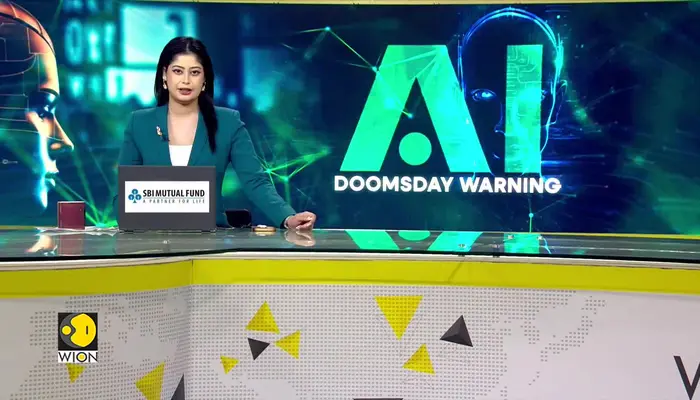
India ranks fourth in AI globally but attracts just 1% of global investment, when its neighbours Pakistan, Bangladesh and Sri Lanka languish between 59th and 68th. The experts who wrote the report say the talent is world-class but the capital, the compute & the regional strategy are not.
India ranks fourth in artificial intelligence (AI) globally. It attracts one per cent of global AI investment. That contradiction, buried inside one of the most comprehensive digital economy benchmarking exercises published this year, is what researchers are now calling India's defining structural challenge. The experts who wrote the report are blunt about it.
"India's application-layer focus is a smart strategic choice if it is used as a launchpad," Dr Deepak Mishra, Distinguished Visiting Professor at ICRIER and lead author of the State of India's Digital Economy 2026report, told WION. "It becomes a risk if we stop there."
This captures the tension at the heart of India's digital story:
India holds the world's second-largest AI talent concentration, accounts for 19.9 per cent of global AI users, and generates USD 328 billion in digitally delivered trade. No other developing economy at comparable income levels math this. Thus, the rankings are real, as is the gap sitting underneath them.
The Input-Output Problem
Trending Stories
)
)
)
&im=FitAndFill=(700,400))
)
)
)
)
&im=FitAndFill=(700,400))
)
)
)
)
)
)
)
)
)
)
)
)
)
)
)
)
)
)
)
)
)
)
)
)
)
&im=FitAndFill=(700,400))
)
)
)
&im=FitAndFill=(700,400))
)
India scores 100 on AI skilled population in the report's indicator framework. It scores 0.7 on open-source AI models.
For Agrima Khanduri, Research Assistant at ICRIER and co-author of the report's AI index chapter, that juxtaposition is not a contradiction, it is a diagnosis.
"This highlights the distinction between inputs and outputs," Agrima Khanduri told WION. "An AI-skilled population is an input, and India is highly endowed with it. India's near-zero score on open-source models suggests that the conversion of this talent input into model output has not yet happened at scale."
"This is like what happened with IT services," she highlighted. "India did not begin as a dominant producer of digital technologies, but through talent accumulation, learning by doing, enterprise capability, and global delivery models, it became one of the world's leading exporters of digitally delivered services. The current AI landscape may be at a similarly early stage."
The IT services analogy is compelling. As Deepak Mishra's own framing suggests, it's not guaranteed to repeat itself. The capital concentration in AI is fundamentally different than India's IT services story. Private AI investment in India stands at USD 1,160 million. The USattracted USD 1,09.08 billion. China attracted USD 9.290 billion. India trails South Korea, Canada, France, Germany, the United Kingdom, Sweden, and the UAE.
"India should exploit its comparative advantage in AI adoption and applications today, while deliberately building the capabilities needed to move up the AI value chain tomorrow," Dipak Mishra said. World-class engineers, foreign capital, foreign compute, foreign models - that is the structural reality behind the fourth-place ranking of India.
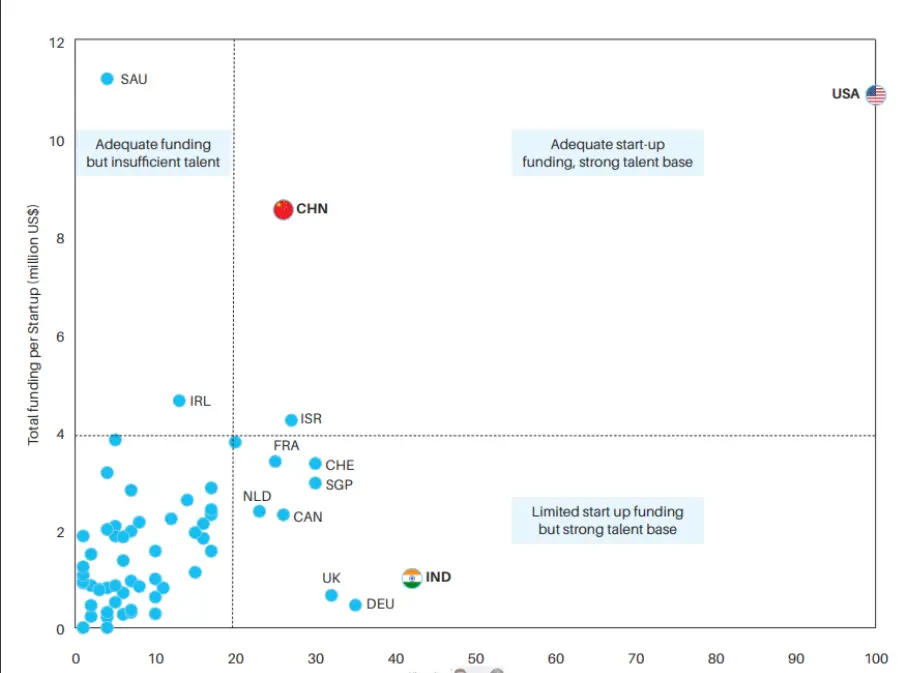
World-class talent, barely any startup capital, India's AI positioning in one scatter plot. Source credit: IPCIDE Team, State of India's Digital Economy 2026
The Upskilling Paradox
India's leadership in relative AI skills penetration is one of the report's exciting findings. But Agrima Khanduri urges caution about what it actually measures, saying it “should not be interpreted as evidence that the entire workforce is AI-ready.” "It reflects the depth of AI-related skills among India's digitally enabled and tech-oriented workers," she said.
The World Economic Forum projects that over 60 per cent of India's workforce will need upskilling by 2030. Both these data points, Agrima Khanduri argues, can coexist in a large and diverse economy:millions of highly skilled AI workers alongside tens of millions who will require significant reskilling as AI reshapes tasks across sectors. The risk is that the first number gets cited at policy forums, while the second is quietly set aside.
The Benchmarking War
India's fourth place in AI ranking sits against the IMF's AI Preparedness Index, which ranked India 71st among 174 countries, is a divergence that sparked a public dispute at Davos in January when India's IT Minister Ashwini Vaishnaw challenged the IMF's methodology on a live panel.
Deepak Misra is direct about where the IMF went wrong. "The IMF index largely ignores scale effects, a serious limitation in the digital economy, where scale is not incidental but central to value creation," he explained. "Despite being called an AI Preparedness Index, it relies heavily on traditional digital-readiness indicators. These are important complements, but they are not the same as AI preparedness."
Without such a framework, he said, rankings can become misleading. “Because they mix inputs, enablers, outcomes, and institutional variables without a clear theory of how they contribute to digital transformation.” Policymakers and investors would be better off using second-generation indices,he said, naming Stanford University and Oxford Insights alongside the SIDE report as more reliable frameworks.
The South Asia Blind Spot
An aspect of India's digital rise receives hardly any attention in the rankings debate. India sits at fifth globally, while Pakistan ranks 59th, Bangladesh 63rd and Sri Lanka 68th. In Deepak Misra's view, this is not a development gap but a strategic liability. "In an era where digital infrastructure, data systems, payment networks, and AI platforms are becoming instruments of geopolitical influence, India has an interest in a digitally capable and better-connected neighbourhood," he said. His prescription is not a standalone Digital India for South Asia project, but a broader regional partnership in which technology cooperation sits alongside trade, institutional cooperation, and trust-building. "Digital transformation must be nationally built, but it can be regionally supported," he said, adding, “If pursued in a spirit of mutual respect and reciprocity, digitalisation could become one of the most practical ways to rebuild regional confidence in South Asia.” That is perhaps the most underreported finding in the entire report, and the one with the longest shelf life. The rankings will be debated and revised next year. But the capital gap and the regional disconnect will still be there.
About the Author
