
&imwidth=800&imheight=600&format=webp&quality=medium "'During one of the darkest periods in recent history India stood with Guyana': President Irfaan Ali at WION Health Pulse")
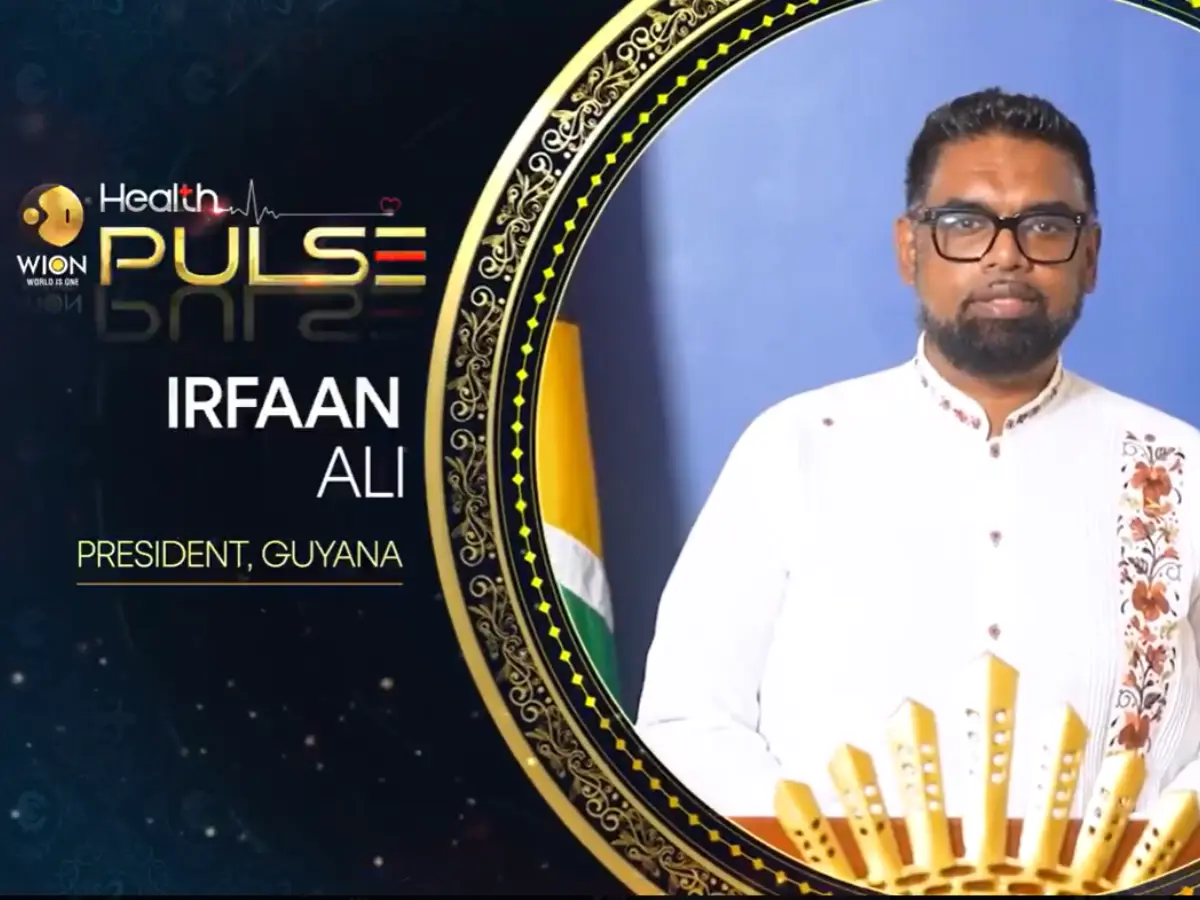
Guyanese President Dr Mohamed Irfaan Ali on Wednesday (Jun 17), while speaking at the WION Health Pulse Summit, painted a picture of a healthcare system undergoing a dramatic transformation. Addressing healthcare professionals, researchers and policymakers, Ali said the world is witnessing a historic moment where technology and medicine are converging to reshape healthcare delivery. He also thanked India for its support “during one of the darkest periods of recent history, the COVID-19 pandemic”.
13,905 km: The surgery that captured global attention
Ali began by highlighting a milestone that recently placed Guyana in the global spotlight.

He referred to the world's longest-distance cardiac telesurgery, during which renowned Indian cardiac surgeon Dr Subir Srivastava successfully performed a coronary artery bypass graft procedure from Guyana on a patient located thousands of miles away in India.
The achievement, he said, demonstrated how technology is erasing geographical barriers in healthcare. "This sort of removal procedure used to be the stuff of science fiction," Ali said, describing the operation as a glimpse into the future where expertise can cross borders instantly and patients can access specialised care regardless of location.
Trending Stories
)
US Treasury rallies global financial institutions for Op Economic Outcast to isolate Iran
)
Trump praises India’s Opium crackdown, hails anti-drug efforts
)
Saudi Vs Houthis: Yemeni military rebels clash with Houthis
)
Veteran actor Anant Nag honoured with Indian cinema’s highest award
)
Pakistan boycotts chess match against Israel at Olympiad
)
Lionel Messi for 2026 Ballon d’Or over Mbappe and Yamal, says Diego Simeone
)
Protests erupt over migrant housing plan in Piddington
)
Formula One reveals the 2027 race calendar; Monaco to host sprint race for the first time
)
Bigg Boss 20: Mahhi Vij reveals she lost Yuva role to Kareena Kapoor; 'didn’t work out in my favour'
)
No Pandya as Auqib Nabi earns maiden ODI call-up; Mayank returns for WI T20Is| check full squads
)
Former India player Diana Edulji wants Smriti Mandhana to replace Harman as skipper at the earliest
)
US House votes 417-3 to pass Ratepayer Protection Act targeting AI data center electricity costs
)
Pakistan: Imran Khan's sons Kasim & Sulaiman claim their father is 'tortured' in jail
&im=FitAndFill=(700,400))
New OTT releases this week (September 14-20, 2026): Lust Stories 3, Waiting Hai, Irumudi- 5 new titles coming on Netflix, Prime Video and more
)
Taiwan seeks deeper India ties as direct flights restart soon and chip projects advance
)
Trump gets new power to hit India, China with up to 100% tariffs as US Senate clears Russia sanctions bill
)
Former OpenAI researcher warns of growing risks from Artificial Intelligence
)
Want to get married within a year? Why 18 lakh people rush to Jaipur for ‘sacred henna’
)
Fed raises rates for first time in 3 years, Kevin Warsh defies Trump as inflation mounts
)
Chiefs tight end Travis Kelce named one of the victims in $35 million ponzi scheme
)
The Early Spring season 2 is happening, but fans have one request - 'don't change the actors'
)
All Indian goods to get duty-free access to New Zealand
)
Sydney Sweeney defends provocative ad choice, the internet is still not impressed
)
Shahzad Bhatti Network declared terrorist organisation under UAPA: Govt order
)
Europe wants a common playbook for security threats, seeks security beyond NATO
)
Trump calls Canada-EU associate membership plan ‘laughable’ and threatens 'very serious tariffs'
)
‘Imagine 50 AI fighters cornering one manned jet’: India’s mobbing doctrine eyes a new era of air warm
)
AUS vs SA: Steve Smith still gets 'little flashbacks' from sandpaper gate
)
India breaks silence on US Russia sanctions bill, 100% tariff threat: ‘Committed to energy security’ for 1.4 billion
)
Abhishek Sharma rises to No. 2 in T20Is; ENG’s Robinson 3rd after record Pakistan Tests
)
Daayra movie review: Kareena Kapoor, Prithviraj Sukumaran shine in Meghna Gulzar’s cop-versus-cop crime thriller
)
Katrina Kaif’s postpartum weight is not the problem; your gaze is
)
Hong Kong unveils 11 new measures to boost birth rates, offers higher cash bonuses and housing perks
)
US trade tariff: 100% tariff targets Russian buyers amid trade tensions
)
Pak batter Rizwan's petition against being questioned by cyber crime agency rejected by court
)
Saudi vs Houthis: Riyadh claims to have shot Houthi drone targeting Mecca
)
Prime Minister Narendra Modi's birthday: Italian PM Meloni sends birthday wishes
&im=FitAndFill=(700,400))
Suriya and Jyothika say ‘I do’ again after 20 years! See their dreamy wedding pics
)
Pakistan naval vessel returns to harbour with 'severe damage' after collision with Indian warship in Arabian Sea
"It was a demonstration that medicine is entering a new era, an era where expertise can travel faster than airplanes, where knowledge can move instantaneously across borders, and where the best care need not be limited by physical location."
Building healthcare from the ground up
The President said Guyana is undertaking what he described as the "most ambitious healthcare transformation" in the country's history.
At the foundation of that effort is a major expansion of healthcare infrastructure.
According to Ali, Guyana is investing heavily in primary and secondary healthcare to ensure citizens can access essential services closer to home. The government has already built 25 new health centres and health posts while expanding maternal and child healthcare services and increasing the availability of healthcare professionals across the country. The broader goal, he said, is to make healthcare accessible to every citizen.
Expanding specialised medical care
Beyond basic healthcare services, Guyana is also investing in advanced medical treatment.
Ali said the country is strengthening services in cardiology, oncology, ophthalmology, stroke rehabilitation, maternal healthcare and other specialised fields. A dedicated mother and child hospital is also under construction.
"The second level of transformation involves catapulting our tertiary health care system into the future," he said, adding that the nation was investing heavily in highly specialized medical services, including advanced gynecology and maternal health care, cardiology and stroke rehabilitation, oncology and cancer treatment, ophthalmology and cataract surgery, and a wide range of other specialized services.
A digital healthcare ecosystem
Finally the nation is undergoing a "digital transformation," which, he noted "involves building a digitally integrated health care ecosystem".
The aim, he said, is to create a system where patients no longer need to travel abroad for high-quality treatment.
Artificial intelligence is expected to play a growing role as well. Ali said that, "AI-assisted interpretation of medical images is already under exploration". These, he noted would help improve clinical decision-making and patient outcomes.
Investing in people: Level 4, human capital development
Ali stressed that technology and infrastructure alone cannot transform healthcare. He said Guyana is significantly expanding training programmes for doctors, nurses, technicians and specialists to ensure that the country's workforce grows alongside its healthcare capabilities.
"Guyana also recognizes that a system is only as strong as its people," he said.
Level 5, research and innovation
Looking ahead, Ali unveiled plans for what could become one of the Caribbean's most ambitious healthcare projects: a national life sciences park. He said that the next four years would "witness one of the most transformational developments in Caribbean health care".
The proposed hub will include biobanks, a tropical medicine institute, centres for drug and diagnostic development, vaccine manufacturing facilities, biotechnology research centres and advanced data analytics capabilities.
"It will help position Guyana as an emerging regional leader in health care and life sciences," he said.
India identified as a key partner
Throughout his address, Ali repeatedly highlighted India's role in Guyana's healthcare ambitions. He praised India's contributions during the COVID-19 pandemic and described the country as a global leader in pharmaceuticals, biotechnology, digital healthcare and medical education.
"Guyana values the friendship and partnership with India deeply. During one of the darkest periods of recent history, the COVID-19 pandemic, which many countries struggled to secure vaccines, India stood with Guyana. India extended support when it mattered most."
Guyana, he said, is seeking deeper collaboration with Indian hospitals, universities, healthcare companies, pharmaceutical manufacturers, telemedicine providers and investors. "We welcome partnerships in research. We welcome partnerships in training. We welcome partnerships in technology. We welcome partnerships in investment," Ali said.
Inviting healthcare stakeholders to explore opportunities in Guyana, the President said the country's rapidly evolving healthcare sector presents significant opportunities for international cooperation.
"The future of healthcare will not be built by one country acting alone," he said. "It will be built through partnerships."

