

&imwidth=800&imheight=600&format=webp&quality=medium "Bengaluru private cars grow rapidly to 2.5 million. What it says about the public transport system of India's ‘Silicon Valley’")
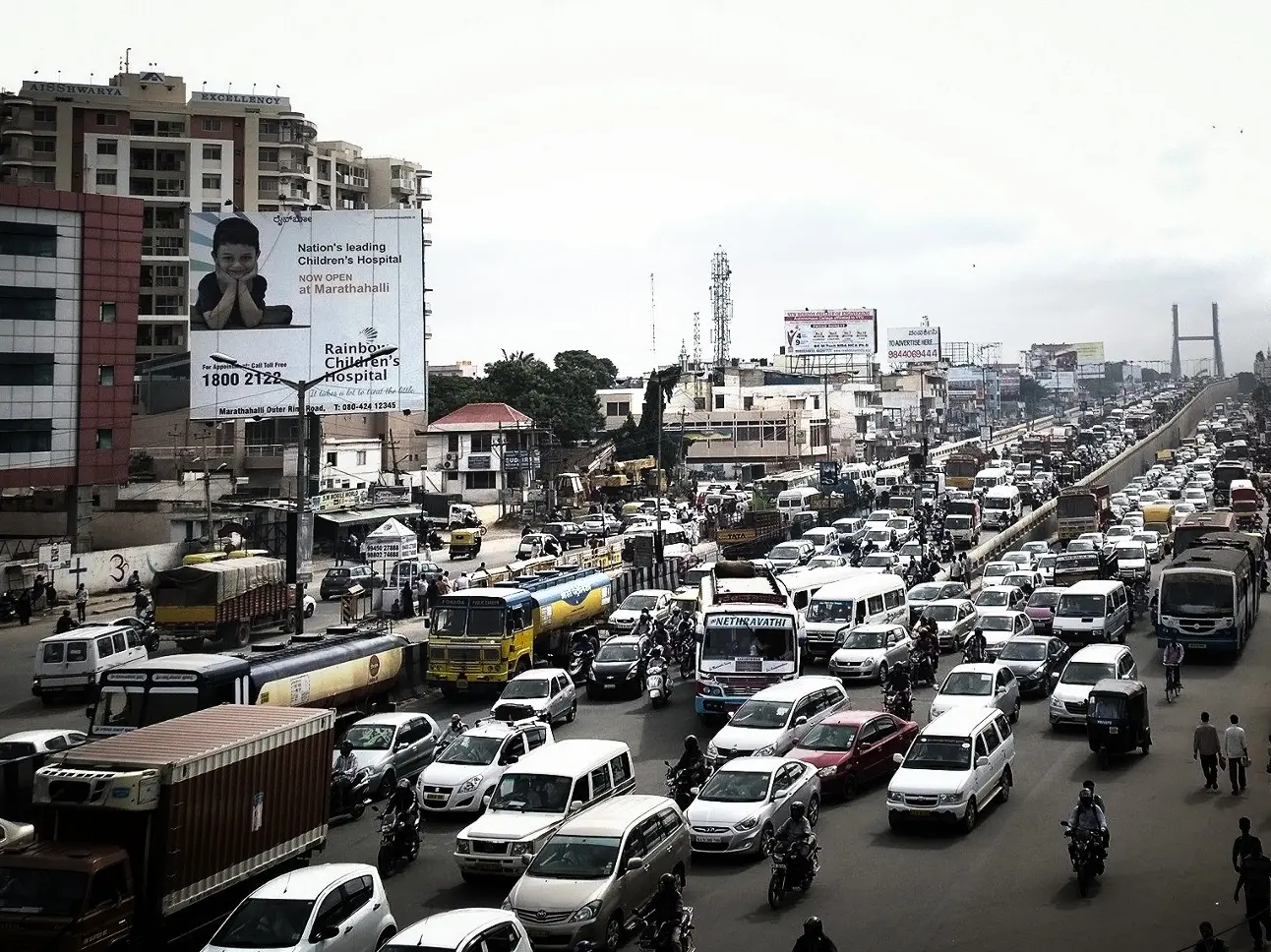
Bengaluru now has one of the highest private vehicle concentrations in India, including 2.52 million cars and 8.7 million two-wheelers. While this may reflect economic growth, rising incomes and the expansion of the IT sector in India’s Silicon Valley, it also highlights the challenges facing public transport in the southern city. Bus and metro systems have not kept pace with Bengaluru’s rapid expansion over the past three decades, forcing many residents to depend on personal vehicles. This, in turn, has contributed to perennial traffic congestion and longer commute times.
Private vehicles in Bengaluru in numbers
A Deccan Chronicle report citing Karnataka Transport Department figures said Bengaluru had 12.8 million registered vehicles as of 30 June this year. Besides the private vehicles mentioned above, nearly 300,000 taxis operate on the city’s roads. In June alone, 78,084 vehicles were added, in a city with an estimated population of more than 14 million. The 2025–26 period recorded 790,000 new vehicle registrations, including approximately 150,000 cars and 520,000 two-wheelers.
The past five years saw 100,000 new car registrations annually in the past five years. The annual growth of 10 per cent is substantially faster than population growth.
With 14,063 km of road network as recorded by the Greater Bengaluru Authority, the city now has roughly 900 registered vehicles per kilometre of road.
Trending Stories
Slow progress of Namma Metro in Bengaluru
Namma Metro had an operational network of 96.1 km and 83 stations by August 2025, according to the Bangalore Metro Rail Corporation Limited (BMRCL), which manages Bengaluru’s metro rail system. This makes it India’s third-largest metro network. Phase 2 construction is continuing, while Phase 3 has received approval but is yet to enter full-scale construction. A Deccan Herald report noted that repeated alignment revisions, including double-decker and tunnel corridors under Phases 3 and 3A, have delayed metro expansion. No major new metro construction was started in the past four-and-a-half years.
Up to 1 million passengers use Namma Metro daily as bus fleet shrinks
The metro and buses together account for only about half of daily travel, while private vehicles, including cars, two-wheelers and app-based taxis, dominate most trips, according to studies by the Directorate of Urban Land Transport, BMRCL and the World Resources Institute India.
The Bengaluru Metropolitan Transport Corporation (BMTC) bus fleet has declined, reducing public transport accessibility and pushing more commuters towards private vehicles. Experts cited in a Deccan Herald report said this decline has directly contributed to rising private vehicle ownership, adding that expanding tunnel roads and elevated corridors alone would induce more traffic rather than reduce congestion.
Traffic congestion resulting from more private vehicles on roads
The 2025 TomTom Traffic Index ranked Bengaluru as the world’s second-most congested city after Mexico City, with average travel time reaching 36 minutes and 9 seconds for a 10 km journey. The report estimated that Bengaluru drivers lost 168 hours annually in peak-hour traffic.
Experts also noted that suburbs such as Whitefield and Sarjapur developed without adequate street networks, making them heavily dependent on a few arterial roads. Improving public transport coverage, strengthening bus and metro integration, enhancing last-mile connectivity and managing private vehicle use are suggested to address Bengaluru’s worsening congestion.

