Without local cloud, Nigeria's data will remain abroad: Engr. Nnamani warns industry leaders at TSSF 7.0

&imwidth=600&imheight=450&format=webp&quality=medium "Without local cloud, Nigeria's data will remain abroad: Engr. Nnamani warns industry leaders at TSSF 7.0")
Nigeria's digital economy faces an infrastructure crisis. What needs to change? Photograph: (WION)
Engr. Nnamani noted that all those we see today as hyperscalers who truly run the digital infrastructure and make it happen are not the traditional players we know. They emerged and were able to rule the world because of their ability to embrace modern, emerging technology and dominate in it.
The Telecom Sector Sustainability Forum (TSSF) 7.0 has once again brought to the fore the current reality of Nigeria’s obsolete telecom infrastructure and the need for smarter plans to develop new technologies and attract more investment.
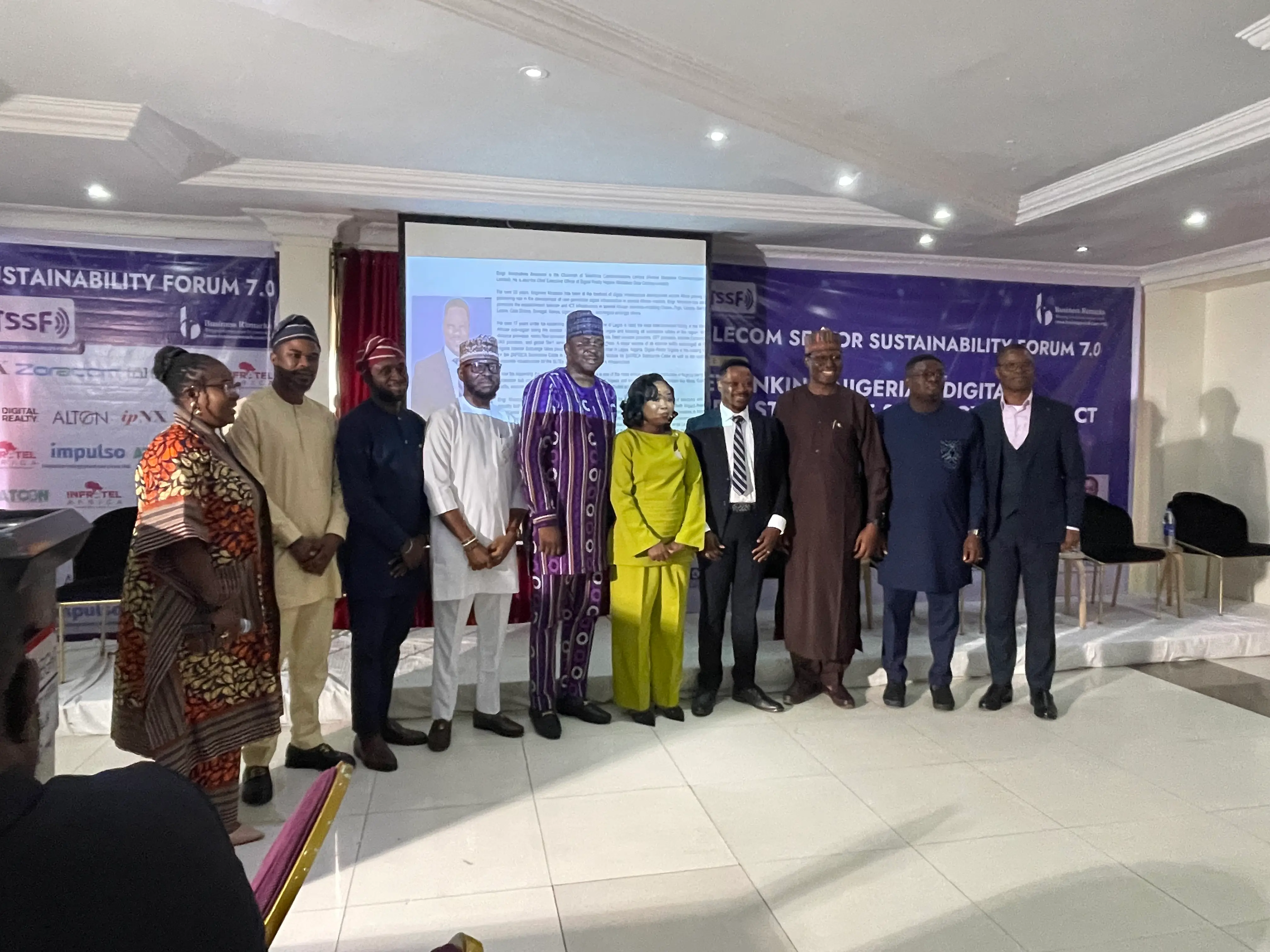
The event, which took place in Lagos on Wednesday, September 16, 2026, was attended by policymakers, regulators, operators, investors, innovators, and industry experts in the telecom industry.
Telecom Now Backbone of Digital Economy — Convener
In her opening remarks, the Convener, Bukola Olarewaju, highlighted that telecommunications is no longer simply an enabler of communication but a fundamental pillar of Nigeria’s data-driven digital economy, supporting financial services, e-commerce, healthcare, education, governance, innovation, and virtually every aspect of modern technology.
According to Olarewaju, “Sustaining the progress requires us to confront some difficult realities that can stall existing goals in the industry: the rising infrastructure cost, foreign exchange pressures, high financing cost, energy expenses, inflation and the increasing cost of network deployment.”
She stressed that demand for reliable connectivity continues to rise as businesses, government and citizens become increasingly dependent on digital services.
Trending Stories
)
)
)
)
)
)
)
)
)
)
)
)
)
)
)
)
)
)
)
)
)
)
)
)
)
)
)
&im=FitAndFill=(700,400))
)
)
)
)
)
)
)
)
&im=FitAndFill=(700,400))
)
)
“It is on this premise of recent industry concerns over the cost of financing and maintaining network infrastructure that the urgency of the theme, ‘Rethinking Nigeria’s Digital Infrastructure Strategy to Attract Investment and Drive Innovation,’ has become imperative to discuss,” she said.
Olarewaju pointed out that this year’s theme, which seeks to deepen Nigeria’s digital infrastructure strategy to attract investments and drive innovation, is timely and deliberate.
“The question before us is not whether Nigeria needs more digital infrastructure — invariably we do — but more importantly, how do we create the right environment to attract the capital required to build, maintain and expand that infrastructure sustainably?” she queried.
We Don’t Licence GSM, We Licence Spectrum — Engr. Nnamani
Speaking while presenting the lead paper titled “Enabler of Digital Infrastructure Development and Investment,” the Chief Executive Officer (CEO) of Digital Realty Nigeria and Co-Chair of the National Sovereign Investment (NSI) Technical Working Group, Engr. Ike Nnamani, declared that digital infrastructure is evolving based on the way service providers see it.
He revealed that Nigeria never issued any Global System for Mobile Communications (GSM) licence, but what the Nigerian Communications Commission (NCC) issued was a Digital Mobile Licence.
“The regulators issue spectrum, they don’t licence service. What you do with the spectrum they give you is up to you, based on the technology you decide to adopt,” he said.
Nnamani disclosed that MTN, which is widely regarded as the biggest telecom operator in Africa from a mobile telephony standpoint, does not see itself as a traditional mobile operator. Rather, according to him, MTN has decided to set up a subsidiary to go into data centres.
“The biggest plan for MTN is to go into cloud services. They are actually looking at the emerging cloud service as their biggest business going forward,” he revealed.
Engr. Nnamani noted that all those we see today as hyperscalers who truly run the digital infrastructure and make it happen are not the traditional players we know. They emerged and were able to rule the world because of their ability to embrace modern emerging technology and dominate in it.
“The big names like Amazon and Apple are not traditional telephony service providers. We should be asking ourselves, in another 10 years, who are going to be the market leaders?” he asked.
Citing data from a graph, Engr. Nnamani further explained that from a telephony standpoint, Nigeria is perceived as the biggest market in Africa in line with its population, but even within Africa, the flow of internet traffic between Nigeria and South Africa is way smaller compared to the traffic between South Africa and Kenya.
“This is so because the Kenya market is more digitised than the Nigerian market,” he explained.
Nnamani also informed participants that Nigeria was officially announced to have a digital economy by the late President Muhammadu Buhari on Democracy Day, May 29, 2023. However, he noted that without having local cloud infrastructure, all data would be piped through submarine cables and stored elsewhere.
He declared that the National Information Technology Development Agency (NITDA) set up a Technical Working Group to ensure that government services are based on a Cloud-First policy.
“For instance, if one wants to host data belonging to Nigerians, it should be sitting in a geographical space within Nigeria,” he said.
According to him, NITDA has developed a National Sovereign Cloud Initiative to localise cloud services and ensure that cloud operations are domiciled in Nigeria.
Quality Customer Experience Key
Corroborating Engr. Nnamani’s position, Engr John Nwachukwu, Chief Strategy/Executive Officer (CSEO) of Zoracom Communications Limited, clarified that network operators are now more reliant on cable connectivity, rolling out fibre even to homes.
“If you have a quality customer experience, you will ensure your customers are happy by bringing in solutions,” he pointed out.
On his part, Mr. Chidi Ajuzie, Chief Operating Officer (COO) of WTES Group, said Nigeria has 90 percent mobile penetration, but broadband penetration is still 67 percent based on current data from the NCC.
“This means that the real broadband we need for the digital economy is still a long way off,” Ajuzie said.
Earlier in his goodwill message, Mr. Ajibola Olude, General Secretary and Chief Operating Officer of Association of Telecommunications Companies of Nigeria ATCON, said focus must extend beyond connectivity statistics to measurable outcomes that improve lives and strengthen the economy.
He emphasised the need to develop a pipeline of skilled, industry-ready digital professionals who can meet the demands of Nigeria’s technology ecosystem.
He also stressed that rural inclusion is critical, because a majority of rural communities are still not connected.
“For growth to thrive, we need to enable digital businesses to emerge, expand and create meaningful employment opportunities across Nigeria,” Ajibola said.
Tell Our Success Stories Too — ALTON Chairman
On his part, the National Chairman of the Association of Licensed Telecom Operators of Nigeria (ALTON), Engr. Gbenga Adebayo, said problems and challenges will never end.
He noted that while forums like TSSF discuss challenges and needs, operators must also tell their success stories because no one will do it for them.
“As we look at sustainability and the progress of the future, we must remember to talk about the work we have done and the sacrifices made that are enhancing society everywhere,” he said.
Adebayo cited the recent initiative by ALTON members to provide zero-rated access to professional and educational websites as an example of industry contributions that have positively impacted many Nigerians.
The summit, which was intelligently moderated by WIONEWS Nigeria Correspondent, Louisa Olaniyi, concluded with an insightful panel session that had Engr John Nwachukwu of Zoracom, Mr Chidi Ajuzie of WTES, Rosalin Ilori of Bridge 57 Solutions, Dr. Olusola Teniola of IPNX who joined virtually, Mr. Wasiu Oluwole of Cedarview Communication, Mr Akinyele Oludare of Impulso integrated services, and Mr Debo Daudu of Infratel Africa.
The panellists unanimously agreed that Nigeria must rethink its infrastructure strategy, harmonise policies, encourage infrastructure sharing, resolve power and Right of Way (RoW) challenges, and create a sustainable, investor-friendly environment that will drive innovation and secure the future of its digital economy.
