

&imwidth=800&imheight=600&format=webp&quality=medium "Vikram chip at Semicon India 2025: India fired its first shot in global 'chip wars'. Here is why it's not just another science story")
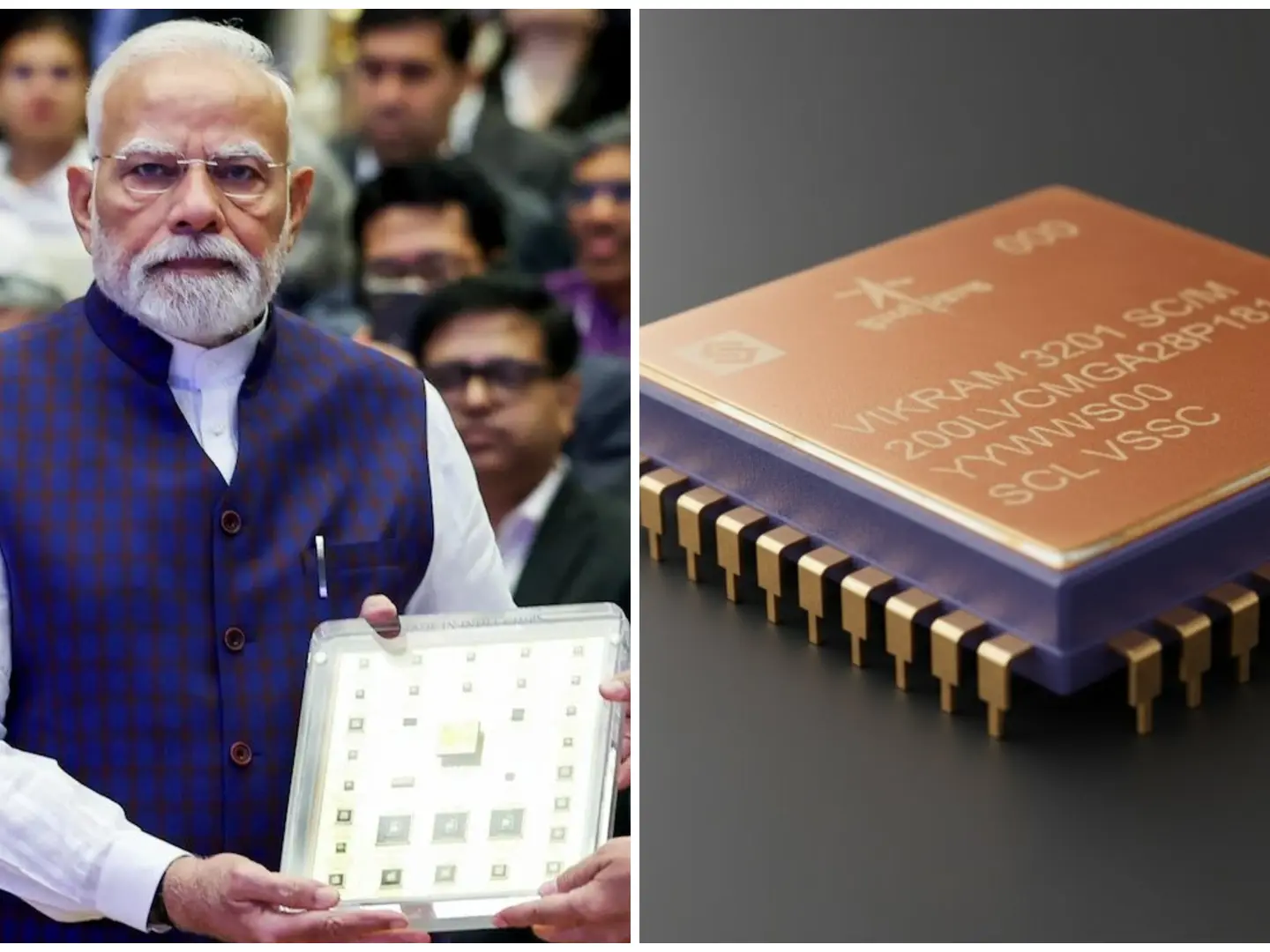
If you think the unveiling of Vikram, India's first fully indigenous semiconductor chip, is just another science event, read this. The launch of the 32-bit chip is India's announcement to the world that it has joined the global semiconductor race, often called the 'chip war'. Here is what you should know about chip wars, who the main contenders are, and why the unveiling of the Vikram chip by Prime Minister Narendra Modi at Semicon India 2025 in New Delhi on Tuesday (Sep 2), is a milestone event with far-reaching ramifications.
What is the Vikram chip?
India's first fully indigenous semiconductor chip, the Vikram 32-bit processor, was developed by the Indian Space Research Organisation’s (ISRO) Semiconductor Laboratory. The formal presentation of the chip to Prime Minister Narendra Modi by Union Information Technology Minister Ashwini Vaishnaw marked India’s official entry into the global race to dominate the semiconductor industry.
The primary function of the Vikram 32-bit processor is to withstand the harsh conditions of space launches.
Vikram, named after the iconic leader of the Indian space programme Vikram Sarabhai, supports the Ada programming language, features floating-point computation capabilities, and uses open-source software toolsets.
The Vikram chip was validated during the PSLV-C60 mission for its reliability for use in aerospace, defence, automotive, and energy sectors.
Trending Stories
&imwidth=180&imheight=135&format=webp&quality=medium)
Viral video shows cross falling on Colombia priest, no official confirmation | WATCH
&imwidth=180&imheight=135&format=webp&quality=medium)
Rafale Marine fighter begins flight trials in Goa ahead of Indian Navy induction
&imwidth=180&imheight=135&format=webp&quality=medium)
Ranbir Kapoor apologises for Dussehra speech slip, clarifies remark at Ramayana event
&imwidth=180&imheight=135&format=webp&quality=medium)
Meta slapped with $25 billion fine in New Mexico over Facebook data practices, company plans appeal
&imwidth=180&imheight=135&format=webp&quality=medium)
WATCH: Woman IPS officer fires several rounds of AK-47, ignites debate online
&imwidth=180&imheight=135&format=webp&quality=medium)
EU probes Booking.com under Digital Services Act
&imwidth=180&imheight=135&format=webp&quality=medium)
Pakistan signs another defence pact even as Makkah Alliance shows no teeth. This time, it's with Qatar, Indonesia, Turkey
&imwidth=180&imheight=135&format=webp&quality=medium)
Ilhan Omar breaks silence over alleged marriage to her brother; Trump thinks it's 'really good answer'
&imwidth=180&imheight=135&format=webp&quality=medium)
US-Iran war: Bibi, Trump gamble on new Iran war to save themselves in polls
&imwidth=180&imheight=135&format=webp&quality=medium)
From Agni-V to Project Kusha: How are India’s indigenous missile systems and defence shield reshaping modern warfare
&imwidth=180&imheight=135&format=webp&quality=medium)
'It's a crime not to see this scene': Tehran puts Trump 'behind bars'
&imwidth=180&imheight=135&format=webp&quality=medium)
Will Rohit and Kohli play ODI World Cup 2027? BCCI president Manhas says board 'not in a position to comment'
&imwidth=180&imheight=135&format=webp&quality=medium)
Why websites around the world are suddenly going offline? What you need to know about PHP
&imwidth=180&imheight=135&format=webp&quality=medium)
US midterms 2026: What polls and prediction markets indicate about Congress
&imwidth=180&imheight=135&format=webp&quality=medium)
'You are a dummy, you are a stupid person': Trump loses temper with CNN, ABC reporters after questions about Russia sanctions
&imwidth=180&imheight=135&format=webp&quality=medium)
China's dancing robot turns violent bodyguard, lifts cars and fights intruders - Watch
&imwidth=180&imheight=135&format=webp&quality=medium)
16-foot doomsday fish in Chile triggers fears that the next earthquake is coming
&imwidth=180&imheight=135&format=webp&quality=medium)
US to get 850 F-35 stealth fighter jets under 10-year Pentagon-Lockheed deal
&imwidth=180&imheight=135&format=webp&quality=medium)
Are the US and Israel preparing for another major attack on Iran? Here's what report claims
&imwidth=180&imheight=135&format=webp&quality=medium)
Priyanka Chopra celebrates Dussehra 2026 with Nick Jonas and daughter Malti Marie | See pics
&im=FitAndFill=(700,400)&imwidth=180&imheight=135&format=webp&quality=medium)
New OTT releases this week (October 19-25, 2026): Gajab Raat to Chaar Yaar-8 titles to watch during Dussehra week on Netflix, Prime Video and more
&imwidth=180&imheight=135&format=webp&quality=medium)
‘I caution the president...’: Trump’s ex-press secretary warns after Zacharia’s exit
&imwidth=180&imheight=135&format=webp&quality=medium)
'Father of all bombs' vs 'mother of all bombs': Iran threatens US with new weapon as Trump hints at MOAB strike
&imwidth=180&imheight=135&format=webp&quality=medium)
Diljit Dosanjh's Oct 30 Delhi show hits roadblock, Delhi Police denies permission
&imwidth=180&imheight=135&format=webp&quality=medium)
Australia police arrest former national 100m champ Jake Doran for alleged child abuse
&imwidth=180&imheight=135&format=webp&quality=medium)
'Gyanu must go': CJP's Saurav Das, Ashutosh Ranka after release, despite Jantar Mantar protest undertaking
&imwidth=180&imheight=135&format=webp&quality=medium)
Kolkata airport: CISF detects ₹1.13 crore in US dollars hidden in bags of 2 Bangkok-bound passengers
&imwidth=180&imheight=135&format=webp&quality=medium)
Feds obtain DNA evidence that could prove Ilhan Omar married her brother: Report
&imwidth=180&imheight=135&format=webp&quality=medium)
US midterms 2026: Trump's approval rating hits record low as Democrats gain ground
Why semiconductors matter: Emergence of the global chip war
Chips are in everything from smartphones and computers to defence systems, space technology, and healthcare. And Vikram is a symbol of India’s ambition to reduce dependency on imported electronics and assert strategic autonomy in the tech sector, critical for economic growth and national security.
Chip wars became a key aspect of global geopolitics since the 2020 COVID-19 pandemic, after the pandemic exposed vulnerabilities in the global semiconductor supply chain.
At the time, a shortage of chips severely affected industries including automotive and electronics, highlighting how much of the world relies on chip production concentrated in East Asia, mainly in Taiwan.
The chip wars contributed to US-China tensions. The US placed tight export curbs on China, particularly on advanced chips below the 9nm node. It was seen as an American attempt to block China’s progress in semiconductor innovation. China launched the “Made in China 2025” strategy, with an aim to dominate critical technologies including chips.
Taiwan, the small big nation in chip wars
Taiwan – a democracy that China considers as its territory that should be united with the mainland even if by force – dominates the chip industry, making 60 per cent of the world’s semiconductors and nearly 90 per cent of the most advanced ones.
South Korea, Japan, and China are the other major producers. Together, this means that only a handful of countries in Asia dominate chip manufacturing capability.
Now, nations that can make smaller and more efficient chips, such as those at 3nm or 5nm nodes, will have a strategic advantage, as these advanced semiconductors are powering emerging technologies like artificial intelligence, defence systems, and 6G telecom networks.
Who are the top semiconductor firms?
Taiwan’s TSMC (Taiwan Semiconductor Manufacturing Company) is the undisputed world leader, making over 60 percent of the world’s chips and nearly 90 percent of advanced chips. South Korea’s Samsung Electronics and SK Hynix are strong in memory chips and advanced fabrication.
While the US excels in chip design with firms like Intel, NVIDIA, and Qualcomm, the manufacturing of many of these chips is not happening in the country.
China’s SMIC (Semiconductor Manufacturing International Corporation) continues to develop despite US sanctions, though it lags in advanced chip production.
Japan’s Renesas Electronics and Toshiba are important contributors, especially in automotive and industrial sectors.
From design to assembly, these countries and corporations control crucial stages of the semiconductor supply chain.
Why India’s Semicon India 2025 is a defining moment in the global chip race
This is the context in which India’s Semicon India 2025, being held from September 2 to 4 at Yashobhoomi in New Delhi, assumes significance.
The event aims to catapult India to a global hub for both chip design and manufacturing.
With more than 20,750 participants, including 2,500 delegates from 48 countries in attendance, it is more than just another science show. How the world is eager to have India join the chip race is evident from 150 speakers and more than 350 exhibitors.
Global CEOs, researchers, and policymakers are discussing topics such as smart manufacturing, advanced packaging, research and development, and investment opportunities.
What you should know about India's semiconductor mission
The South Asian nation's chip journey is driven by the India Semiconductor Mission (ISM). Launched in 2021, ISM is supported by a ₹76,000 crore ($9.1 billion) Production Linked Incentive (PLI) scheme. So far, nearly ₹65,000 crore has been committed to 10 approved projects across six states – Gujarat, Assam, Uttar Pradesh, Punjab, Odisha, and Andhra Pradesh. Five semiconductor units are already under construction, and two are expected to begin chip production soon.
Prime Minister Modi, during his address, described India as a “lighthouse of stability and growth” amid global policy uncertainties.
India’s goal is to capture 5 percent of the global semiconductor market by 2030, when the domestic chip market is expected to be valued at $100–110 billion.
But India has a long way to go in the semiconductor industry
It has to be noted that the Vikram chip may not compete with Taiwan’s 3nm chips – it is built using 28 to 90nm nodes. But it is strategically designed for high-volume applications such as power management, automotive controllers, and IoT devices, which have significant economic and strategic value.
While initiatives under ISM can help India survive global headwinds, tech embargoes, and economic warfare, India has a long way to go in the chip race. Over the past decade, India’s electronics production has increased six times, and electronics exports grew eight-fold, yet challenges remain. India needs capabilities to produce advanced semiconductors like the 3nm chips. The manufacturing ecosystem needs to grow, and needs more sustained investment, a skilled workforce, and robust infrastructure.
India's biggest advantages are the large consumer market and proven engineering capabilities.
The global semiconductor industry is set to be worth $1 trillion by 2030. The Vikram chip is a pivotal moment for India's advances in the sector, and the beginning of its transition from a consumer of semiconductors to a producer.

