
&imwidth=800&imheight=600&format=webp&quality=medium "US appeals court halts Trump's $400 million White House Ballroom project construction; Trump says, 'Will be appealing to US Supreme Court'")
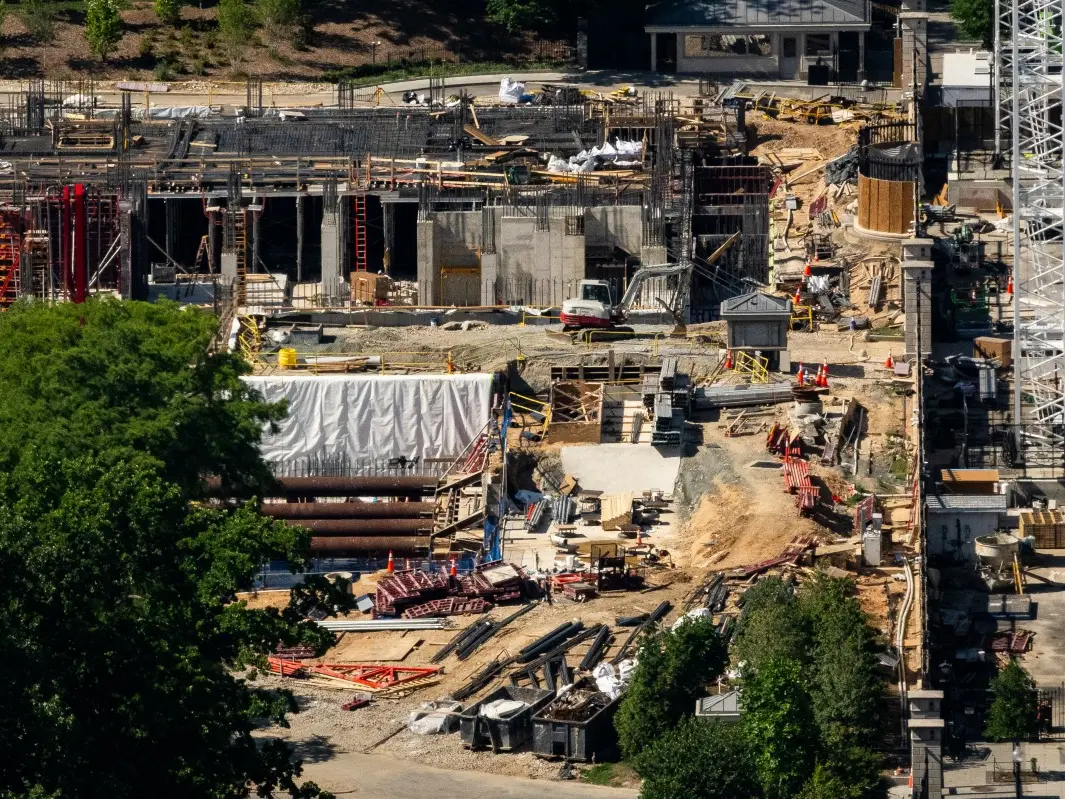
A US federal appeals court on Friday ordered President Donald Trump's administration to halt construction of a $400 million ballroom on the site of the White House's demolished East Wing, marking a significant legal setback in a case examining the limits of presidential authority. In a 2-1 ruling, the Washington-based US Court of Appeals for the District of Columbia Circuit said a president does not have unilateral authority to fundamentally alter the White House without congressional approval.
“Each President is a temporary tenant, not the owner, of the White House” and cannot fundamentally reshape it without congressional approval, the court said. The decision upheld a preliminary injunction secured by the National Trust for Historic Preservation, which filed a lawsuit last year after the administration demolished the East Wing and began constructing a 90,000-square-foot (8,360-square-meter) ballroom without first obtaining authorization from Congress.
The court's majority emphasised that decisions about major structural changes to the White House belong to Congress. "Whether or not a massive ballroom should be constructed is for Congress to decide and is not a matter for Executive self-help," the panel majority wrote. "Congress has not ceded unfettered authority to the Executive Branch to dramatically redesign, reshape, and reconstruct the White House, the People’s House, to fit a particular President’s desires."

The appeals court placed its ruling on hold for 14 days, allowing the Trump administration time to seek review from the US Supreme Court. The White House and the Justice Department did not immediately respond to requests for comment. The National Trust for Historic Preservation also did not immediately comment. The appeal followed rulings by US District Judge Richard Leon, appointed by former President George W. Bush, who twice blocked above-ground construction while allowing underground work to continue.
The ballroom project has been described by the administration as necessary for hosting large formal events while improving White House security. It is also one of several initiatives by Trump aimed at reshaping prominent government buildings and landmarks in Washington. In a separate legal dispute, another judge recently ruled that Trump's name had been illegally added to the exterior of the Kennedy Center and ordered it removed.
Trending Stories
)
IND vs JPN one-off T20I: India survive scare from Japan to win five-over a side match by 2 runs
)
Putin's United Russia party wins 355 seats in Duma election; 4 other parties cross threshold to enter parliament
)
AI models chose to harm humans to stop ‘pain,’ alarming study raises fresh safety questions
)
‘0% chance’: Nvidia CEO Jensen Huang dismisses AI extinction fears by 2030
)
Samay Raina-Mukesh Chhabra controversy explained: What happened over girlfriend joke on India's Got Latent?
)
Trump's helipad event overshadowed by audio failure as major TV networks suspend pool coverage
)
'Needs time away from the international scene': England white-ball captain Brook on pacer Brydon Carse's future
)
New Zealand farms shift to carbon forests: Carbon credits fuel a land rush reshaping rural life
)
Anti-AI activists storm summit, say 'incompetent' leaders are leading us into a disaster - 'We need a vote'
)
Samsung raises Galaxy S26 prices by Rs 20,000: Here’s what each model now costs
)
J&K Assembly Session begins amid chaos: BJP, ruling alliance clash as statehood demand dominates
)
Asian Games 2026: India women's cricket team beats Sri Lanka by 147 runs for first gold
)
Key accused in Bihar's Jamui molestation case, arrested after police shoot him in leg
)
Randeep Hooda arrives in Gujarat for his first National Film Award: ‘Very grateful’
)
US and China vie for AI dominance as calls grow for regulation | Gravitas
&im=FitAndFill=(700,400))
Anant Nag to recieve Dadasaheb Phalke Award: From Ankur to Nishant- Revisit his best films and iconic performances on OTT
)
UK banks are rethinking financial crime detection because of algorithm
)
FIFA chief Infantino wants to reform governing body with consultation from federations
)
India at UNGA81: Jaishankar warns global order under 'growing stress', pushes for ‘reformed multilateralism’
)
IND vs JPN, one-off T20I: Japan captain Kendel on pushing India to the brink - ‘It was special’
)
Raaka creates history! Allu Arjun’s film secures Guinness World Record ahead of release
)
Saudi Arabia exits China-led mBridge digital currency platform amid Saudi-Houthi conflict
)
Indonesian groups sue govt over wildfires as haze crosses borders, nearly 900,000 hectares burned
)
'Lot of things to learn from experienced players': Jayasuriya backs Rohit, Virat for 2027 ODI World Cup
)
$110 billion Warner Bros merger: Paramount reaches settlement with 12 US states
&im=FitAndFill=(700,400))
New OTT releases this week (September 21-27, 2026): Shaque: Trust No One, Hunkkaar, Don’t Be Shy- 5 new titles coming to Netflix, Prime Video and more
)
From ‘communist’ to ‘great mayor’: Trump praises Mamdani after New York meeting, discusses immigration and housing
)
Report: Zelensky meets CIA chief Ratcliffe at Shannon airport, weeks after his secret Moscow trip
)
How Zaheer Khan came to be CSK's head coach of IPL 2027
)
Pilot recreates Mona Lisa in sky over Oklahoma and Arkansas in four-hour flight: VIDEO
)
UK PM Burnham agrees to 'defensive' military support for Saudi Arabia against Houthis
)
Jailer 2: Vidya Balan joins Rajinikanth's upcoming film as Kantha | Watch
)
Microsoft executive called AI training the ‘largest theft of labour in human history’
&im=FitAndFill=(700,400))
National Film Awards 2026: Kartik Aaryan, Mammootty, Yami Gautam, Randeep Hooda and other key winners
)
40-foot waves crash into cruise ship in dangerous stretch near Antarctica. Watch
)
US-Iran war, peace deals and more: What to expect from Trump's UNGA 2026 speech
)
Explainer: Why rare-earth export licences and Board of Trade are US priorities ahead of Trump-Xi summit
)
Two infants die after fire breaks out at RIMS newborn care unit in Telangana's Adilabad
National security arguments
During oral arguments before the DC Circuit on June 5, Justice Department attorney Yaakov Roth argued that courts should not interfere with the privately funded ballroom project. Roth contended that the National Trust's ‘architectural preference’ should not outweigh national security concerns, asserting that the former East Wing left the president and others inside the White House vulnerable to attack.
"They just don't want to go to Congress," responded Thaddeus Heuer, attorney for the preservation group. The majority opinion, written by Democratic-appointed judges Patricia Millett and Brad Garcia, clarified that the ruling does not permanently prohibit construction. Instead, it pauses above-ground work while the lawsuit proceeds and until congressional approval is obtained.
“The bold assertion that the Executive can act with utter lawlessness, destroying treasured national landmarks and harming the interests of individuals, and that no court can stop it flouts our constitutional order,” the majority wrote. The judges also rejected the administration's national security argument, stating that ‘are not an automatic get-out-of-law-free card’. In dissent, Circuit Judge Neomi Rao, appointed by Trump during his first term, argued that the lower court had exceeded its authority.
“The district court seized supervision of construction at the White House, and my colleagues affirm this judicial overreach,” Rao wrote. Trump has continued to defend the ballroom project despite its growing cost, which has doubled from its original estimate. In a Truth Social post in May, Trump said the increased cost reflected the expanded scope of the project, writing that ‘it is approximately twice the size, and a far higher quality, than the original proposal’ and promising ‘it will be magnificent, safe, and secure!’
‘We will be immediately appealing to US Supreme Court’: Trump
US President Donald Trump on Friday criticised an appeals court decision ordering a pause in construction of his White House ballroom, and promised to challenge the ruling in the Supreme Court. "We will be immediately appealing to the United States Supreme Court," Trump said in a post on Truth Social, describing it as "a horrendous, politically motivated, and unlawful ruling" that goes against national security interests.

