Ukrainians deported to Russia from besieged Mariupol dream of home

Mariupol
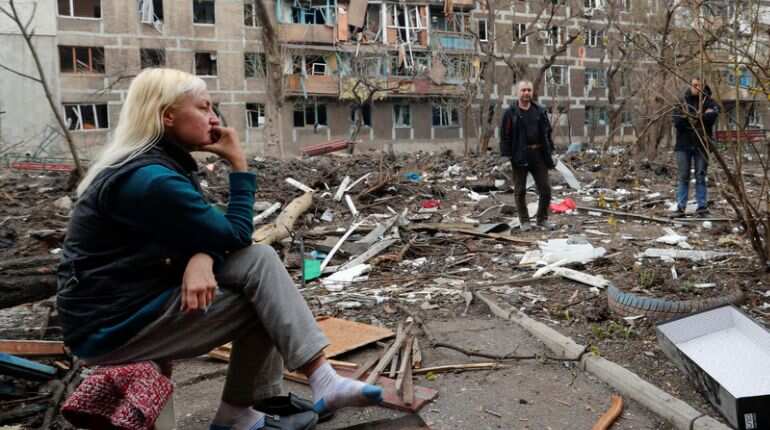
Mila Panchenko found herself on a station platform in southwestRussiaafter lack of food and water forced her to hand herself over to pro-Russian forces to escape thebesiegedUkrainian city ofMariupol.
At the station in Taganrog, a port on the Sea of Azov, she was put on a train along with around 200 otherUkrainiansand told they were being transported to another part ofRussia's Rostov region, which borders Ukraine.
But when the train arrived at its destination, the 53-year-old found herself in Tula province in centralRussia, in the town of Suvorov, some 1,000 km (621 miles) away.

"There were a lot of police. The station was sealed off so noRussian civilians could approach us," Panchenko said, adding that there were crowds to greet them but the son of a friendfromTula - who she did not identify - was not allowed in. "We were met cheerfully, with cookies."
In addition to Panchenko, Reuters spoke to another Ukrainian woman - Natalia Bil-Maer - who escapedMariupollast month, as well as the relatives of two other refugees.
&im=FitAndFill=(700,400)&imwidth=180&imheight=135&format=webp&quality=medium)
Navratri 2026: 9 days, 9 forms of Goddess Durga and 9 colours- Check the complete list
&imwidth=180&imheight=135&format=webp&quality=medium)
Bigg Boss 20: Isha Rikhi evicted after three weeks in Salman Khan’s show
&imwidth=180&imheight=135&format=webp&quality=medium)
Russian woman and Bihar boy's love story goes viral after she reaches India to marry him
&imwidth=180&imheight=135&format=webp&quality=medium)
Arijit Singh 9-city India stadium tour to start from January: Check venue and ticket prices
&imwidth=180&imheight=135&format=webp&quality=medium)
‘Hernia, aneurysm, injuries’: Salman Khan reveals health struggles behind his changing physique on Koffee With Karan 9
&imwidth=180&imheight=135&format=webp&quality=medium)
F1 set to return to Africa for first time since 1993
&imwidth=180&imheight=135&format=webp&quality=medium)
'Don't ever mess with nature!': Trump’s tiger attack post triggers social media backlash as victim's family issues heartbreaking tribute
&imwidth=180&imheight=135&format=webp&quality=medium)
US judge blocks Trump administration sanctions on human rights groups supporting Gaza war crimes investigation
&imwidth=180&imheight=135&format=webp&quality=medium)
Trump's $100,000 H-1B fee: Why neither Republicans nor Democrats want to make it a 2026 US Midterm issue
&im=FitAndFill=(700,400)&imwidth=180&imheight=135&format=webp&quality=medium)
Which jobs are safest from humanoid robots?
&imwidth=180&imheight=135&format=webp&quality=medium)
‘Rise up, young patriots!’: American singer Mary Millben says US donors funding CJP, backs Modi govt
&imwidth=180&imheight=135&format=webp&quality=medium)
Nobel Peace Prize winner Navi Pillay calls on US to 'get back to' being defender of human rights
&imwidth=180&imheight=135&format=webp&quality=medium)
Iranian woman, 23, handed death sentence for ‘blasphemy’ in social media post; appeals for help
&imwidth=180&imheight=135&format=webp&quality=medium)
'Turn approver, resign, we'll forgive you': Rahul Gandhi claims receiving messages from CEC Gyanesh Kumar
&imwidth=180&imheight=135&format=webp&quality=medium)
Somaliland celebrates after Trump calls it 'a totally different country', raise hopes of US recognition
&imwidth=180&imheight=135&format=webp&quality=medium)
Afghan FM Muttaqi to CdA Yatin Patel: We attach importance to relations with India
&imwidth=180&imheight=135&format=webp&quality=medium)
'FWD Supreme' to use AI for flight and threat identification
&imwidth=180&imheight=135&format=webp&quality=medium)
‘My president, I mean my husband’: Trump's new press secretary Katie Zacharia's first briefing goes off the rails in 14 minutes
&imwidth=180&imheight=135&format=webp&quality=medium)
Mars is not for man: Human heart is too weak to survive the trip, study shows
&imwidth=180&imheight=135&format=webp&quality=medium)
‘600,000 people without electricity’: Zelensky calls for ‘strong’ US sanctions on Russia, accuses Moscow of violating Trump’s energy ceasefire
&imwidth=180&imheight=135&format=webp&quality=medium)
Sheikh Hasina warns of 'deep sense of insecurity' among Bangladesh's minorities in Durga Puja message
&imwidth=180&imheight=135&format=webp&quality=medium)
FBI refutes media report claiming Kash Patel is in Russia for talks, says he is in Virginia
&imwidth=180&imheight=135&format=webp&quality=medium)
US inflation hits 3.7% as rising fuel prices pose challenge for Trump ahead of midterms
&imwidth=180&imheight=135&format=webp&quality=medium)
IND vs WI 4th T20I: Shai Hope hundred and Keemo Paul's five-for level series for West Indies
&imwidth=180&imheight=135&format=webp&quality=medium)
Girl 'dead' for 8 hours wakes up at her own funeral, dad insists she wasn't breathing
&imwidth=180&imheight=135&format=webp&quality=medium)
'Ouch!!! That must hurt': Kangana Ranaut hails Kamal Haasan's sharp reply to Elon Musk over Starlink row
&imwidth=180&imheight=135&format=webp&quality=medium)
Three Indians killed in suspected arson attack in Germany, Romanian resident arrested
&imwidth=180&imheight=135&format=webp&quality=medium)
'Totally unacceptable': MEA slams attacks on Saudi civilian infrastructure after Indian national's death
&im=FitAndFill=(700,400)&imwidth=180&imheight=135&format=webp&quality=medium)
New OTT releases this week (October 12-18, 2026): Sacrifice, Koffee with Karan S9, Roadies Rebirth- 6 titles coming on Netflix, JioHotstar and more
&imwidth=180&imheight=135&format=webp&quality=medium)
Did the US withhold missile warnings? Ukraine questions Washington's 'bad weather' explanation after Russian strikes kill six, cut power to 600,000
&imwidth=180&imheight=135&format=webp&quality=medium)
US Singer Mary Millben alleges foreign funding for CJP, warns against anti-Modi forces: All you need to know
&imwidth=180&imheight=135&format=webp&quality=medium)
Global energy crisis hits Indian economy
&imwidth=180&imheight=135&format=webp&quality=medium)
Durga Puja 2026: Power banks, water bottles and more, a foolproof guide to pandal hopping
&imwidth=180&imheight=135&format=webp&quality=medium)
Netflix layoffs: Streaming giant to cut 1,000 jobs globally amid slow growth and declining user engagement
&imwidth=180&imheight=135&format=webp&quality=medium)
Zelensky feels betrayed by Trump, urges Musk to restore Starlink in Ukraine; Musk responds
&imwidth=180&imheight=135&format=webp&quality=medium)
'Girls are uncomfortable': Salman Khan calls out paparazzi for bad angles, speaks on PR on Koffee With Karan
&imwidth=180&imheight=135&format=webp&quality=medium)
After flydubai co-pilot attack, Air France bans Pakistani, Muslim-majority crew on Israel flights
They painted a picture of some civilians inMariupolhaving no choice but to fleefromthebesiegedcity toRussia, a journey that involved repeated searches and questioning by pro-Russian forces before being transported often farfromUkraine's border.
Reuters was unable to verify their stories independently.
The Kremlin did not respond to a request for comment about the independent accounts provided to Reuters by Panchenko and Bil-Maer ofUkrainiansbeing sent to distant parts ofRussiawithout any choice.
Moscow has denied intentionally targeting civilians since invading Ukraine on Feb. 24.
Panchenko said she and the otherUkrainianson the train were taken byRussian authorities to a sanatorium in the Tula region called Krainka. She was given a room with a small fridge, a television and two single beds. Laid on a table was traditional gingerbread, sweet biscuits, water and iced tea.
Watch |Gravitas Global Headlines: 7 killed in Russian strikes in Kyiv
The Krainka resort did not respond to a request for comment on its role in sheltering theUkrainians.
After arriving at the sanatorium, Panchenko - the duty manager of a cistern factory before the war and a member of the local council - said she was fingerprinted, photographed and questioned in front of a prosecutor, whom Reuters was unable to identify.
Panchenko - who speaksRussian and Ukrainian - was asked whether the suppression of theRussian language in Ukraine had worsened since 2014, she said.
In that year,Russiaannexed the Crimea peninsula while two breakaway regions of Ukraine -- Donetsk and Luhansk -- declared themselves people's republics with Moscow's backing.
One ofRussia's justifications for what it calls its "special military operation" in Ukraine is to protectRussian speakersfromwhat Moscow brands aggressionfromUkrainian nationalists. Ukraine has denied this.
"I only said that I could speak Ukrainian and that I loved it ... I said I hadn't witnessed any suppression ofRussian."
Forced Deportations
Liudmyla Denisova, Ukraine's ombudswoman for human rights, said last week thatRussiahad taken 134,000 peoplefromMariupoland that 33,000 of those were forciblydeported. Reuters was unable to determine the accuracy of those statistics.
Rachel Denber, deputy director for Europe and Central Asia at Human Rights Watch, said her organisation had documented at least one instance where there was "no question that it would be considered a forced transfer" - which she defined as "being forced to go to the side that has invaded your country."
The 1949 Geneva Conventions, which defined legal standards for humanitarian treatment in conflict, prohibit the mass forcible transfer of civilians during an international conflict to the territory of the occupying power, classifying it as a war crime.
Russiasays it is offering humanitarian aid to those wanting to leaveMariupol. ARussian government resolution, published on March 12 on its website, listed the whereabouts of 95,909 people acrossRussiawho had left Ukraine and the two breakaway republics.
A month later, on April 14,Russian Colonel-General Mikhail Mizintsev said that 138,014 civilians had been rescued byRussian forces justfromMariupol, as the fighting intensified.
Panchenko said she fledMariupolon March 17 when Chechen troops seized the building on the left bank of the Kalmius river where she and dozens of other civilians had been sheltering in a basement.
"They said that we had to evacuate because they wanted to set up their headquarters there," Panchenko said by telephonefromBrescia, in northern Italy, where she is now living, having leftRussia.
With scant supplies of food and water, Panchenko said she had no choice but to get into the cars offered by the Chechen soldiers to take them toRussian-controlled parts of Donetsk.
They were transported by car and then bus to the village of Bezimenne, where policefromthe separatist Donetsk People’s Republic (DPR) have set up processing facilities, Panchenko said. They were fingerprinted and questioned by separatist police.
Spokespeople for the DPR and the Chechen authorities did not respond to a request for comment.
"We were asked if we had any connection with the Ukrainian Armed Forces, if we knew anyonefromthe Azov Battalion," she said, referring to a Ukrainian National Guard unit that Moscow has accused of targetingRussian speakers. "We weren't on any lists, so they put us on a bus again and took us to Taganrog train station."
Trains sent across Russia
On March 22, Bil-Maer fled the basement of a relative's apartment block with her husband and two children - aged 6 and 7 - as theRussian assault drew closer. They had planned to go to the nearby coastal town of Berdiansk, to the west, but their route was blocked by shelling.
"We had only one way left to go because that part of town was controlled byRussian soldiers ... So they transported us and we weredeportedtoRussia."
As they were taken throughRussian-controlled territory, Bil-Maer saidUkrainianswere repeatedly questioned and men were asked to strip, asRussian forces searched for combatants.
But by March 23 she found herself onRussian soil and was taken to Taganrog station.
"In Taganrog, there were a lot of nice words said to us: “We've saved you. We'll feed you”," said Bil-Maer, who saw trains headed to Tambov and Vladimir in centralRussia. "It was clear that every train was going to a different place."
As soon as Bil-Maer could use her phone, she called an aunt inRussia's Krasnodar region, across the Sea of Azovfromeast Ukraine, and she came to pick up the family.
But, once in her aunt’shome, Bil-Maer said she was reluctant to go outside because she was tired of being told by strangers that theRussian bombing was Ukraine's fault for attackingRussian-speakers. She said manyRussians echoed the Kremlin’s position - reproduced in the media - that civilian casualties in the conflict were caused by Ukraine’s own armed forces to discredit Moscow.
Bil-Maer quickly fled to Georgia with her husband and children.
She does not know how she will returnhome: she is struggling to get helpfromthe Ukrainian embassy and only has her internal passport with her. Her husband also left the country with her illegally when it was banned because he was of fighting age.
Ukraine foreign ministry spokesman Oleg Nikolenko said Ukraine had to close its diplomatic missions inRussiafor security reasons but embassies in the neighboring countries would provide consular assistance toUkrainiansdeportedtoRussiato enable them to returnhome, including temporary travel documents.
After 10 days at the Krainka resort, Panchenko said she persuaded theRussians to allow her to leave for Nizhny Novgorod, a city on the Volga river east of Moscow, to stay with the family of an elderly neighborfromMariupolwho had fled with her.
Once outside the resort, Panchenko and her neighbor, who she identified as Zhan, went instead to Moscow and then to the Baltic States. Panchenko found her way eventually to Italy.
"But my plan is to make some money and return to myhomeMariupol, if it stays Ukrainian," she said. "I want to come back to Ukraine very much."