

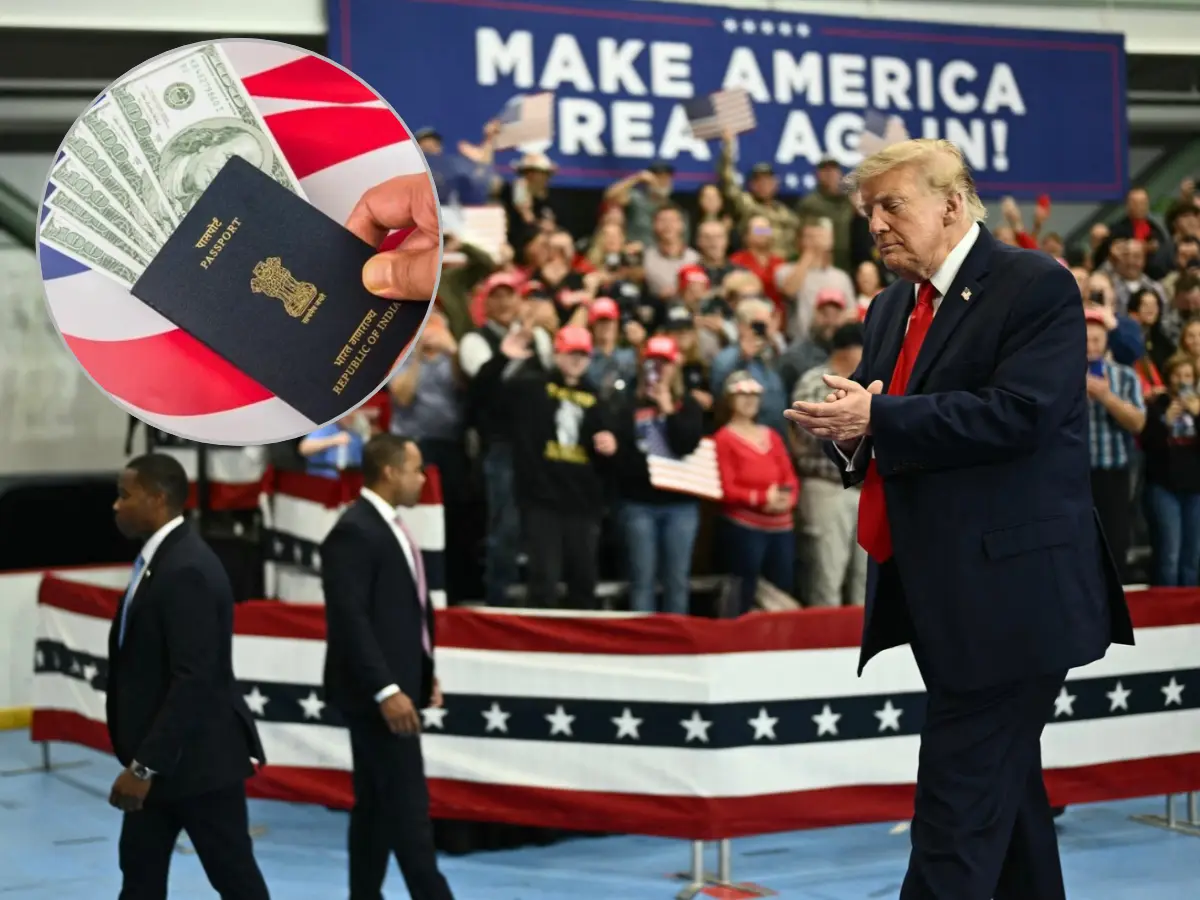
&imwidth=800&imheight=600&format=webp&quality=medium "Trump's $100,000 H-1B fee: Why neither Republicans nor Democrats want to make it a 2026 US Midterm issue")
With the US midterm elections approaching, candidates are talking about inflation, jobs, healthcare, and the cost of living. Immigration remains part of the debate, particularly for Republicans. Yet one policy with direct consequences for Indian professionals and US employers, the $100,000 H-1B visa fee, has received far less attention in the broader campaign conversation.
President Donald Trump’s administration has presented the fee as a way to protect American workers from cheaper foreign labour. For Indian professionals, technology companies and families planning careers in the United States, however, it has raised questions about the cost and accessibility of one of the country's main skilled-worker visa routes.
A policy with consequences beyond Silicon Valley
The Trump administration introduced the $100,000 payment requirement in September 2025 for certain new H-1B petitions. It argued that employers had used the programme to replace American workers with lower-paid foreign employees. In September 2026, the White House renewed the measure, extending its intended duration through September 2027.
Also read | US Midterms 2026: How grocery bills, cost of living are turning the Nov 3 election into a test of Trump
The fee was a dramatic departure from the previous cost structure. Reuters reported that H-1B-related fees had typically totalled around $2,000 to $5,000, depending on the circumstances. The new payment requirement therefore raised concerns about whether some employers would reconsider hiring workers from abroad.
Trending Stories
&imwidth=180&imheight=135&format=webp&quality=medium)
Blasts heard in Sanaa as Saudi-led coalition warns civilians to evacuate; Houthis vow retaliation
&imwidth=180&imheight=135&format=webp&quality=medium)
China's counter-surveillance industry booms amid heightened espionage fears | Gravitas
&imwidth=180&imheight=135&format=webp&quality=medium)
Saudi Arabia strikes Yemen oil sites as Houthi missiles target Riyadh; 'limited fire' breaks out at Aramco
&im=FitAndFill=(700,400)&imwidth=180&imheight=135&format=webp&quality=medium)
Navratri 2026: 9 days, 9 forms of Goddess Durga and 9 colours- Check the complete list
&imwidth=180&imheight=135&format=webp&quality=medium)
Trump accuses Houthis of driving up oil prices before US midterms, warns of consequences
&imwidth=180&imheight=135&format=webp&quality=medium)
New Delhi rejects Beijing’s claims and remarks on Ladakh location naming exercise
&imwidth=180&imheight=135&format=webp&quality=medium)
Russian woman and Bihar boy's love story goes viral after she reaches India to marry him
&imwidth=180&imheight=135&format=webp&quality=medium)
US Midterms 2026: In Alaska, cost-of-living anxiety meets strangest ballot in high-stakes Senate race
&imwidth=180&imheight=135&format=webp&quality=medium)
CMs Vijay-Naidu meet in Vijayawada, discuss water sharing, river-linking
&imwidth=180&imheight=135&format=webp&quality=medium)
'Don't ever mess with nature!': Trump’s tiger attack post triggers social media backlash as victim's family issues heartbreaking tribute
&imwidth=180&imheight=135&format=webp&quality=medium)
OpenAI employee arrested by FBI after allegedly hiding recording device in office
&imwidth=180&imheight=135&format=webp&quality=medium)
Air India Flight from Frankfurt diverted to Jaipur after hijack alert, probe on
&imwidth=180&imheight=135&format=webp&quality=medium)
1,500 drones illuminate Mumbai sky as Cordelia Cruises unveils second ship, Cordelia Sky
&imwidth=180&imheight=135&format=webp&quality=medium)
Delhi Police arrest Cockroach Janta Party's Saurav Das, Ashutosh Ranka, Ajinkya Shinde in Jantar Mantar case, to be produced before court
&imwidth=180&imheight=135&format=webp&quality=medium)
Pakistan to chair UN-backed global Borrowers’ Platform as its own debt burden mounts, triggers sarcastic reactions on social media
&imwidth=180&imheight=135&format=webp&quality=medium)
Robot gropes girl, makes thrusting movements in bizarre crime in Germany
&imwidth=180&imheight=135&format=webp&quality=medium)
France accuses Musk of ‘online harassment’ of European leaders, warns of poll interference
&imwidth=180&imheight=135&format=webp&quality=medium)
'Turn approver, resign, we'll forgive you': Rahul Gandhi claims receiving messages from CEC Gyanesh Kumar
&imwidth=180&imheight=135&format=webp&quality=medium)
MI5 chief warns Russia is UK’s ‘aggressor number one’ as Iran and AI threats grow
&imwidth=180&imheight=135&format=webp&quality=medium)
Trump reconsidering calling off Nidal Hasan's execution livestream. Here's why
&imwidth=180&imheight=135&format=webp&quality=medium)
‘My president, I mean my husband’: Trump's new press secretary Katie Zacharia's first briefing goes off the rails in 14 minutes
&imwidth=180&imheight=135&format=webp&quality=medium)
‘How many people did she illegally bring from Somalia?’ Trump targets Ilhan Omar, questions her net worth
&imwidth=180&imheight=135&format=webp&quality=medium)
Marco Rubio to visit India next week, focus on energy cooperation and strategic ties
&imwidth=180&imheight=135&format=webp&quality=medium)
'Ouch!!! That must hurt': Kangana Ranaut hails Kamal Haasan's sharp reply to Elon Musk over Starlink row
&imwidth=180&imheight=135&format=webp&quality=medium)
Girl 'dead' for 8 hours wakes up at her own funeral, dad insists she wasn't breathing
&imwidth=180&imheight=135&format=webp&quality=medium)
Sidhu Moose Wala’s younger brother wins hearts by recreating late singer’s signature move at Toronto Hologram Show
&imwidth=180&imheight=135&format=webp&quality=medium)
UK school ditches technology, shifts from screen to pen and paper for learning
&im=FitAndFill=(700,400)&imwidth=180&imheight=135&format=webp&quality=medium)
New OTT releases this week (October 12-18, 2026): Sacrifice, Koffee with Karan S9, Roadies Rebirth- 6 titles coming on Netflix, JioHotstar and more
&imwidth=180&imheight=135&format=webp&quality=medium)
New Cold War: Why is China buying more gold? Explained
&imwidth=180&imheight=135&format=webp&quality=medium)
Netanyahu wants to join Saudi's war on Houthis, but Crown Prince denies: Report
&imwidth=180&imheight=135&format=webp&quality=medium)
Anupam Kher joins Ranbir Kapoor's Ramayana as Jatayu, new poster unveiled
&imwidth=180&imheight=135&format=webp&quality=medium)
Measles kills again: 6 dead in Pennsylvania as America faces its worst outbreak in decades | Gravitas
&imwidth=180&imheight=135&format=webp&quality=medium)
Ken Paxton's Dubai night out with two US fugitives sparks political storm as Texas Senate race tightens
&imwidth=180&imheight=135&format=webp&quality=medium)
Cornell University suspends fraternity parties over 2024 gang rape allegations
India has a particularly large stake in the debate. According to the Carnegie Endowment for International Peace, citing US Citizenship and Immigration Services data, people of Indian origin accounted for 71 per cent of new H-1B petitions in fiscal year 2024. In Carnegie's 2026 Indian American Attitudes Survey, about two-thirds of respondents opposed the $100,000 fee.
Why the issue struggles to break through
The first reason is the campaign's broader economic focus. In an analysis published on October 8, The Washington Post reviewed more than 8,000 advertisements in competitive congressional and gubernatorial races. Nearly three in five mentioned the economy, with affordability, housing, groceries and other costs featuring prominently. Immigration remained a major Republican advertising issue, but it was no longer as prominent as in the 2024 election. Democrats, in comparison, devoted relatively little advertising to immigration.
For Republicans, mentioning the issue comes with its own political complication. The fee is part of Trump's effort to restrict what his administration describes as abuse of the H-1B programme. Challenging it could alienate voters who believe foreign workers compete with Americans for jobs. On the other hand, defending it without qualification, meanwhile, risks concerns among technology employers and skilled workers who depend on international recruitment.
For Democrats, opposing the fee offers a way to challenge a Trump administration policy and appeal to workers, employers and immigrant communities. But a broad defence of immigration can be politically difficult in an environment where campaigns are concentrating on affordability and where candidates in competitive districts must respond to local concerns.
Also read | US midterm elections: Why Zohran Mamdani's influence could become a headache for Democrats and Republicans
Trump's $100,000 H-1B fee: Latest court order
There is another reason the issue may be difficult to campaign on: the fee's legal status has changed. On September 30, a federal judge in California blocked the requirement in a separate case brought by a coalition of unions, employers and nonprofit organisations. In Global Nurse Force v. Trump, U.S. District Judge Haywood S. Gilliam, Jr., in the Northern District of California, wrote, “The Agency Policies are VACATED and REMANDED to Agency Defendants. Agency Defendants, and all persons acting under their direction, are enjoined from enforcing or implementing the Agency Policies made pursuant to or in implementation of Proclamation No. 10973 and its extension in Proclamation No. 11069, until notice-and-comment rulemaking under the APA (Administrative Procedure Act) and regulatory flexibility analyses under the RFA have been conducted.”
The decision followed an earlier ruling in June by a federal judge in Boston, which was upheld when an appeals court declined to pause it in July. The legal challenges concern the administration's authority and its failure to follow required procedures.
What happens after November?
The November 3 midterms will determine who controls Congress, but the result will not automatically settle the H-1B dispute. The immediate outcome will depend heavily on the courts and on the administration's next legal steps. Three broad possibilities remain.
- First, the legal challenge continues. If the court orders remain in force, the administration cannot simply treat the fee as enforceable because it has renewed the proclamation. Further proceedings will determine the limits of its authority and whether the policy can survive judicial review.
- Second, Congress takes up the question. Lawmakers could debate legislation governing H-1B fees, employer obligations and protections for American workers.
- Third, the dispute moves into a different policy framework. Reuters reported that the Department of Homeland Security had moved in August to adopt a permanent fee of about $103,000. Notably, the agency's proposal could raise separate legal questions from those challenging Trump's original requirement.

