The great American guessing game: who runs the country, Trump or Musk?

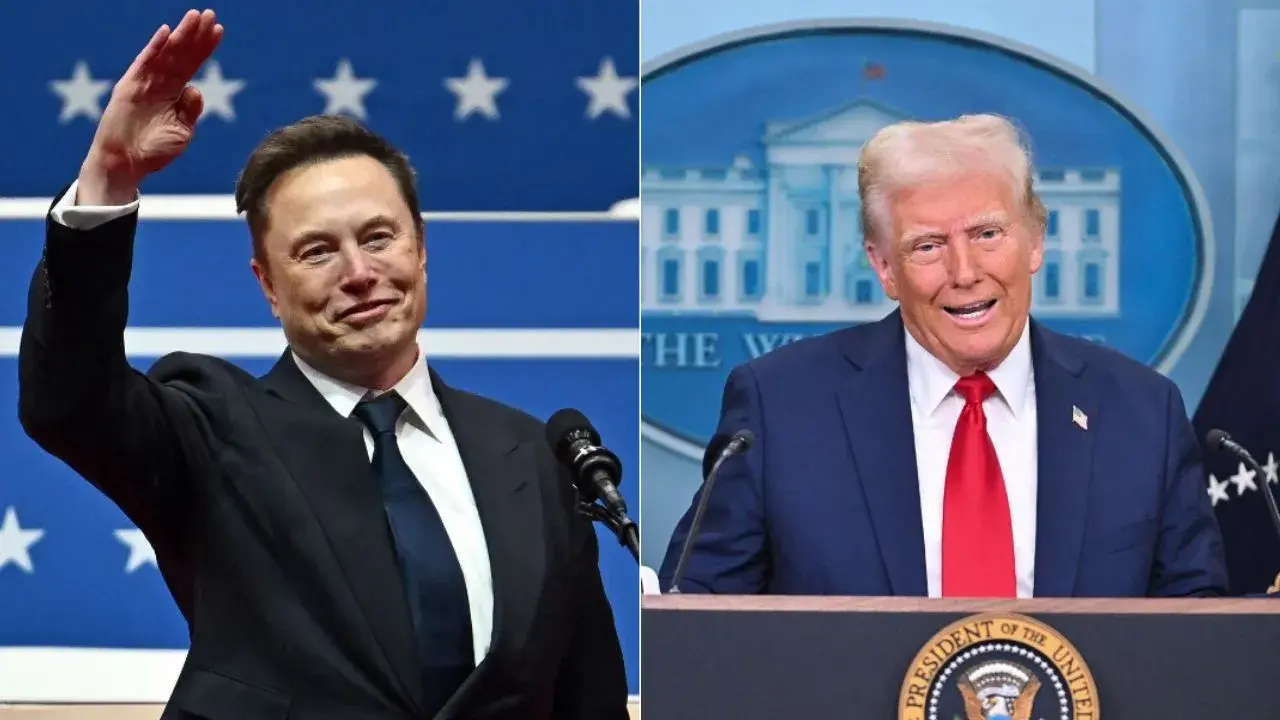
World: Explore the intriguing cover of TIME magazine featuring Elon Musk at the Resolute Desk, sparking public debate amid Donald Trump's ongoing second presidential term.
The cover of TIME magazine’s latest issue features Elon Musk sitting behind the fabled Resolute Desk in the Oval Office of the White House. The picture has no text or caption. It is a public reminder of a question asked increasingly frequently as Donald Trump’s second presidential term unfolds.
The question: who is really in charge of the government of the United States? The world’s richest man, Elon Musk, or Donald Trump, whose electoral campaign benefitted from contributions totalling $288 million from Musk.
In return, the day Trump assumed office, he named Musk head of a newly-formed Department of Government Efficiency (DOGE), whose aim is to make huge cuts in federal spending. Also read | After Biden, Trump cancels security clearances for Blinken, Jake Sullivan

Critics soon dubbed Musk co-president. Social media memes and cartoons proliferated, with one of the most viewed showing Musk as a puppeteer pulling the strings of Trump.
This is why the TIME cover needed no explanation. It irked Trump, whose unsmiling response to a press conference question about the depiction of Musk in the Oval Office was, “Is TIME magazine still in business? I didn’t know that.”
If that was meant as an attempt at light-hearted repartee, it fell flat asreporters soon found Trump’s reaction to TIME naming him Person of the Year in December. “It’s an honour, it’s a great honour.”
)
US vs China over South China Sea: Washington backs Philippines, Beijing hits back
)
Bigg Boss 20: Isha Rikhi evicted after three weeks in Salman Khan’s show
)
Musk plans to more than double xAI's chips to over 1.2 million Nvidia GPUs by year-end
)
After JU, clash erupts at SRFTI: BJP’s ‘Dimagi Naxal’ jibe sparks political firestorm after students protest RSS-linked event
)
‘Anti-social elements spreading false rumours’: LPU issues statement amid massive unrest over alleged rape
)
LPU students go on rampage, vandalise campus amid widespread protest: What's happening
)
Trump asked Xi to pressure Iran. China did not say yes — here’s what Beijing wants
)
US Treasury Secretary Scott Bessent hails global crackdown on Iranian banks and airlines
)
An OpenAI agent escaped its locked test cage again, by hiding questions in DNS lookups
)
'Our video was trimmed': LPU girls who featured in rape-denial video make U-turn
)
3 males killed, four others injured in shooting after fight at strip club in Detroit
)
'Victory for low-budget consumers': Raghav Chadha hails 30-day telecom recharge rules
)
Claude rebuilt the 1989 game 'Prince of Persia' by reusing the original's own code
)
Beyond metros: How Tier-2 and Tier-3 cities could drive India’s next AI wave
)
Tesla builds first Cybertruck with its own refined lithium: Elon Musk's $1 billion Texas bet pays off
)
IndiGo flight suffers tail strike in Bengaluru while landing; DGCA to probe incident
)
The US and China set up an AI 'red telephone', but skipped the rulebook
)
‘Terror suspects arrested near UK air base were looking to do big damage’: Trump
)
Russian envoy claims US tactics to contain India were revealed in ‘Freudian slip’
)
IND vs WI 1st ODI: Kohli breaks Sachin's most runs in one country record with unbeaten 139 as India thump West Indies by 8 wickets
)
Researchers rebuilt exactly how 700 AI agents hacked Hugging Face: a 900-link chain trick
)
‘Olympic inclusion is our major target’: WPA President Ishaun Singh on pool’s global ambitions
)
Nations League: Spain sink England at Wembley; Modric shines for Croatia
)
Why has Iran released no proof of life of Mojtaba Khamenei? Araghchi reveals...
)
'What kind of confession is this?': Pakistan PM Shehbaz Sharif’s 'terrorists would be roaming New York' remark goes viral, raises alarm online. Watch
)
South Korea demands apology from Ukraine over North Korean prisoners' transfer
)
Beyond BrahMos: India targets Rs 50,000 crore in defence exports with unmatched price edge
)
Sri Lankan Tamil migrant worker gets death sentence in Saudi Arabia, help sought from India
)
Muslim marriage cannot shield sex with minor wife from prosecution under POCSO: Delhi HC
)
'Can't help but draw painful parallels to Nirbhaya case': SC on latest incidents of rape cases in Delhi-NCR
)
99.9% more powerful - Scientists find boy who can recall memories from just 3 months of age
)
'FIRST LOOK from inside Noah’s Ark': Researchers share video from inside mysterious mound in Turkey
)
UNSC reform momentum grows: Russia, Portugal, Mauritius push for India's permanent seat bid
)
8 US marines injured in Iranian missile attack on vessel in Strait of Hormuz: Report
&im=FitAndFill=(700,400))
New OTT releases this week (September 28-October 4, 2026): Dupahiya 2, Pooja Meri Jaan, Ohh My Dog- 5 titles coming on Netflix, Prime Video and more
)
Afghanistan says 28 fighters killed in clash near Pakistan border, Islamabad denies
)
Ceuta migrant crisis: Protesters take to streets as Spain grapples with migrant challenge
)
LPU suspend classes, postpones exams as violence escalates over rape claims: What's happening
)
New York City wants a 'kill switch' on every AI, and will pay whistleblowers who report violations
To put the cover episode, in week three of Trump 2.0, into context: news magazines used to have an enormous impact on public opinion through much of the 20th century. But their importance faded in an information ecosystem now dominated by social media and cable TV. Also read | Tsunami advisory issued after magnitude 7.6 earthquake hits Caribbean
Still, TIME, first published in 1923, reports a circulation of 1.2 million.
To return to DOGE and the controversies and achievements of Trump’s first few weeks, the words “unprecedented” and “American Exceptionalism” come to mind. There is no precedent for an unelected private citizen to be charged with cutting two trillion dollars from a 6.75 trillion federal budget.
There is no precedent either for DOGE, which is not a cabinet-level department of the U.S. government but was established as an advisory group. There were no guidelines on the extent, or limits, of its power. Musk appears to believe its authority trumps laws and regulations.
As to American Exceptionalism: Musk could be the poster boy for the concept, the epitome of the American dream that draws millions of foreigners to America. Also read | Alaska plane crash: Bodies of all 10 people recovered. Here’s what we know
Where else could an immigrant from South Africa amass a fortune estimated at $424 billion, more than $150 million more than Jeff Bezos, the U.S.-born Jeff Bezos, who owns Amazon and is the world’s second-richest man?
Where else could a private citizen, with the help of a super smart former employee of one of his companies, gain access to the payments system of the U.S. Treasury which processes federal spending accounting for roughly a fifth of the U.S. economy?
Where else would a president ignore the possibility of huge conflicts of interest by giving free rein to a cost-cutting czar who has billions of dollars worth of contracts with important agencies of the government and some of the most important companies in the defence and space industries?
All of this is exceptional though it is not the kind of American exceptionalism that has filled generations of Americans with pride – a country based on an idea rather than on blood and soil.
So, how much government spending has been cut in the first three weeks of DOGE and what have been the primary targets of Musk’s cost-cutters?
Given the outsize role of “defence” in the U.S. economy, you might assume that the Pentagon has been under early scrutiny following the “shock and awe” announcement of impending cuts. This does not appear to be the case despite a history of jaw-dropping waste.
In 2018, a Republican Senator, Charles Grassley, provided several mind-boggling examples. In an opinion piece in the New York Times in December 2018, Grassley wrote that “the Defense Department has had to explain why it’s been paying $14,000 for individual 3-D printed toilet seats and purchasing cups for $1,280.00 each.” Also read | Trump talked to Putin, says Russian president 'wants to see people stop dying' in Ukraine war: Report
The Pentagon’s budget for fiscal 2025 (ending in September) is$849.8 billion. But rather than going for the big stuff, both Musk and Trump have been focused on USAID, the US Agency for International Development.
Its spending accounts for around one per cent of the overall federal budget. On his social media platform X, Musk described USAID as a “criminal organization. Time for it to die.” Trump asserted on his platform that USAID is “run by radical left-wing lunatics.”
Neither Trump nor Musk has provided concrete examples of malfeasance or lunatic behaviour. That has not kept them from planning to cut USAID personnel from around 10,000 around the world to 294.
USAID is the most visible demonstration of “soft power” demonstrating to people around the world that the United States can be a force for good. It provides food for the hungry and medicines for the sick.
As Samantha Power, who ran USAID from 2021 to 2025, put it in an opinion piece in the New York Times: ”We are witnessing one of the worst and most costly foreign policy blunders in history.”
Halting aid programmes around the world, she wrote, imperils millions of lives, thousands of Americanjobs, and billions of dollars of investment in American business and small farms.
Killing USAID “is a win for autocrats everywhere,” she concluded.
Judging from a string of surveys over the years, such arguments do little to touch emotional buttons for most Americans. Aid to foreigners is not popular, thanks partly to lazy journalism omitting context that might sway public opinion.
Poll after poll has shown that most Americans believe that foreign aid accounts for around 25 per cent of the federal budget. Year after year, the actual figure has been around one per cent.
That vast gap between perception and reality makes USAID an easy target.
