Taiwan's China-friendly presidential hopeful faces backlash in divided south

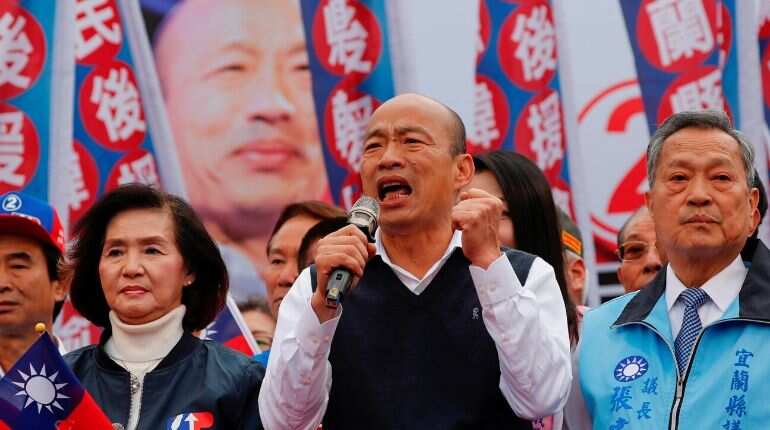
Opposition Nationalist Kuomintang Party
In balmysouthern Taiwan, with its rural hamlets, industrial belts and slower-paced cities, a rising tide of residents are pushing back against oppositionpresidentialhopefulHan Kuo-yu, fearing he'll sell out core Taiwan interests toChina.
Han, the mayor of thesouth's biggest city of Kaohsiung, had been expected to build his support base over the past year since winning office on a promise to help citizens "make a big fortune" by forging better economic ties withChina.
Instead, as he prepares for the election on Saturday against incumbent president Tsai Ing-wen and her independence-minded Democratic Progressive Party (DPP), he has seen his fortunes wane, hammered by criticism over controversial public remarks and failing to deliver on campaign promises, including oil exploration in theSouthChinaSea.

Last month, a coalition of groups called "Wecare Kaohsiung" held a mass anti-Han rally that drew tens of thousands, some holding signs with the words "Dismiss pro-Communist mayor".
"Every Taiwan leader needs to find a balance between the USandChina, but with Han, he has completely shifted towardsChina," said Aaron Yin, one of the leaders of the movement.
Taiwan'svote for a new president and parliament comes at a delicate moment for its giant neighbour, and sentiment insouthern Taiwan has become a key factor for the election, which could set the democratic island's future course with autocraticChina.
In March last year, Han, whose Kuomintang Party favours close ties withChina, paid a high-profile visit to Hong Kong andChina, where he met with senior Chinese officials and reiterated his commitment to "oneChina" as a core of cross-strait relations.
Han's red-carpet treatment raised alarm bells, as many Taiwanese harbour a deep mistrust ofChina, especially after Chinese President Xi Jinping threatened Taiwan with force.

"The main aim of this election is to reject any rapprochement withChina," Yin told Reuters in a small office stacked with anti-Han pamphlets and those pledging solidarity with the pro-democracy protesters in Hong Kong.
Han, 62, has proven a divisive figure since reappearing in politics in 2017 to make a failed bid for the chairmanship of the Kuomintang. Known for fiery rhetoric, his ability to electrify crowds helped him clinch the mayorship of Kaohsiung in late 2018.
Although Han has said "one country, two systems" isn't an acceptable model for Taiwan, he has promised to restart dialogue withChinaif elected president and called for an agreement betweenChina's Communists and the Kuomintang that both sides belong to "oneChina", with each having their own interpretation of what that means.
Han has describedTaiwan'sformal independence as scarier than syphilis and warned that Tsai's re-election could lead to a "volcano eruption" of tensions withChina.
Wang Lin Chiao, a Kuomintang politician seeking a parliamentary seat in thesouthern township of Meinong, said that stability is paramount, and that continued engagement withChinais the only way forward.
"The 21st century belongs toChina," Wang said as she campaigned on a quiet street with a three-person support team, struggling to find people to speak to.

"Taiwan needs a good future, so we don't want to meddle in sensitive political issues and change things. People only care about money here, and having a safe life," she said, noting a decline in Chinese tourists and exports of agricultural produce toChinaafter curbs by Beijing last year.
But some, such as Chiu Yi-Ying, a DPP lawmaker competing against Wang for the 222,700-voter constituency, say Taiwan must further deepen its "NewSouthbound Policy" of economic engagement with 18 countries inSouth-east Asia, rather than rely onChina.
Chiu peppers her lobbying with Hong Kong references, telling older voters that an influx of Chinese immigrants and tourists into Hong Kong since the city returned to Chinese rule in 1997 had substantially lengthened queues at public hospitals and depleted supplies of essentials like milk-powder.
"That's when they really understand that Hong Kong today isTaiwan'stomorrow," she told Reuters in her campaign office, where massive billboards feature her smiling beside Tsai.
Some farmers and pigeon breeders in thesouth's rural patchwork of ponds and fields say they've been scarred by past decades of conflicts withChinaand want to avoid that. But they can't ignore the realities of Hong Kong and the dangers faced by a more aggressiveChinaunder Xi.
"One country, two systems is not good," said Chen Jin-Wen, a pigeon breeder in the north of the historic port city of Tainan as he exercised his birds along a stretch of coastline overlooking the Taiwan Strait, referring to the model by whichChinahas been ruling Hong Kong.
"You see what's happening in Hong Kong. The Hong Kong people are used to freedom, like Taiwan people," he said, as his racing birds pecked about in a wooden cage before bolting skywards.
"But mainlandChinais taking it away from them now," he said. "It's like my birds, they can fly free for a while but they always end up back in a cage."