

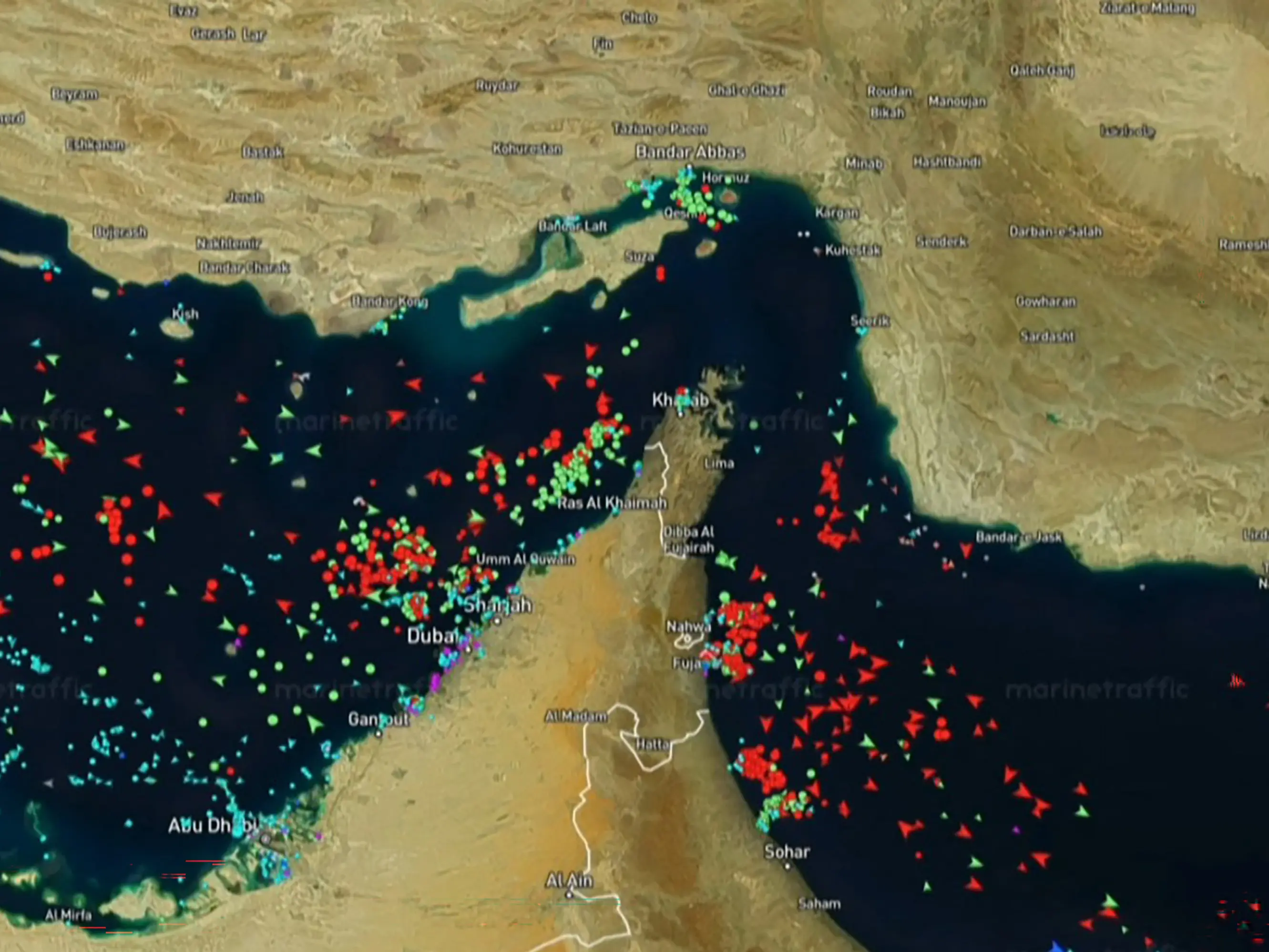
&imwidth=800&imheight=600&format=webp&quality=medium "'Militarily closed': Iran says Oman route does not mean Strait of Hormuz is reopening")
Iran has rejected any suggestion that a temporary maritime arrangement reached with Oman amounts to a reopening of the Strait of Hormuz, with Deputy Foreign Minister Kazem Gharibabadi saying the waterway remains closed from a military standpoint.
"The understanding between Iran and Oman does not mean the opening of the Strait of Hormuz," Gharibabadi said in a television programme on Tuesday night, according to ISNA.
Asked when the strait could reopen, he was equally direct: "The Strait of Hormuz will not open tomorrow."
What is the temporary route?
Under the arrangement discussed with Oman, ships entering the Persian Gulf would use a route through Iranian waters, while vessels leaving the Gulf would use Omani territorial waters.
Gharibabadi said that, despite the two directions, ships would pass through Iranian waters under the temporary arrangement. "This route is like a round-trip highway with a total width of about 7 miles," he said.
Trending Stories
The arrangement is intended to be temporary. Iran and Oman are expected to negotiate a permanent maritime route within 30 to 60 days, replacing the previous traffic arrangement.
Also read | 'If Iran overplays its hand': US won't rule out 'kinetic strikes' on Tehran, War Secretary Hegseth warns
Iran says the strait remains militarily closed
Gharibabadi stressed that the new shipping arrangement should not be confused with a full reopening. "Militarily, the Strait of Hormuz is closed," he said.
He added that military vessels would not be allowed to use the temporary arrangement and only commercial vessels would be permitted to pass.
Gharibabadi said the issue of maritime routes had become a matter of Iranian national security, arguing that Tehran had suffered damage under the previous arrangement.
"For the past 58 years, ships have been passing through Omani waters, and Iran has suffered severe damage," he said, adding that "fundamental changes" were needed in the routes used for entry and exit.
Military plays key role in route decisions
Gharibabadi said discussions with Oman were being conducted through a joint working group involving Iran's Foreign Ministry, Ports and Maritime Organization, the Islamic Revolutionary Guard Corps, including its Navy, and the General Staff of the Armed Forces.
He said the armed forces had the leading role in determining the routes. "The main guidance regarding the routes actually lies with military friends and the armed forces complex," he said.
According to Gharibabadi, the proposals presented to Oman originated with Iran's armed forces and had the backing of all relevant government and military bodies. He also stressed that deciding specific maritime routes was a technical matter and not something handled by the Foreign Ministry.
Trump warns Iran over mine-laying
Gharibabadi's comments came hours after US President Donald Trump said the US Navy had informed him that mines had been removed or detonated in international waters in the Strait of Hormuz.
Trump warned that any attempt by Iran to lay new mines in international waters would trigger an immediate US military response. In a post on Truth Social, he said any vessel involved in placing new mines would be “immediately and systematically destroyed.”
US not planning new Iran strikes 'for the time being', Rubio tells allies
US Secretary of State Marco Rubio has told several allied foreign ministers that Washington does not expect to launch new strikes against Iran "for the time being", Axios reported.
According to the report, Rubio said the Trump administration would instead focus on increasing economic and maritime pressure on Tehran. The strategy includes a US naval blockade and a new sanctions initiative announced by the Treasury Department.

