Inside Ceuta’s chaos: Tiny Spanish enclave at the centre of Europe’s border crisis | WION Decodes

&imwidth=600&imheight=450&format=webp&quality=medium "Inside Ceuta’s chaos: Tiny Spanish enclave at the centre of Europe’s border crisis | WION Decodes")
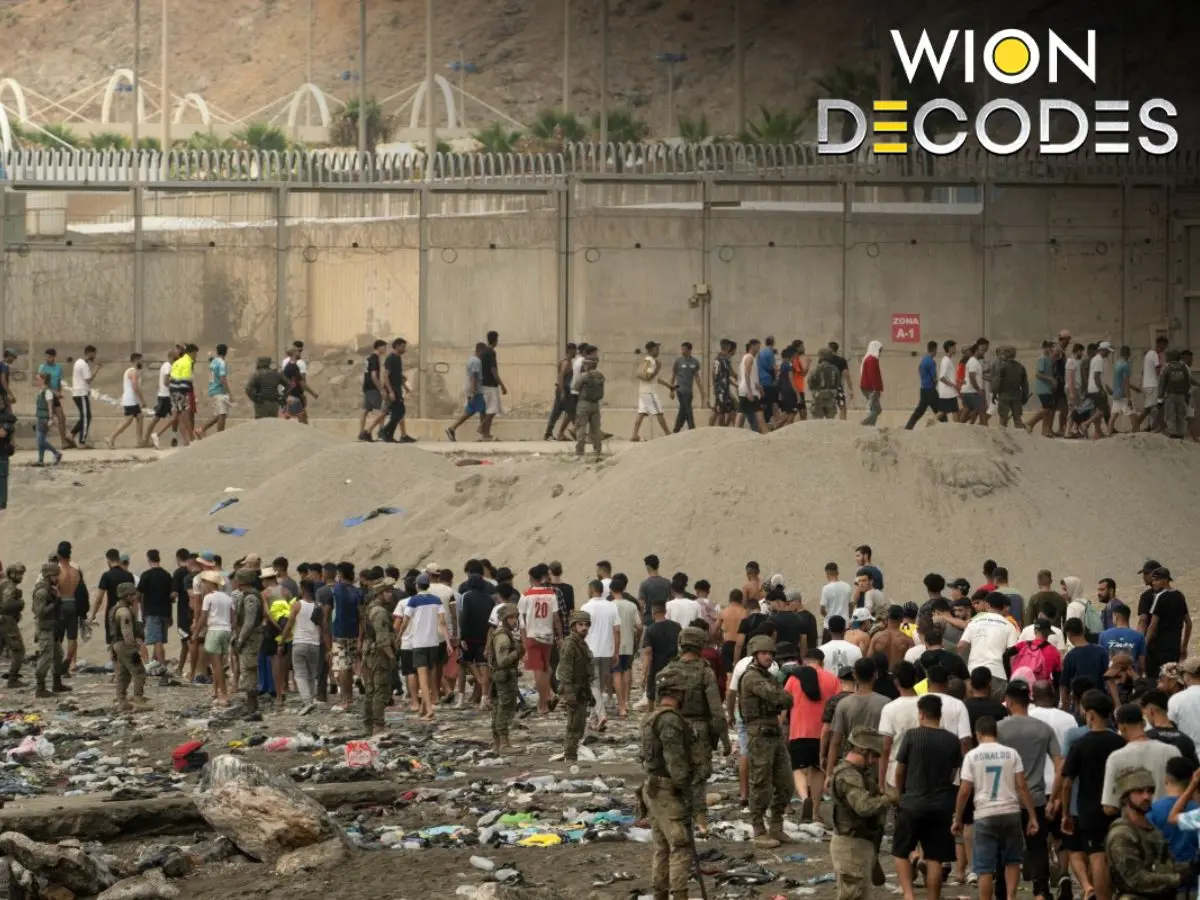
Spanish soldiers control as migrants cross back to Morocco after they crossed the border to enter Spain's north Africa's Ceuta enclave on July 31, 2026. Photograph: (AFP)
Ceuta, a tiny Spanish enclave in Africa, has become Europe’s latest migration flashpoint after thousands crossed from Morocco, sparking deaths, border tensions and a political crisis.
Ceuta, a small Spanish territory on the northern coast of Africa, has become a flashpoint of one of the largest migration crises in Europe. The issue began when an estimated 60,000 people from Morocco crossed the border illegally, entering Spain’s autonomous city. According to the latest data, at least 67 people have been killed as thousands attempted to cross the border through land and sea.
The sudden influx began on July 30, triggering concerns from European nations that fall under the Schengen Area. Tensions rose when Italy announced that it was suspending Schengen rules allowing free-border travel with Spain over the issue.
On Saturday (Aug 1), Spanish Interior Minister Fernando Grande-Marlaska said that practically all migrants who crossed the border into Ceuta have been returned to Morocco and the situation has become normal in the city.
“Almost all of them have already left Ceuta,” the minister said. “The situation has been almost entirely reversed.”
Why are migrants crossing into Spain?
While the reason for the sudden influx of migrants from the border in Ceuta is not clear, Spain’s Territorial Policy Minister Angel Victor Torres on Friday (Jul 31) said that the recent surge could be linked to several factors, including a Spanish Supreme Court ruling earlier this month that barred authorities from immediately returning migrants intercepted at sea while trying to reach Ceuta and Melilla under special procedures.
Trending Stories
&im=FitAndFill=(700,400))
)
)
)
)
)
)
)
)
)
)
)
)
)
)
)
)
&im=FitAndFill=(700,400))
)
)
)
)
)
)
)
)
)
)
)
)
)
)
)
)
)
)
Where is Ceuta?
Ceuta is a small Spanish autonomous city on the northern coast of Africa, located at the entrance of the Strait of Gibraltar and surrounded by Morocco. Although it is geographically part of Africa, the territory belongs to Spain and is considered an external border of the European Union. Covering just 18.5 square kilometres, Ceuta has a population of around 85,000 and shares a 6.4-kilometre land border with Morocco, while mainland Spain lies about 17 kilometres away across the strait. Together with Melilla, located around 400 kilometres to the east, Ceuta represents the EU’s only land borders with Africa. Under Spanish control since 1580, the city has a diverse population of Christians and Muslims and remains strategically important because of its location between the Atlantic Ocean and the Mediterranean Sea.
The city remains a major point of contention between Spain and Morocco. Rabat does not recognise Spanish sovereignty over the enclave and refers to Ceuta and Melilla as “occupied territories”. The city has repeatedly become a flashpoint over migration and diplomacy. In May 2021, around 8,000 migrants entered Ceuta from Morocco after border controls were relaxed, triggering a diplomatic crisis between Madrid and Rabat linked to tensions over Western Sahara.
Why Ceuta is so important
Ceuta’s importance comes from its unique position: it is one of the only places where the European Union shares a land border with Africa. Along with Melilla, another Spanish enclave, Ceuta has become a major route for migrants attempting to enter Europe from Morocco.
Over the years, thousands have tried to cross into the territory by scaling border fences, forcing their way through checkpoints or attempting the dangerous sea route around the Tarajal breakwater. Many risk their lives in the process, facing strong currents, rough waters and strict border security.
However, reaching Ceuta does not mean migrants can freely travel across Spain. Those who enter irregularly are subject to immigration procedures before any onward movement to mainland Europe.

